San Francisco and Milan, while very different other than that they are in close proximity to spectacular mountain lakes, are vying for similar titles. One is the worst great city in the world, and one is the best crappy city in the world. Since another author I read a long time ago crowned SF the former, I’ll explain how Milan wins the latter.
Milan is a hub of business and fashion. But if you don’t have the money to spend at Dior or Fendi or even Tod’s, it is an ugly city to visit even by American standards. Philadelphia has more charm. Cincinnati has more charm.
Architecturally, it reminds me of Houston or Dallas in the sense that the most striking architecture is grotesque in its brutality. Brutesque, if you will. And before my Texan friends protest my dig on their architecture, some of which is legitimately outstanding, drive on a freeway in downtown Dallas or Houston at rush hour and you’ll understand what I mean.

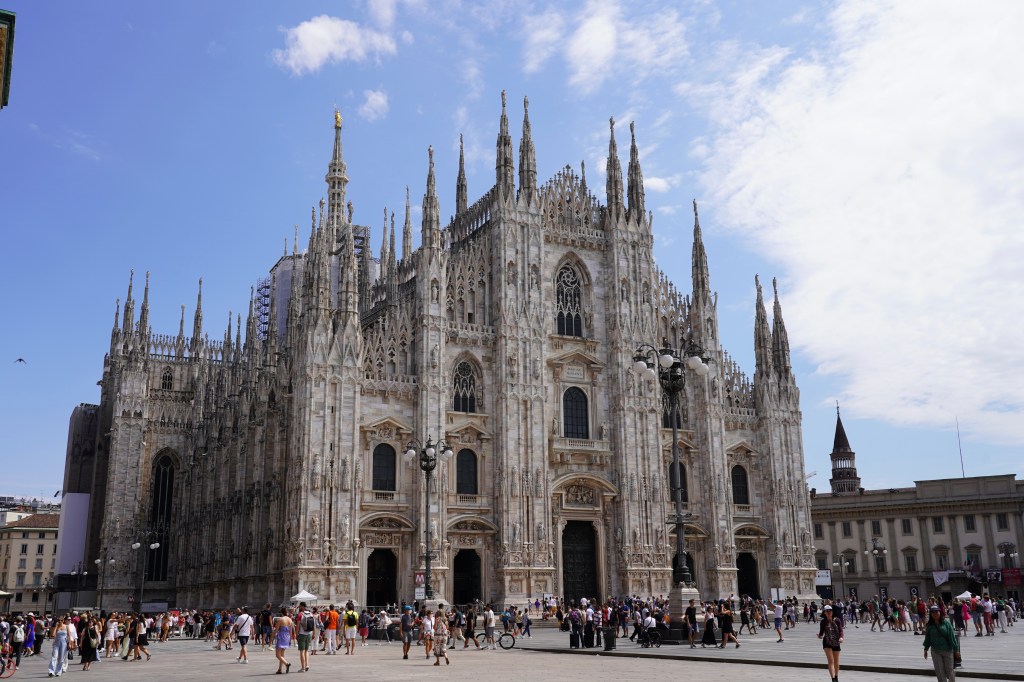
But I digress. Milan. Let’s start with the Duomo.
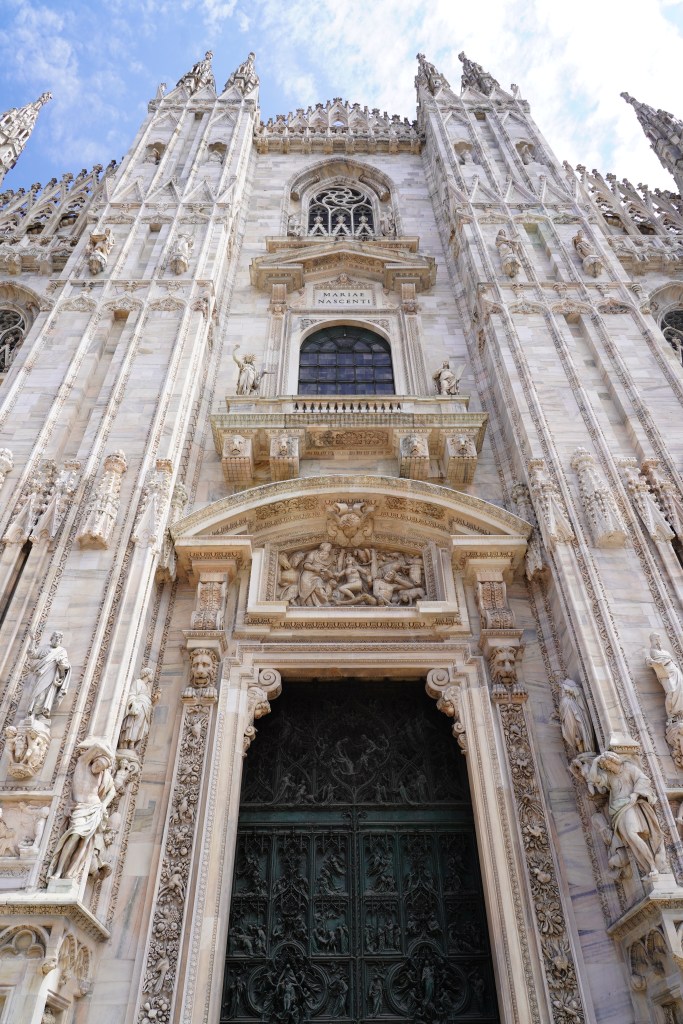
I will say the exterior does have a beauty to it—the marble gleams and the bronze doors capture your attention when you look closely.

In the shadowless plaza beneath, you feel twice burned by the sun and the travertine.

But there’s a reason you don’t see pictures of the Duomo’s interior. You walk in, and your first impression is immensity and grayness. The cathedral is taller and longer than you expect from the outside, and the pillars holding it up are girthy. The stained glass windows are small relative to the size of the building. You do not come to this building to commune with God. You come here to be cowed by God and to be intimidated by Milan. Can you imagine a bishop or even a priest saying Mass in such a place, how the immense stone would crush any sense of wonder and awe at the divine and any sense of connection with the parishioners? And yet, it does feel kind of awesome to be in such an inhuman space, imagining yourself as an emperor being crowned to lord over all the known realms of the world, as though a primal scream of power is coursing through you. St. Peter’s to me conveys a sense of rigidity and formality that is stifling, but it is so vast and has so many beautiful treasures that one can still reach to the heavens and rejoice. It does not convey immensity in the same oppressive way as the Duomo in Milan.
Milan’s other great sights underwhelm.
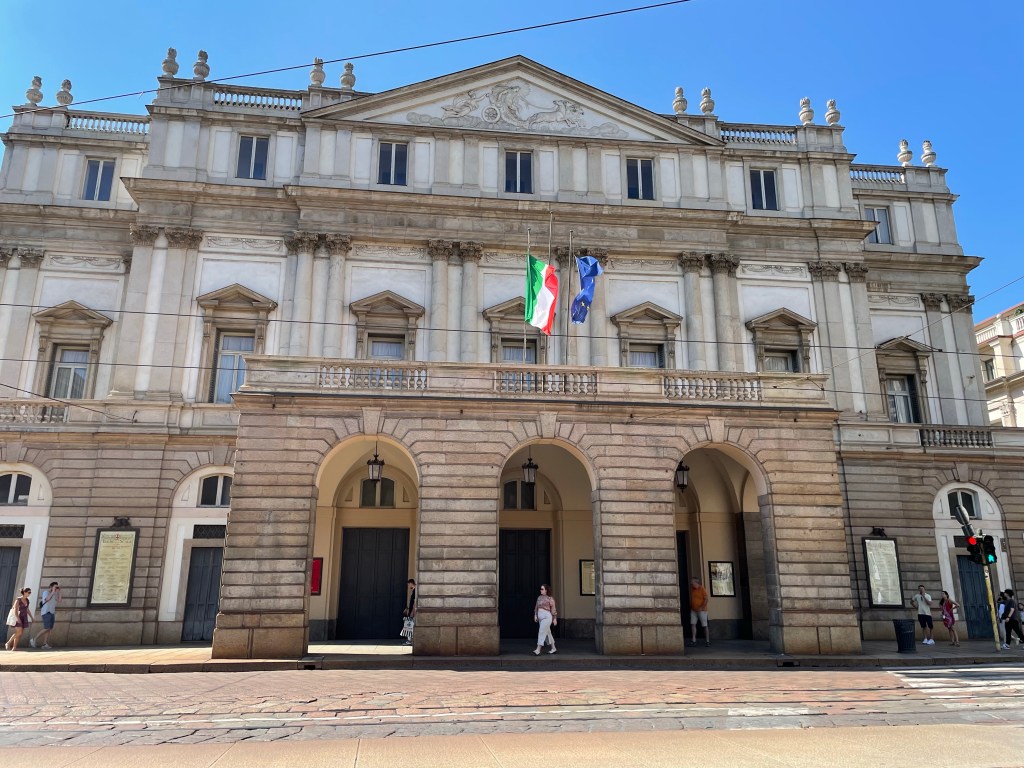
Teatro alla Scala, the world’s greatest opera house, is from the outside the ugliest theater I’ve ever seen. And that includes the cube that was my high school theater.
Milan’s prettiest building is a mall. A MALL.

Its liveliest area, Navigli, conveys the San Antonio river walk without the greenery or charm. And the people there ironically are the least fashionably dressed in all of Europe. It’s shorts and t-shirts just like back home. My travel planner told me I should go there at night and take photos. But there was nothing I wanted to remember visually.
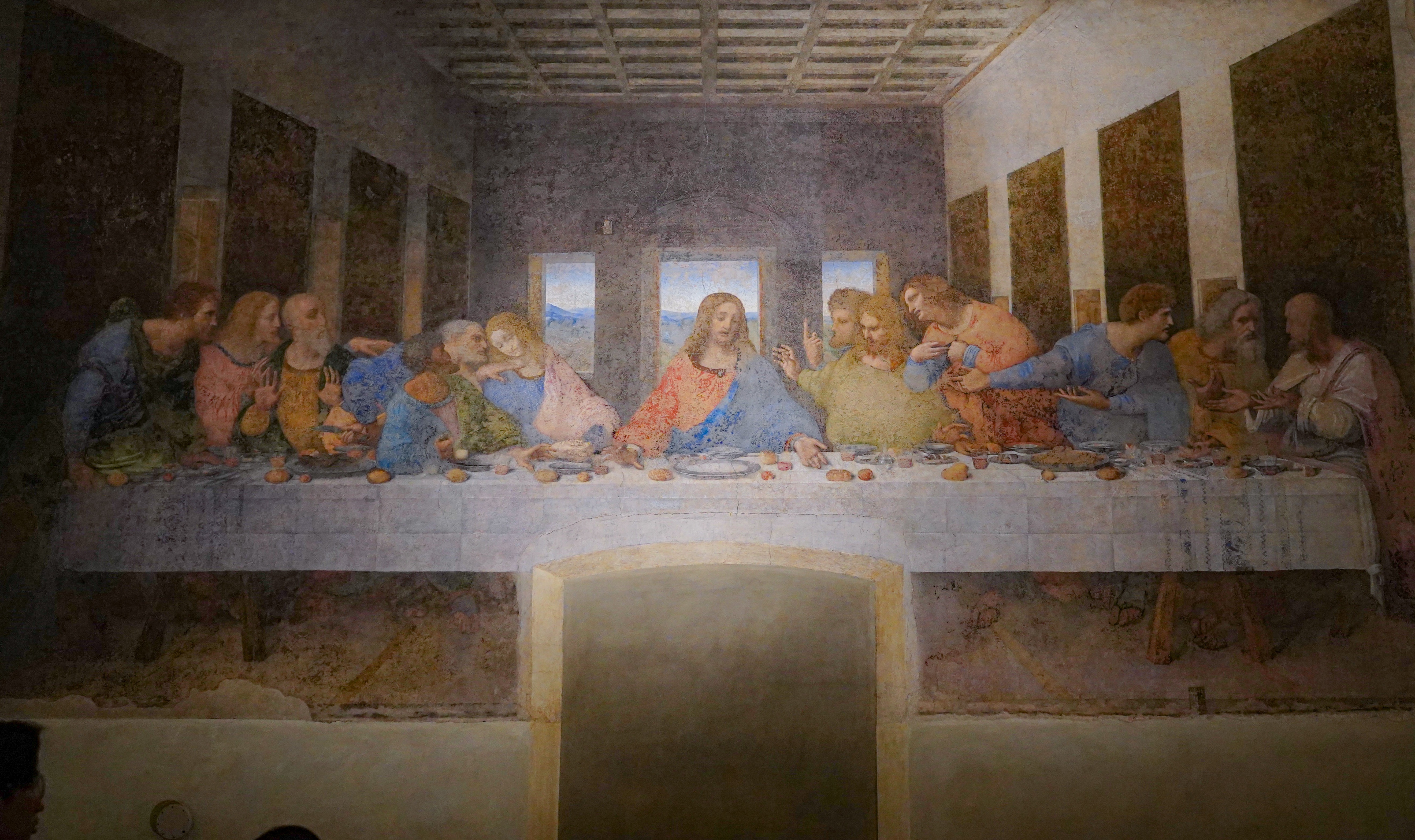
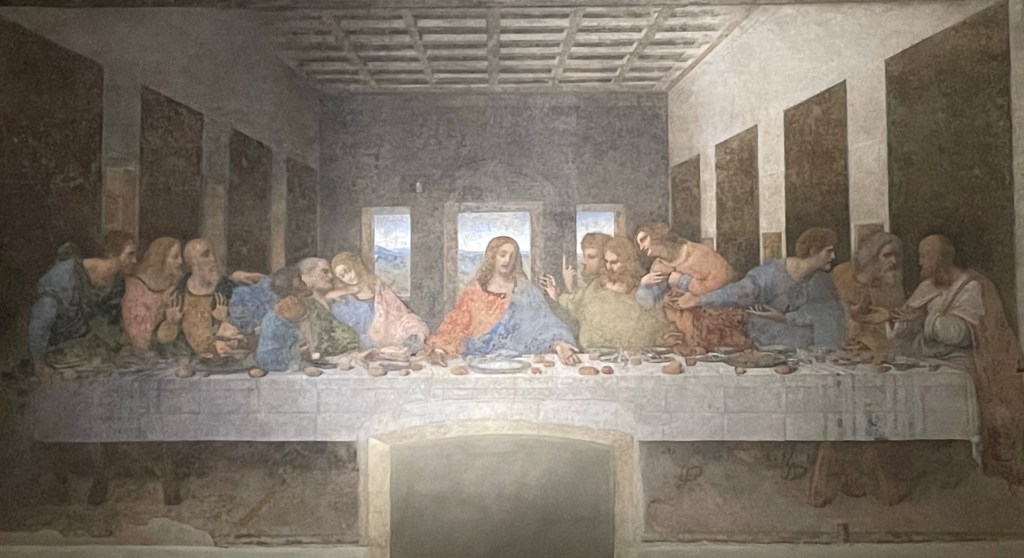
Milan’s beauty is hidden, and even then ugliness can’t help but seep through. Milan’s most famous work of art is the Cenacolo Vinciano. You know it as the Last Supper. Did you know it was in Milan? Until I got here, I didn’t.
Leonardo da Vinci moved to Milan to escape what he felt were stifling artistic norms in Florence in the late 15th century. As the uber-Renaissance man, he took a job to re-engineer the Milan canal system to ensure consistent water flow without flooding, and according to the tour guide, fixed the previously unsolvable problems in a matter of weeks. He was granted lifetime residency in Milan by the ruling duke as a result, and stayed there for 20 years.
- An aside about tourism in Italy. Why was I on a tour of the Last Supper instead of just buying a ticket? Ah. You see, sites such as the Cenacolo Vinciano sell a limited number of tickets to the general public which sell out months in advance. But you can still get tickets through tour groups. And frankly, virtually everyone in there was with a tour group. So instead of paying $16, I paid $77 and got access as part of a 3 hour Milan walking tour, which I left after 90 minutes. It’s an officially sanctioned tourist scam to milk more money out of you. Even worse was the way I got legally scammed on the train from the airport. You buy a ticket but they don’t make it clear that you have to validate it, and when the conductor sees you haven’t validated your ticket, he charges you an extra 8 euro fine. It’s just a tourist tax. You’re damn right I paid him in cash so he’d have to fish for change. But you realize that all these scams are just part of the culture here and you’re kind of OK with it because Italy is so exceptional. And since I got forced paying $77 for the tour, you’re going to hear about what I learned. Now. Back to getting my money’s worth.
While he was there, he painted the Last Supper. The Last Supper is, I kid you not, a cafeteria mural. Actually, it was painted directly on the wall of a dining room of a monastery. It was meant to convey Jesus and his disciples as diners seated at the table next to the monks. Instead of depicting Jesus and his disciples as static figures, he made the novel decision to paint them as living human beings with emotion. This was a radical departure from the norm in the 1400s, part of why I suppose he left Florence so he could break the rules.
Leonardo chose a novel way of painting on the wall. Instead of using fresco technique, where paint is quickly applied to a wet wall, Leonardo wanted to take his time and use a technique that allowed him to work more slowly. He innovated an experimental technique where he mixed oil and tempera paints and painted them on a dry wall. This allowed him to paint the extraordinary figures that he did.
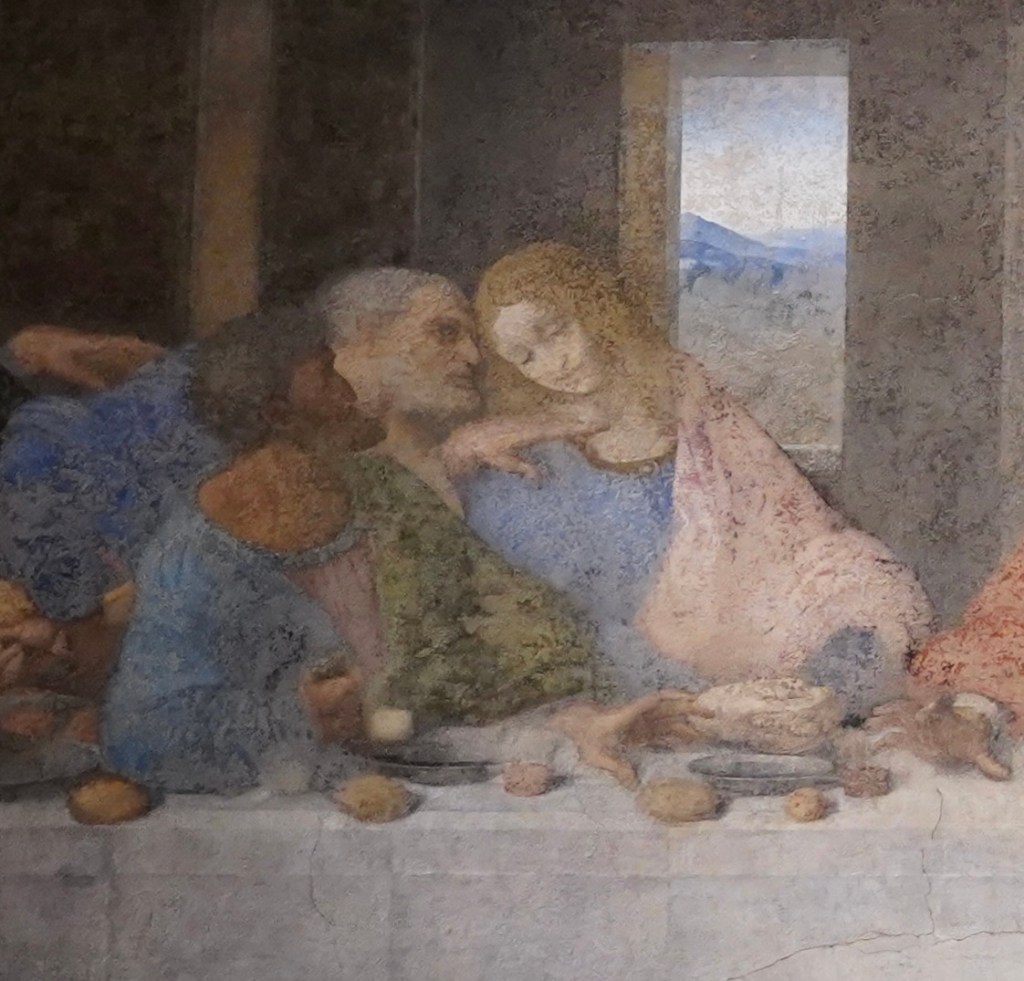
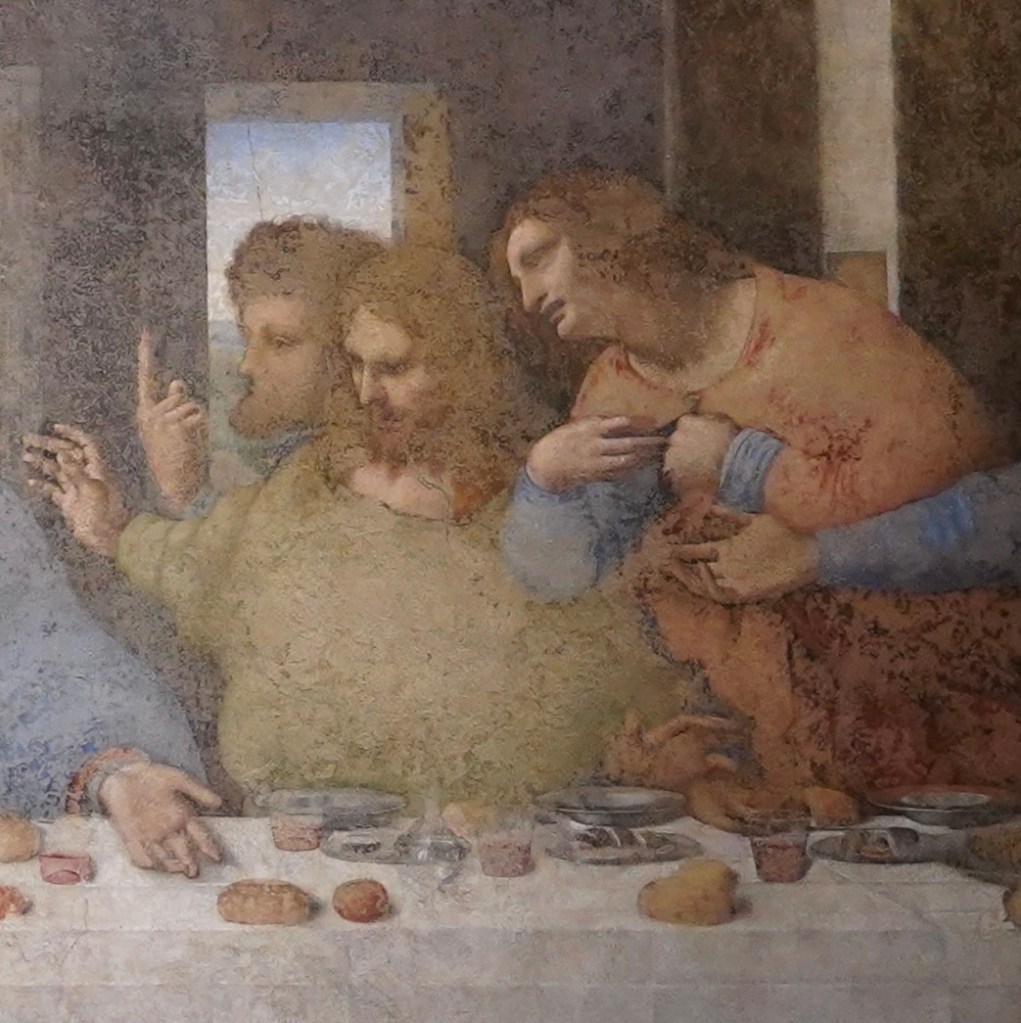
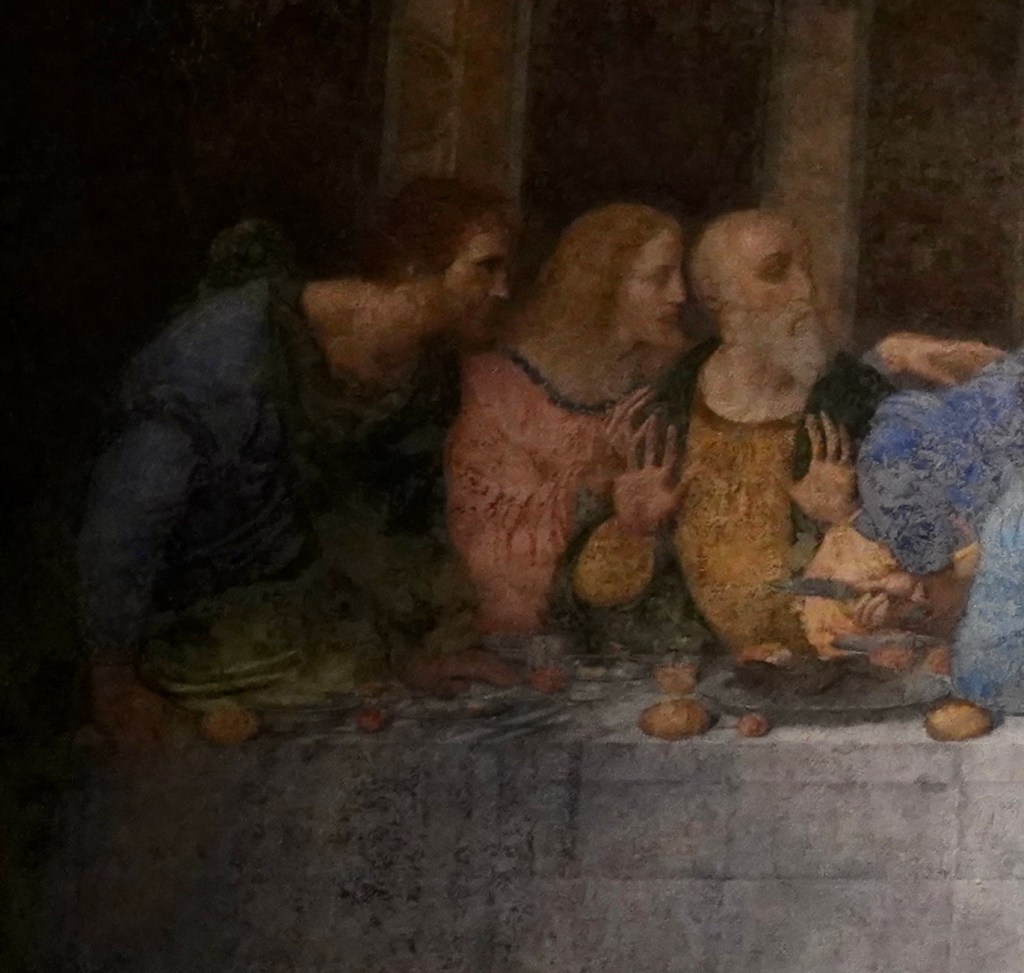
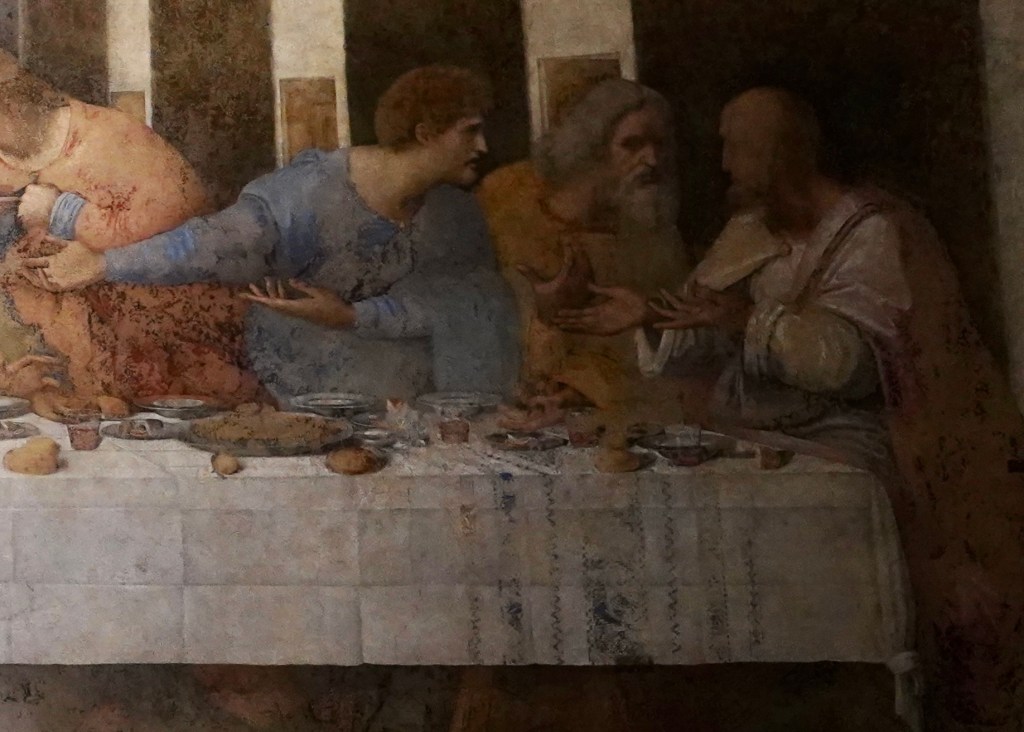
Sadly, this technique did not result in paint sticking to the walls for the long term, and paint began flaking off the walls within a few years. The Last Supper deteriorated over the years, not to mention was nearly destroyed by Allied bombing in World War II—the adjacent building was. Oops 🇺🇸

The painting was closed for restoration for over 20 years until it was reopened in 1999. I had no idea that for so much of my life, this work was completely inaccessible to the public. The photographs you see are generally oversaturated and brightened to make the figures more vivid. In truth, the work is pale, dim, and crumbling, and yet still conveys the beauty of Leonardo’s ability to capture the humanity of the disciples.
- Another aside: this is where a real camera is needed. All the images above were from the same single photo. This is the best my iPhone could do. It gets the light balance right but the expressiveness is totally lost.
And that’s the thing about Milan. It’s human. It’s a real, living, organic city. It’s not a museum like Venice, and it’s not stiff like Copenhagen. It’s the kind of place that someone will jump over your back trying to force their way into closing subway doors. (That happened. The kid was wearing an SF Giants cap.) It’s messy, but it has a pulse. And as a result, you’re able to meet people that just want to hang out and have a good time. So I did, meeting locals and tourists along the way.
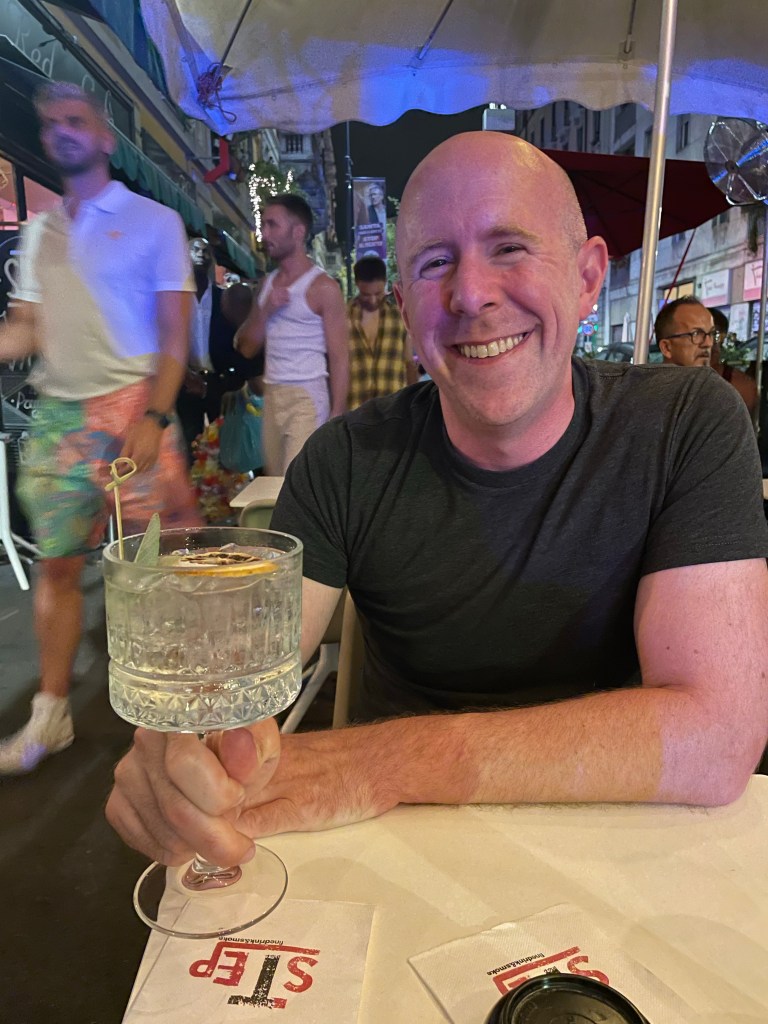
I don’t know what this drink was. The details are hazy. But while I was drinking it there was a fistfight outside the bar. The cops showed up and broke it up, and then they stayed and smoked and hung out, their cars blocking the road for half an hour while the bars were packed.
Thanks Milan for a really good couple of days. Yeah you’re a mess, but you’re as good of a crappy place as I’ve ever been.
Oh yeah, I mentioned dinner theater from God too. Well, one night I went to Lake Maggiore for dinner to meet some American friends, and we got caught in a hailstorm. If it wasn’t for some dude named Fabio, I would have missed my train back to Milan.
 Steve Simko