I watched the Los Angeles Dodgers win the National League pennant Friday night after one of the greatest individual performances in baseball history, and it got me thinking.
Baseball is a soil in which my family’s story and memory are well rooted. My grandfather was a minor-leaguer in the Reds organization, giving up baseball when my future grandmother made him choose between his itinerant profession and their relationship. Growing up in central Illinois, my dad loved the nearby St. Louis Cardinals and their star Stan Musial but didn’t inherit his father’s skill or power, batting an appalling .059 in his worst little league season. I took after my father in terms of natural baseball aptitude. At my first major league game in 1984, I accidentally spent most of the game cheering against my hometown Atlanta Braves, mistakenly thinking the fans in front of us were cheering for the home team as well. I couldn’t see anything but the backs of their heads, so I just did what they did! Then there was the incident of me running the bases the wrong way around in my first Little League tryout. My dad still likes to make fun of me for that, but we’re going to leave the blame at his feet for inadequate preparation there. After all, I was six.
But six is an age where unforgettable core memories can form. My core baseball memory came while playing for the undefeated Lancers in the 1985 Murphey Candler Park tee ball league championship game. It was in actual fact the hottest day of the year, unusually hot even for Atlanta that early June day, with temps reaching 98 or 99 degrees at gametime, with the requisite brutal Georgia humidity. It was too hot for the teams to sit in the cinder block dugouts, so we sat in the bleachers with the unusually large number of family members who had turned out. I was a hypercompetitive child and got so anxious when we trailed 4-2 to our archrivals, the Rockets, after one inning that I started crying. The Lancers had been so good all year that I hadn’t had the experience of even trailing! After wild momentum swings, the Lancers came to bat in the bottom of the final inning trailing by 3 runs. I don’t remember how I got on base, but I did, and eventually found myself standing on third base with the game tied and one of our best hitters at the plate. I WILLED that hitter to hit that ball to right field so I could score easily, not that it really mattered in this battle of defensive, um, juggernauts. He did, and I did, and we won the game, 28 to 27. It was the first time I’d experienced the joy of uninhibited bedlam. I remember jumping up and down in the empty dugout with a couple of parents and they were jumping too–when did that ever happen at home or school or church or anywhere? I still have the framed team photograph from that day. Everyone is beaming. I have better stories about life lessons I learned in Little League and “wow” experiences watching my own beloved pro teams reach the pinnacle of the sport, but I’m not sure I’ve ever experienced such personally intense excitement amid so much collective joy in baseball or any other context.
I haven’t paid meaningful attention to baseball in a long time. Except for the Giants winning the World Series the week I moved to San Francisco in 2014, I haven’t lived near a city that won a postseason baseball series in over two decades. Worse, during that time baseball regressed from a beloved national pastime to a performance enhancing drug-plagued fraudscape of fallen heroes to an arid, dull wasteland swimming in analytics and technicians. I might have memorized statistics from the backs of baseball cards when I was nine–I still remember that Jesse Barfield led the AL with 40 home runs in 1986 as a result–but for me baseball needs peanuts, hot dogs, story, nostalgia, drama, hope, and magic for me to actually care. I need a rooting interest, not an OPS+.
A few weeks ago, I decided to stay in Los Angeles for the second half of October. Right around then, the baseball playoffs were starting and, bored at home one night back in SF, I turned on a Dodgers-Reds game. The Cincinnati Reds have been a forgettable, irrelevant franchise since winning their last championship in 1990. Coming in as the underdog who skated past the overpaid, overhyped New York Mets for the last playoff spot, and being from a former home of mine, the Reds were absolutely a team I’d normally cheer for. But perhaps taking heed of my grandfather’s advice to cheer always for the city where you’re living, I instinctively started cheering for the defending World Series champion Dodgers. This year, the Dodgers won their division but underperformed relative to expectations during the regular season, plagued by a bullpen that had been imploding for weeks. In the game that night, they appeared on the verge of blowing a big lead in the 8th inning, giving up a few runs but staving off a rally before things got too out of hand. In the 9th, the Dodgers brought in an inexperienced first-year pitcher, Rōki Sasaki, to finish the game.
Rōki the rookie signed with the Dodgers from Japan in the offseason. Because he was only 23, he was not eligible for unrestricted free agency and thus a massive contract. Per MLB.com:
Because Sasaki is younger than 25 years old, he is considered an amateur international free agent, meaning he comes with six years of club control and will earn a rookie salary in 2025 (in addition to a $6.5 million signing bonus).
In other words, he cost himself millions of dollars in potential income that he could have earned if he had waited just two more years. Why, besides his drive to face the best players in the world?
The transition of the 23-year-old Sasaki to Major League Baseball was atypical. Almost every Japanese player who leaves for MLB does so after a series of high-end accomplishments. Sasaki did throw a perfect game in 2022 followed by eight more blemish-free innings in his next start. But over the next two seasons, he barely threw 200 innings total, with arm and oblique injuries limiting his time on the mound….
He…wasn’t himself in his final seasons in Japan. During his meetings with teams, Sasaki wanted one question answered: How would you fix my fastball? It had leaked velocity over the previous two seasons, and teams’ responses, Sasaki figured, would offer him the best insight into their philosophies on pitching.
Sasaki was a starting pitcher for the first 6 weeks of the season, and his performance was mired in mediocrity. A viral tweet this spring showed him in the dugout with visibly red, teary eyes. One former major league journeyman catcher called for veteran teammates to coach him up to overcome being “soft.” As it turns out, he was discovered to have chronic shoulder inflammation, and the Dodgers shut him down for several months. Once healthier, the Dodgers sent him to the minor leagues for a rehab stint, during which time team coaches and advisors earned his trust enough to alter his mechanics such that he could rediscover his velocity. And when the big league team bullpen cratered late in the season, he was called into service as a reliever for the first time in his career. Within a few appearances, he emerged as a dominant, electric, compelling, unhittable closer–a must-see every time he took the mound with a 101 mph fastball and a devastating forkball. His path to success wasn’t about overcoming softness–the drive to be dominant was already there, ready to be unleashed–but about being supported by a world-class franchise, being given time to recover from chronic injury, and finding a biomechanical fix for his pitching problems.
Watching him for the first time, I realized what an “Oh my god!” sensation he was. After the Dodgers took a series lead against the favored Phillies, I journaled that I’d buy a Dodgers Sasaki jersey if they reached the World Series. He’s been nearly perfect in the playoffs, giving up just 1 earned run in 7 appearances and 8 innings. Most impressively, he threw three perfect innings in a tie game in the clinching game against the Phillies, where a run would have lost the game. He’s adopted the song “Báilalo Rocky” (but pronounced like his first name, Rōki) as his entry music with his teammates banging on the dugout wall when he enters the game.
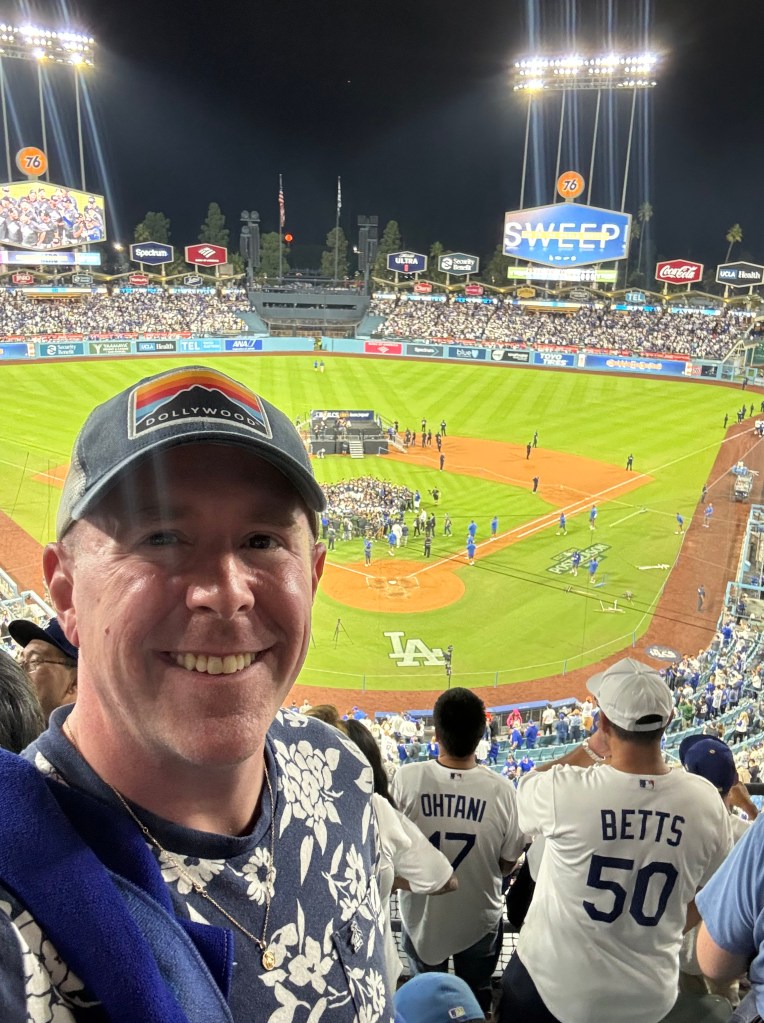
Once I got to LA, I realized I could get a ticket to a National League Championship Series game for about a third of the price of a World Series ticket. WIth the Dodgers up three games to none against the Milwaukee Brewers and with the legendary Shohei Ohtani pitching, I didn’t hesitate to buy a ticket for what I hoped would be the clinching game. I hope you don’t need me to explain Shohei Ohtani’s genuinely unparalleled, unique greatness if you’ve made it this far into this post. On Friday night, Ohtani hit 3 home runs, one of which left the stadium and was one of the longest home runs ever hit in Dodger Stadium. He ALSO pitched 6 scoreless innings, striking out 10 batters, relying on his 100+ mph fastball and five or six other pitches. In a playoff series-clinching victory. I knew in the moment it was nothing like anyone had ever seen before or possibly in the 125 years of modern baseball. I was screaming uncontrollably when he launched his third home run. Rōki closed out the game, but nothing could have prepared me for what Ohtani did that night.
It’s said that the Dodgers, with their uncapped salary spending, are breaking baseball. Good. If baseball is going to be a source of inspiration not just to its next generation of players but across wide swaths of society, it needs to be broken. Besides former Dodger Corey Seager, I couldn’t name a single player who played in the 2023 World Series between the Rangers and Diamondbacks. I hadn’t really cared about the sport in years. But it’s fun to like baseball again, even if just for the short time I’m staying in LA, to see transcendentally great players like Ohtani paired with young phenoms like Sasaki discovering their own excellence thanks to world-class organizational dynamics. It’s fun to cheer for the team that integrated baseball in the ‘40s, that expanded its geography when it moved to the West Coast in the ‘50s, and now that’s globalizing the sport. More than that, the Dodgers are giving baseball the stories of its players back. I don’t just have cool new analytical methodologies–I can root for real flesh and blood.
The lessons of recent eras of baseball are instructive about what doesn’t work to help hold a society together the way a national pastime should. Memory and nostalgia without renewal and transformation are a snooze. Pure novelty is just a dopamine hit, a fix to get you through the day but one that doesn’t sustain. Technical perfection inspires very few when divorced from meaning and purpose. But rediscovering the threads of a lost throughline, a story you can trace back through your own generations and forward beyond the world as it is, maybe to something better than what we’ve seen before, is for me a strand of timely hope and inspiration. Thanks Rōki and Shohei and the Dodgers for helping me to reconnect to a joyful part of my own life story, and for transforming a uniquely American institution into something broader and better. Makes me dream that a chaotic, troubled America still has hope to follow a broader and better path to a dynamic, transformational future.
 Steve Simko