Frankly, I’ve had a lot of bad food in Portugal, even at restaurants rated 5 stars on TripAdvisor or recommended by the trip planner who put my itinerary together. There is an obsession with cod here, and the bits that I had in restaurants or on a food tour my first few days here tasted like freezer-burnt fish sticks, not the flaky, fatty stuff we get at home in good fish and chips. They’re obsessed with canned sardines like Hawaiians and Spam, and the sardines are better here than in the US but still not exactly tasty. Bread in this country is consistently inedible. It just turns to paste in my mouth. In Porto, at a restaurant that had already served me several minimally edible dishes, I ate one bite of an order of mashed potatoes and sent it back—if my instinctive toddler memory serves, wallpaper paste would have had a less gluey texture. One night I ate at an outdoor restaurant in a marina that had served me pork tenderloin that was tough as shoe leather, and then noticed the patio I was sitting on was covered in ants and seagull shit. Up until my last day here, my best meal was cooked in a restaurant in Porto…by a Brazilian. You get the idea.
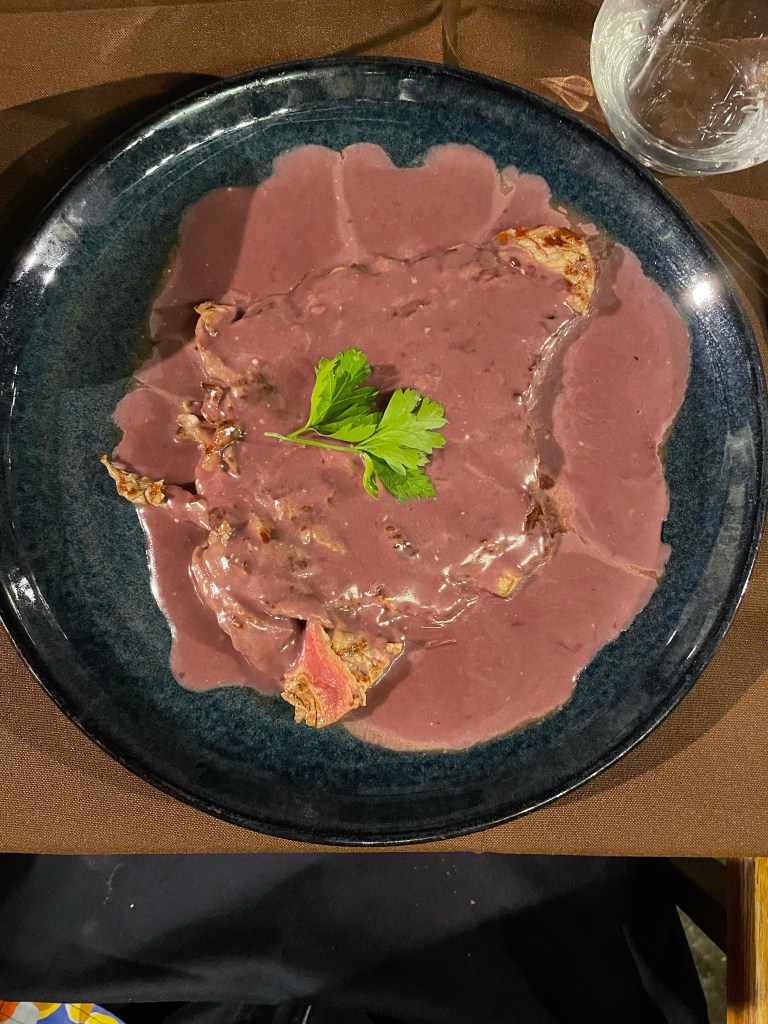
But I had two very good meals on my last day in Portugal. One was a fish cataplana, essentially a Portuguese cioppino. All of the seafood was perfectly cooked, even the salmon, and especially one whitefish that literally just melted in my mouth.
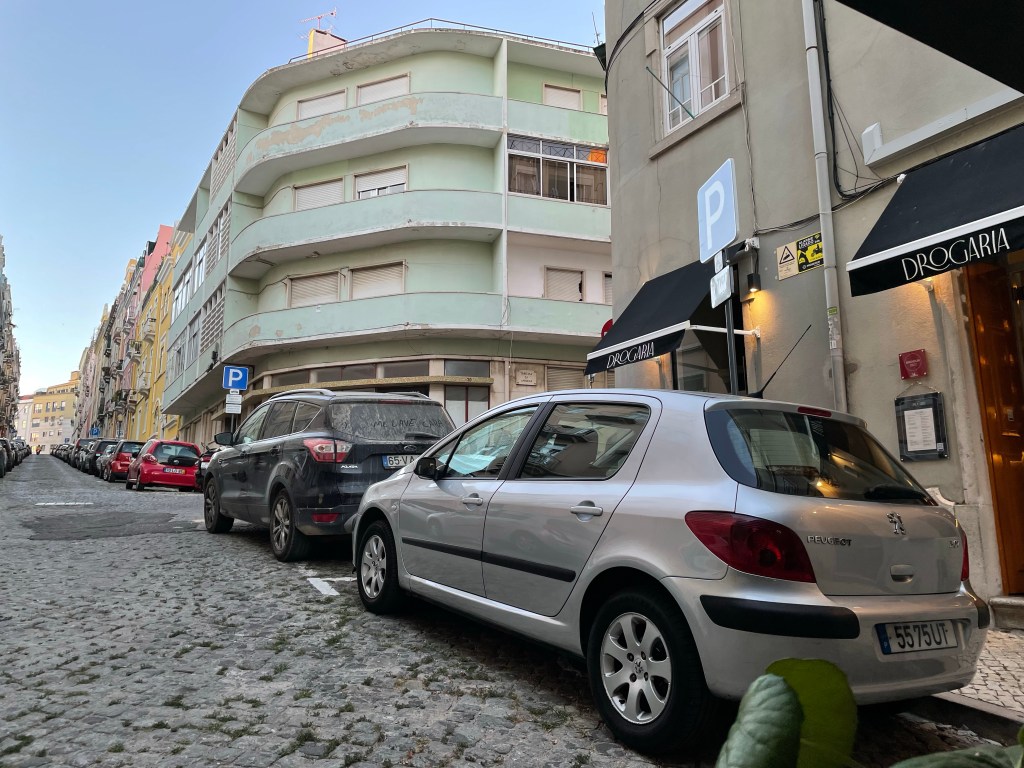
Last night, I ate at a restaurant called Drogaria, which means “drugstore.” I found it after google searching “best new restaurants in Lisbon” and coming across a Forbes article written by an American expat living there. They were included in the Michelin guide that includes restaurants beyond their star rating, so I figured, this can’t be all bad. I Ubered to Drogaria and never would have found it otherwise, as it was in a hilly neighborhood far from any business district and with narrow streets packed with apartment buildings. I sat outside. On my right was a tree and a pocket park, but on my left was a crumbling 1950s faded lime green apartment building that looks like something from a barrio in LA or Miami. The shop on the ground floor was a dry cleaner. So the name of the restaurant fit the setting. And since the intent of the restaurant was to provide new takes on traditional Portuguese food, to have the location in such an ordinary residential area fit as well.
The chef, if memory serves, previously worked in a Michelin 3-star restaurant in Macau, a former Portuguese colony, so the Asian fusion elements in the cuisine were unsurprising. But there was nothing passé about these dishes. The first dish was gyoza, with the most lightly fried edge, stuffed with a Portuguese meat stew, cozido. The stew was sublime, with tender shredded chicken being the primary texture but with sausage, beef, and pork contributing to the rich flavor. It was served with the stew broth poured on top. As I finished the gyoza, the broth was left over and I (quite rudely, I thought) started spooning it down. The flavor was different than the stew itself—tangier, brighter, complex. This was not food to be appreciated by a Neanderthal. As it turns out, the broth is often served as an appetizer before the stew, so I guess I wasn’t too ill-behaved.
The roast duck was a take on duck a l’orange with delicate potatoes au gratin and spinach and mushrooms in a soy ginger sauce. If you don’t think duck a l’orange goes with the spinach, or all three together in one bite, think again. I think this was the chef’s intent, to have the diner taste each dish separately but let the flavors and ultimately the foods meld into one bite by the end. The wine accompanying this was a red blend described simply as “dry” by the server but it was far more complex than a single varietal and certainly not bland like a merlot—it was so indescribably complex that it was simpler and easier to ponder the meaning of this dining experience and marvel at the wonders of what was going on.
Then dessert was a turd, an actual turd.
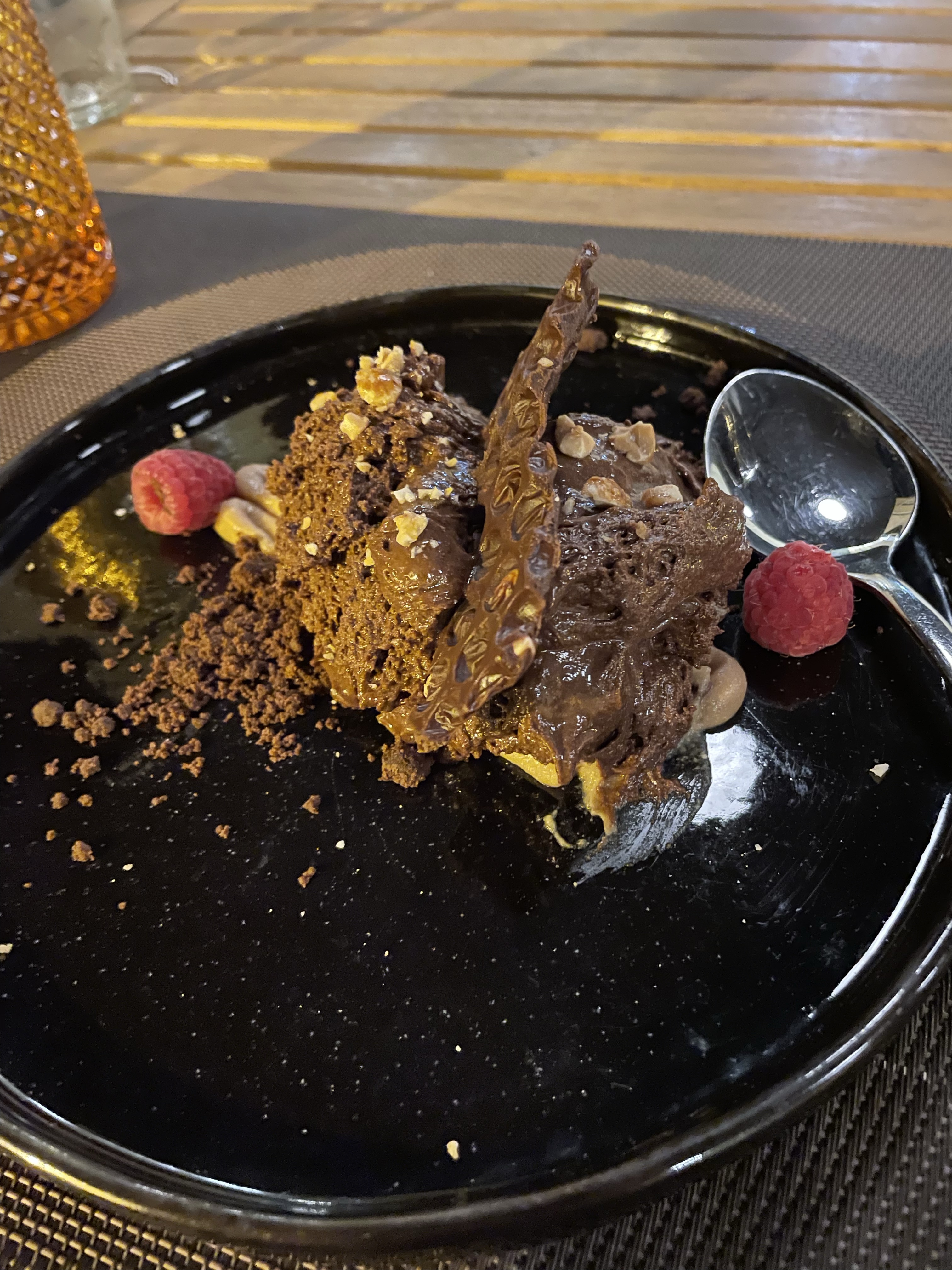
If the rest of the dinner hadn’t have been so delicious, I would have been furious, but here I knew the turd was not the actual guano from the other night. It was a milk chocolate mousse with a dark chocolate [chip] in the middle and a white chocolate mousse underneath. It was glorious.
I guess I can describe the meal better in a different context. I am listening to a 15 year old Chanticleer recording as I type this. Chanticleer is a professional men’s a cappella group based in San Francisco, and they set the gold standard for classical men’s a cappella singing in the US. They sing with perfect intonation and technique, but they sing music that is not necessarily accessible to people without a lot of experience listening to Renaissance or modern music. When I listen to them, particularly live in the Italianate marble St. Ignatius church on the campus of the University of San Francisco, I experience feelings I can’t normally access, often at the same time. I feel more than the same exhilaration than I felt the first time heard a men’s chorus. I feel sorrow and get teary, but am not sad because below that I access deep peace. I feel my own emotional scars and yet they do not hurt, because I feel love for the world and the universe at the same time. For me the epitome of quality in art, or food, is that it unlocks this complexity of emotional range and experience in us. It requires a high degree of technical expertise to reach this level—in fact my chorus director Joe Piazza goes so far as to state that the best music performance is devoid of emotional input from the singer but that it is the technical excellence that communicates the message, the meaning, the complexity, the sublimeness, the emotion, the experience to the listener. Regardless of how much emotional contribution is required from the artist, that is the character of quality that I experienced at Drogaria.
That is the unspoken hope I think I have for this trip—to experience those deeper feelings, richer feelings, complex feelings that I’ve been so numb to for a while. To “rehumanize,” to reexpand after feeling so desiccated for the last few years, like a spore waiting to germinate, like those expandable water toys we had as kids. And also experience authenticity, the uniqueness of a place, perhaps in search of something authentic inside myself.
And if I’m to be honest, I didn’t experience this for the most part in Portugal. If you will indulge my perhaps unfair generalization but one that matches my experience, Portugal is a gritty country. Its cultural quality is not generally or easily accessible except to the wealthy or well informed, and the rest of us are stuck looking for ordinary food in crowded restaurants or (as in Porto) enjoying the beauty of the place without the easily found deeper cultural meaning and quality that is conveyed in places like France or Italy.
It is said that Lisbon is the San Francisco of Europe because of its charming buildings, hills, and total knockoff golden orange bridge. And I think I’m disappointed in Lisbon, in Portugal, in the same ways I’m disappointed in San Francisco too.
Drogaria, vintage port, and Chanticleer are the exceptions in Portugal and San Francisco rather than the rule. And Drogaria is the most deeply local experience of all of these: Portugal as it can be (a thoughtful experience of ancient foods in new ways) but equally necessary, what it is (a crumbling barrio apartment, possibly even a turd). That honesty makes the quality authentic, and the quality makes the honest truth more than bearable but something beautiful.




 Steve Simko