-
Threads of a lost root
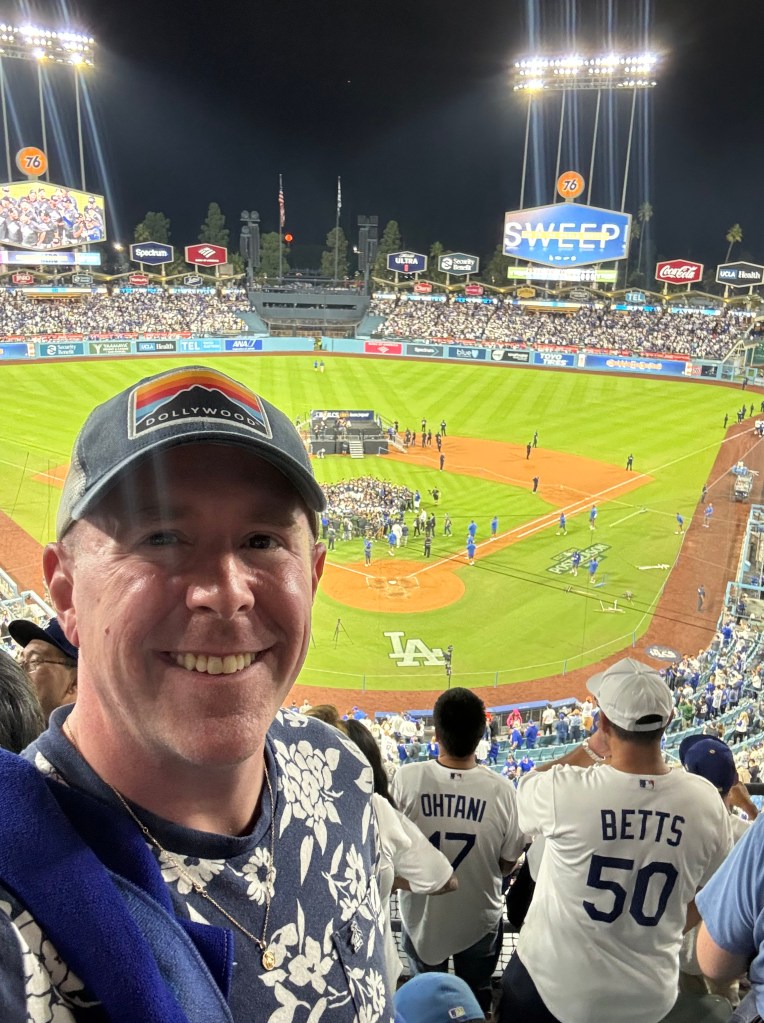
I watched the Los Angeles Dodgers win the National League pennant Friday night after one of the greatest individual performances in baseball history, and it got me thinking.
Baseball is a soil in which my family’s story and memory are well rooted. My grandfather was a minor-leaguer in the Reds organization, giving up baseball when my future grandmother made him choose between his itinerant profession and their relationship. Growing up in central Illinois, my dad loved the nearby St. Louis Cardinals and their star Stan Musial but didn’t inherit his father’s skill or power, batting an appalling .059 in his worst little league season. I took after my father in terms of natural baseball aptitude. At my first major league game in 1984, I accidentally spent most of the game cheering against my hometown Atlanta Braves, mistakenly thinking the fans in front of us were cheering for the home team as well. I couldn’t see anything but the backs of their heads, so I just did what they did! Then there was the incident of me running the bases the wrong way around in my first Little League tryout. My dad still likes to make fun of me for that, but we’re going to leave the blame at his feet for inadequate preparation there. After all, I was six.
But six is an age where unforgettable core memories can form. My core baseball memory came while playing for the undefeated Lancers in the 1985 Murphey Candler Park tee ball league championship game. It was in actual fact the hottest day of the year, unusually hot even for Atlanta that early June day, with temps reaching 98 or 99 degrees at gametime, with the requisite brutal Georgia humidity. It was too hot for the teams to sit in the cinder block dugouts, so we sat in the bleachers with the unusually large number of family members who had turned out. I was a hypercompetitive child and got so anxious when we trailed 4-2 to our archrivals, the Rockets, after one inning that I started crying. The Lancers had been so good all year that I hadn’t had the experience of even trailing! After wild momentum swings, the Lancers came to bat in the bottom of the final inning trailing by 3 runs. I don’t remember how I got on base, but I did, and eventually found myself standing on third base with the game tied and one of our best hitters at the plate. I WILLED that hitter to hit that ball to right field so I could score easily, not that it really mattered in this battle of defensive, um, juggernauts. He did, and I did, and we won the game, 28 to 27. It was the first time I’d experienced the joy of uninhibited bedlam. I remember jumping up and down in the empty dugout with a couple of parents and they were jumping too–when did that ever happen at home or school or church or anywhere? I still have the framed team photograph from that day. Everyone is beaming. I have better stories about life lessons I learned in Little League and “wow” experiences watching my own beloved pro teams reach the pinnacle of the sport, but I’m not sure I’ve ever experienced such personally intense excitement amid so much collective joy in baseball or any other context.
I haven’t paid meaningful attention to baseball in a long time. Except for the Giants winning the World Series the week I moved to San Francisco in 2014, I haven’t lived near a city that won a postseason baseball series in over two decades. Worse, during that time baseball regressed from a beloved national pastime to a performance enhancing drug-plagued fraudscape of fallen heroes to an arid, dull wasteland swimming in analytics and technicians. I might have memorized statistics from the backs of baseball cards when I was nine–I still remember that Jesse Barfield led the AL with 40 home runs in 1986 as a result–but for me baseball needs peanuts, hot dogs, story, nostalgia, drama, hope, and magic for me to actually care. I need a rooting interest, not an OPS+.
A few weeks ago, I decided to stay in Los Angeles for the second half of October. Right around then, the baseball playoffs were starting and, bored at home one night back in SF, I turned on a Dodgers-Reds game. The Cincinnati Reds have been a forgettable, irrelevant franchise since winning their last championship in 1990. Coming in as the underdog who skated past the overpaid, overhyped New York Mets for the last playoff spot, and being from a former home of mine, the Reds were absolutely a team I’d normally cheer for. But perhaps taking heed of my grandfather’s advice to cheer always for the city where you’re living, I instinctively started cheering for the defending World Series champion Dodgers. This year, the Dodgers won their division but underperformed relative to expectations during the regular season, plagued by a bullpen that had been imploding for weeks. In the game that night, they appeared on the verge of blowing a big lead in the 8th inning, giving up a few runs but staving off a rally before things got too out of hand. In the 9th, the Dodgers brought in an inexperienced first-year pitcher, Rōki Sasaki, to finish the game.
Rōki the rookie signed with the Dodgers from Japan in the offseason. Because he was only 23, he was not eligible for unrestricted free agency and thus a massive contract. Per MLB.com:
Because Sasaki is younger than 25 years old, he is considered an amateur international free agent, meaning he comes with six years of club control and will earn a rookie salary in 2025 (in addition to a $6.5 million signing bonus).
In other words, he cost himself millions of dollars in potential income that he could have earned if he had waited just two more years. Why, besides his drive to face the best players in the world?
The transition of the 23-year-old Sasaki to Major League Baseball was atypical. Almost every Japanese player who leaves for MLB does so after a series of high-end accomplishments. Sasaki did throw a perfect game in 2022 followed by eight more blemish-free innings in his next start. But over the next two seasons, he barely threw 200 innings total, with arm and oblique injuries limiting his time on the mound….
He…wasn’t himself in his final seasons in Japan. During his meetings with teams, Sasaki wanted one question answered: How would you fix my fastball? It had leaked velocity over the previous two seasons, and teams’ responses, Sasaki figured, would offer him the best insight into their philosophies on pitching.
Sasaki was a starting pitcher for the first 6 weeks of the season, and his performance was mired in mediocrity. A viral tweet this spring showed him in the dugout with visibly red, teary eyes. One former major league journeyman catcher called for veteran teammates to coach him up to overcome being “soft.” As it turns out, he was discovered to have chronic shoulder inflammation, and the Dodgers shut him down for several months. Once healthier, the Dodgers sent him to the minor leagues for a rehab stint, during which time team coaches and advisors earned his trust enough to alter his mechanics such that he could rediscover his velocity. And when the big league team bullpen cratered late in the season, he was called into service as a reliever for the first time in his career. Within a few appearances, he emerged as a dominant, electric, compelling, unhittable closer–a must-see every time he took the mound with a 101 mph fastball and a devastating forkball. His path to success wasn’t about overcoming softness–the drive to be dominant was already there, ready to be unleashed–but about being supported by a world-class franchise, being given time to recover from chronic injury, and finding a biomechanical fix for his pitching problems.
Watching him for the first time, I realized what an “Oh my god!” sensation he was. After the Dodgers took a series lead against the favored Phillies, I journaled that I’d buy a Dodgers Sasaki jersey if they reached the World Series. He’s been nearly perfect in the playoffs, giving up just 1 earned run in 7 appearances and 8 innings. Most impressively, he threw three perfect innings in a tie game in the clinching game against the Phillies, where a run would have lost the game. He’s adopted the song “Báilalo Rocky” (but pronounced like his first name, Rōki) as his entry music with his teammates banging on the dugout wall when he enters the game.
Once I got to LA, I realized I could get a ticket to a National League Championship Series game for about a third of the price of a World Series ticket. WIth the Dodgers up three games to none against the Milwaukee Brewers and with the legendary Shohei Ohtani pitching, I didn’t hesitate to buy a ticket for what I hoped would be the clinching game. I hope you don’t need me to explain Shohei Ohtani’s genuinely unparalleled, unique greatness if you’ve made it this far into this post. On Friday night, Ohtani hit 3 home runs, one of which left the stadium and was one of the longest home runs ever hit in Dodger Stadium. He ALSO pitched 6 scoreless innings, striking out 10 batters, relying on his 100+ mph fastball and five or six other pitches. In a playoff series-clinching victory. I knew in the moment it was nothing like anyone had ever seen before or possibly in the 125 years of modern baseball. I was screaming uncontrollably when he launched his third home run. Rōki closed out the game, but nothing could have prepared me for what Ohtani did that night.
It’s said that the Dodgers, with their uncapped salary spending, are breaking baseball. Good. If baseball is going to be a source of inspiration not just to its next generation of players but across wide swaths of society, it needs to be broken. Besides former Dodger Corey Seager, I couldn’t name a single player who played in the 2023 World Series between the Rangers and Diamondbacks. I hadn’t really cared about the sport in years. But it’s fun to like baseball again, even if just for the short time I’m staying in LA, to see transcendentally great players like Ohtani paired with young phenoms like Sasaki discovering their own excellence thanks to world-class organizational dynamics. It’s fun to cheer for the team that integrated baseball in the ‘40s, that expanded its geography when it moved to the West Coast in the ‘50s, and now that’s globalizing the sport. More than that, the Dodgers are giving baseball the stories of its players back. I don’t just have cool new analytical methodologies–I can root for real flesh and blood.
The lessons of recent eras of baseball are instructive about what doesn’t work to help hold a society together the way a national pastime should. Memory and nostalgia without renewal and transformation are a snooze. Pure novelty is just a dopamine hit, a fix to get you through the day but one that doesn’t sustain. Technical perfection inspires very few when divorced from meaning and purpose. But rediscovering the threads of a lost throughline, a story you can trace back through your own generations and forward beyond the world as it is, maybe to something better than what we’ve seen before, is for me a strand of timely hope and inspiration. Thanks Rōki and Shohei and the Dodgers for helping me to reconnect to a joyful part of my own life story, and for transforming a uniquely American institution into something broader and better. Makes me dream that a chaotic, troubled America still has hope to follow a broader and better path to a dynamic, transformational future.
-
An update with some poetry
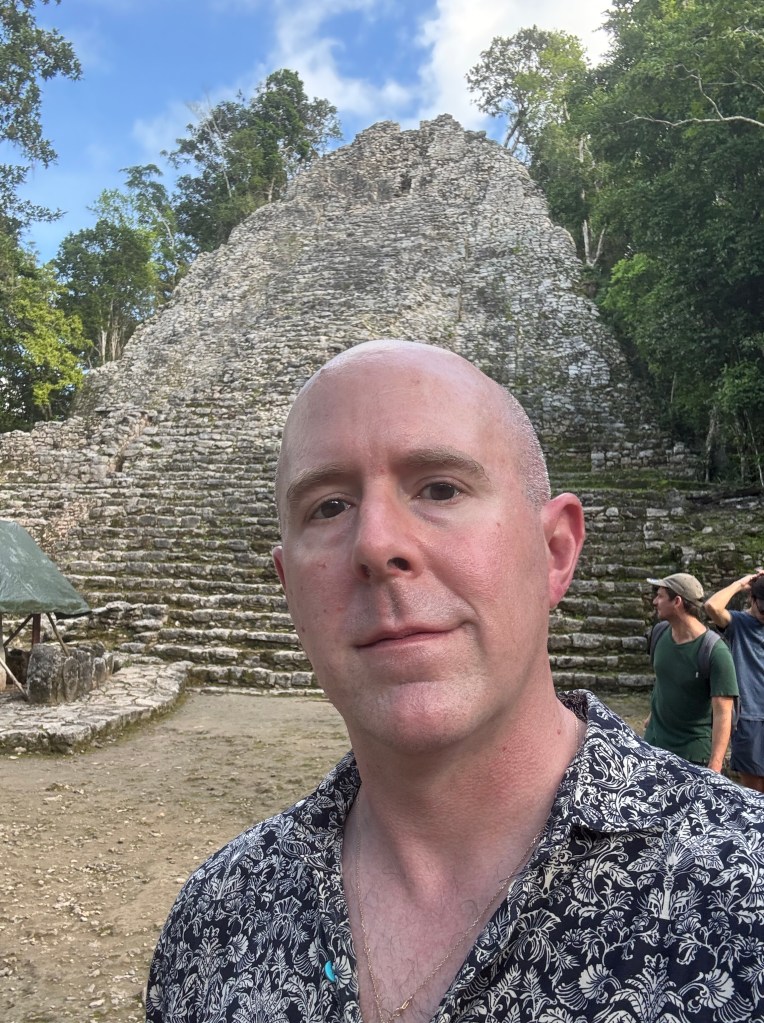
Near Tulum, Mexico, December 2024 Finally my first entry from my career break! Consider this an update in the form of poetry.
I recently did an exercise where I wrote some poems in a Tanka-like style. A Tanka poem is a Japanese poem that, when written in English, consists of 31 syllables in 5 lines (5-7-5-7-7). These poems contain fewer syllables than that but illustrate my state of mind on several aspects of my life at the moment. Even for me these have several meanings, so interpret them as you see fit. One positive caveat: while these poems reflect some of my inner and outer challenges at the moment, I’m satisfied with my frame of mind at the moment and excited to experience this new creative emergence.
On travel and home
I thought the world
waited for my presence,
but I find
I cannot escape here
or stake my tent here either.On romance
No love has ever
worthed the chord progressions
In Romantic-
era concertos
or their resolutions.On my spiritual journey
I am not guru;
neither are you,
wannabe
leader of lost souls.
Neither of us for me.Always happy to discuss them further!
-
The next adventure
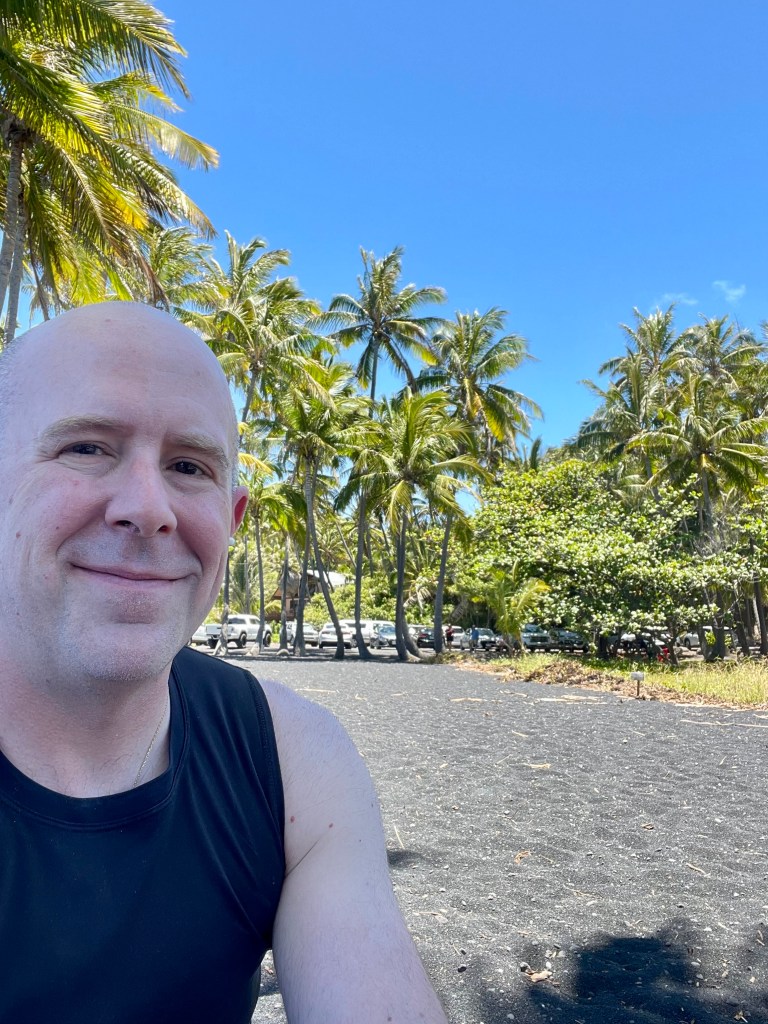
Some personal news. I have decided to leave my job to take a career break! I’ll be spending the coming months focusing on self-discovery, relationship building, and of course a fair amount of exploring the world. I consider myself exceptionally fortunate that my life circumstances afford me the freedom to do this, and that I have exceptional colleagues taking over for me at work.
I’m not sure where this journey will lead in terms of eventual home or career direction. I’m staying based in San Francisco for now, but there are a lot of factors that will play into whether I decide to continue in SF as my long term home. And before I settle on what l want in my next job, I want to focus on matters closer to the heart first.
I’ll be posting on here periodically with some updates on my adventures. Can’t wait to share them with you.
Much love to you all! Let’s goooooo!!!!
-
Berlin: Misfit Island

Former East German leader Erik Honecker kissing Nikita Khrushchev, as painted on a remaining section of the Berlin Wall When I was in the sixth grade, the Berlin Wall came down. I can’t remember a single news event in my lifetime that made me feel as joyful. The Berlin Wall was constructed to stop the flood of emigrants from East Germany in 1961. Approximately 2.5 million people, or a sixth of the East German population, left the country prior to the overnight border closure. I remember having seen a news feature—possibly during the 1988 Olympics?—about the Berlin Wall and how people who wanted to cross from East to West Berlin were shot. And a year later, after a flood of news stories talking about how border controls were melting in the Eastern Bloc and how East Germans were making their way to Austria, one November night the border controls at the Berlin Wall were rescinded. Imagine something that seemed so deadly, powerful, and permanent just vanishing!
A few months later, several kids from my school and I participated in a public phone call with students from a school in Germany to highlight the possibilities of global communication and connection. The call was sponsored by MCI, a telecom giant who was building their new world headquarters a mile from my school. Because their headquarters was a construction site, they dubbed the event the Wall to Wall Call, thus becoming my first exposure to deeply thoughtless corporate psychobabble. Strangely they paired us with 16 year olds on the call—what on earth were a bunch of 10 and 11 year olds going to talk about with people in a very different stage of life? But I exchanged a few pen pal letters with one of the young women I spoke with on the call. I remember being surprised at her unwillingness to demonize East Germany and that she saw the good in it. As a young American raised in the Reagan era, I had not yet developed an appreciation of either the moral complexities of the Cold War or, more importantly, a recognition that she might be gaining more freedoms but she was losing her entire country. East Germany might have been a prison state doomed to oblivion, but it was also her home.
I had friends who traveled to Berlin right after the wall came down, and they brought me a chip off the wall. There was a smooth side from the original facade and a rough side, and since the smooth side had spray paint on it, they assured me it was part of the original graffiti.
It was in that context that I later decided to take German starting in eighth grade, a decision that I stuck with all the way through high school. I didn’t have the same emotional connection to Spanish- or French-speaking countries, and there was no way I was going to spend my time learning Latin when I could never use it. I think my decision at 13 was more instinctive? But of course it would have been with that much of a backstory.
I never made it to Germany while I was studying the language. My parents refused to even entertain the idea of letting me go abroad as a teenager on a high school summer exchange trip that a lot of my friends went on, and in college they were dead set against me even paying my own way to study abroad there for a semester, so I dropped the idea. Symbolically, Germany became in my mind the country of a hopeful future that was always out of my grasp, and that I wanted to reach.
Even though I’ve been to the German-speaking world many times, it’s mostly been to Switzerland for work, and I only ever made it to Germany for the first time many years after forgetting almost all my German. My trip to Berlin this week was the first time I’ve been there, and only the second time I’ve spent meaningful time in Germany proper. Maybe I’ve just been too embarrassed with myself to go back after, on my first day trying to speak German, I confidently walked into my hotel and asked reception, “Guten tag. ¿Cómo estás?”
Berlin is not like other European capitals. Berlin wasn’t really the capital of anything until the 1700s when it was made the capital of the Prussian kingdom, a region that eventually stretched throughout northern Germany and northern Poland. It did not become the capital of modern Germany until the 1870s when the nation roughly as we know it today came into existence. So it lacks the grandeur of London and Paris, the old world charm of Amsterdam, or the ancient magnificence of Rome. In the 1890’s Mark Twain described it (favorably, to be clear) as the Chicago of Europe because of its orderly design, tidiness, and flatness, the last of which makes for cities that can be easily transited. Because it was largely destroyed in World War II, its construction both in the former West and East Berlins is remarkably uniform—6 story apartment buildings on top of each other without decorative flourish. While East Berlin is mostly postwar glum Communist construction with little greenery interspersed among buildings, West Berlin has a similar lack of architectural aesthetics despite being more generally green. There’s a difference between the two Berlins, but not a big difference.
Except for Hamburg and perhaps Hanover, Germany’s other population centers—and the rest of Western Europe—are far from Berlin. The Ruhr valley is a 5 hour train ride away, and Munich is even further. Even Prague, the closest major international city, is 4 hours away. Because West Berlin was an island surrounded by East Germany with limited connections to the West until the 1990s, it never developed as a travel hub after WWII. Even though Berlin has a new airport, it still has few direct connections to non-hub cities except via discount airlines such as Ryanair, and I can promise you you don’t want to fly with them unless you have to. Also Berlin’s airport evokes the charm of a shiny new Supermax prison, so you don’t feel exactly welcomed on arrival. But the connectivity issues mean that, more than in a city like San Francisco where you can drive to a spectacular coastline or forests or mountains quickly, you are dependent on the city for your social life, your entertainment, your aesthetics, your sense of place.
A travel planner who is at a similar stage in life helped me put the architecture of my trip together and has traveled all over the world. He does not like Berlin and advised me to spend less than the week than I originally planned. I didn’t believe him that there was a lot not to like about Berlin. Everyone I know who’s been had a fabulous time here. My relatives who have been ADORE it there.
My hope was that I would discover a city that I would vibe with, that I could connect with, and more deeply, that I could maybe someday live in. Some American friends I had dinner with early on in my stay explained the potential of Berlin—you can live affordably, and you have the social freedom to become whatever you want to be. They described an expat friend who had moved to Berlin and found it affordable enough to become an artist despite no prior formal training or major experience. The allure of living with a higher quality of life is strong—if I told you my rent and what I don’t get for it, those of you outside SF or NY would not believe me.
The challenge, of course, is that the awesomeness of Berlin is not easily accessible to someone visiting for a few days. Or as a friend put it, “It’s about people and experiences. It’s not touristy! You have to go to bars and openings and parties and meet and engage.”
My first night in Berlin, I went out and had an experience. I waited in line outside of a gay dance club, SchwuZ, for 2 hours. A friend was there and he told me it was super inclusive and that I could wear whatever I wanted! It was really warm that night and I wore a tank top and shorts, and as it turns out that was a smart move given the heat inside. The club welcomed *everyone.* There were several individuals in wheelchairs, and they’re club regulars—on less crowded nights they’re known to all get together on the dance floor. The club had 3 dance floors, so if you didn’t like the music or DJ in one, you moved to the next. I hung out with my friend for a while and then I just danced when he left, and felt free and easy. We don’t have accessible gay clubs quite like that in SF—they’re mostly dive bars that don’t do much to create a good experience, or it’s a ticketed party that you have to be in the know about and that is usually much more crowded and sweaty than SchwuZ, where the experience of waiting in line actually made the experience inside less crowded and far more enjoyable.
Contrast that with the most famous club in Berlin, Berghain, which is considered a techno Mecca. It is an exclusive place and entry is determined by the bouncer when you get to the front of the line. So you can wait for hours and not get in. They’ve been accused of racial profiling, some nights only letting Germans in. It’s said you’re better off wearing all black, not smiling, etc. And I ask, who the hell wants to go to a club like that? I don’t care how fun or amazing the experience is, I don’t want to have an experience just because I meet some asshole bouncer’s criteria for acceptability especially when I want to wear vibrant colors and smile.
And this contrast raises the question: if a city’s greatness isn’t really that accessible to everyone, can it be considered a great city at all?
My problem in Berlin was that my one “experience”—dancing until 5 am—wore me out for the next couple of days. And I tried to do too many things during the day that, because of the heat and lack of climate control (hello German frugality + energy shortage), wore me out too much to go out at night. Exploring underground scenes isn’t something I’m into if I don’t have a lot of energy for it.
There were other limitations and interruptions too to my experience of Berlin too. My local experience was interrupted by very welcome social engagements with American friends who happened to be in town. The aesthetics of Berlin—the unrelenting apartment buildings, the oversized state architecture on Unter den Linden and Museum Island—were soul-crushing to me. The food, unlike Italy or even Denmark, was decidedly ordinary. The Berlin Wall, something I thought I’d be moved by, felt like it was just an ugly wall. And plus, I am 6 weeks into a long trip and my energy was flagging.
Even my day trips out of the city, though lovely, weren’t something that was going to be part of my life if I were to ever move there. Sans Souci, the royal summer palace of the 18th century Prussian King Frederick the Great, was stunningly and uniquely beautiful in its mix of royal quality, informality, and eccentricity. Dresden, the old capital of Saxony that was destroyed by extreme Allied bombing in World War II and subsequently rebuilt, was charming in a limited way but not somewhere I’d want to visit on a regular basis.
So Berlin, I don’t know if it was you or me, or bad timing, but I just didn’t vibe with you. And in reflecting on it, my expectations of connecting with Berlin were largely founded in my adolescent love of the Germany that existed in my own head from the Wall to Wall Call and the later sense of disappointment I had in not going. Of course disappointment was inevitable. But my feelings are more than just disappointment. I know I don’t want to be in a place where you have to build social capital and local experience for a while before you can really enjoy it. I don’t want to be with aesthetics that don’t inspire me. And I don’t want to live on an island so seemingly disconnected from other places, where your city is the only show in town.
And I don’t have to be disappointed anymore that I didn’t ever follow through on mastering conversational German or traveling to Germany at a young age. Leaving the Berlin airport, the one I already described as architecturally oppressive, one of the agents at the security checkpoint got mad at me for not going out of my way to put away one of my bins while I was still waiting on my items to come through. Airport security assholery is universal, but this was a uniquely bizarre request that emblematic of how I feel about my time in Berlin—I was irritated, I felt penned in, and the amount of cultural learning I’d have to go through to find out whether the irritation and sense of confinement were just steps on an amazing journey didn’t seem like they’d be worth the effort.
While I was in Berlin, I knew I needed a different kind of experience besides those that I’d had in Europe before I went home. A different culture. A different world. One that might be messier but more musical, rhythmic, relaxed, joyful. And my planned destination, Iceland, wasn’t going to do it for me. It’s going to be cold and rainy there this week. In parallel, I reflected that has been my longest trip outside of the US by a long way now. The previous winner was a medical mission trip I took many years ago to Venezuela. The locals I met there were some of the most easygoing, relaxed, joyful people I’d ever met, people who could make me laugh despite the language barrier. And to my regret, I haven’t been to South America since. While Venezuela is sadly no longer a viable travel destination, I knew at least that it was time to come back to the New World to finish this trip’s work of self re-creation.
The weather is going to be brilliant in Rio this week—sunny and mild. Time to see if I can fall in love with a very different kind of place. See you there. 🇧🇷🇧🇷🇧🇷
-
Florence is for Americans
Finally a blog post that isn’t about me and is entirely travel advice you can use! As one of my friends that I made in Milan told me, “Florence is for Americans.” So let this American tell you the lowdown on this town, known as Firenze in Italian.
Florence’s oversimplified story
While historians debate exactly when the Renaissance began, or whether it was just a continuation and expansion of the late Middle Ages, the universal consensus is that whatever it was that began started in Florence. A confluence of factors contributed:
- the economic shift from feudalism to mercantilism, resulting in a concentration of wealth earned in the textile industry;
- the consolidation of power with the Medici family
- The patronage of the arts. In the Medici’s case, it was more than just patronage—it was a vision to create a new Athens. And that motivation was more widely shared after the Black Plague ravaged Florence in 1347, when over half the town was killed.
- The unparalleled presence of great artists over several centuries. This started before the Renaissance. Whether this was good fortune or due to the other factors mentioned is debatable, but the names of great Florentines poured forth for centuries: Dante. Giotto. Donatello. Ghiberti. Brunelleschi. Botticelli. Michelangelo.
- Far from being Donatello’s contemporary, Michelangelo actually was born over a hundred years later. Teddy Roosevelt and Barack Obama are closer in age. Donatello and Michelangelo have about the same age gap as FDR and AOC.
By contrast, Rome did not see such a flowering until the early 1500s, when Pope Julian II (“a crazy man” according to one of my tour guides who spent his papacy largely focused on Vatican military and political power) exerted similar patronage of the arts and architecture as the Medicis in Florence.
So the Renaissance means different things in different places, but in Florence it certainly was in full swing by 1401, when Ghiberti and Brunelleschi entered a competition to create the bronze doors of the Baptistry. Their entries were judged equal and they were offered the chance to co-create the doors, but the headstrong Brunelleschi backed out, not wanting to work with Ghiberti. Ghiberti created something more than a mere masterpiece, but Brunelleschi would achieve a crowning achievement even more remarkable. We’ll come back to these guys later.
Incidentally, who do you think should have won the contest between the two? We have their entries depicting the sacrifice of Isaac.
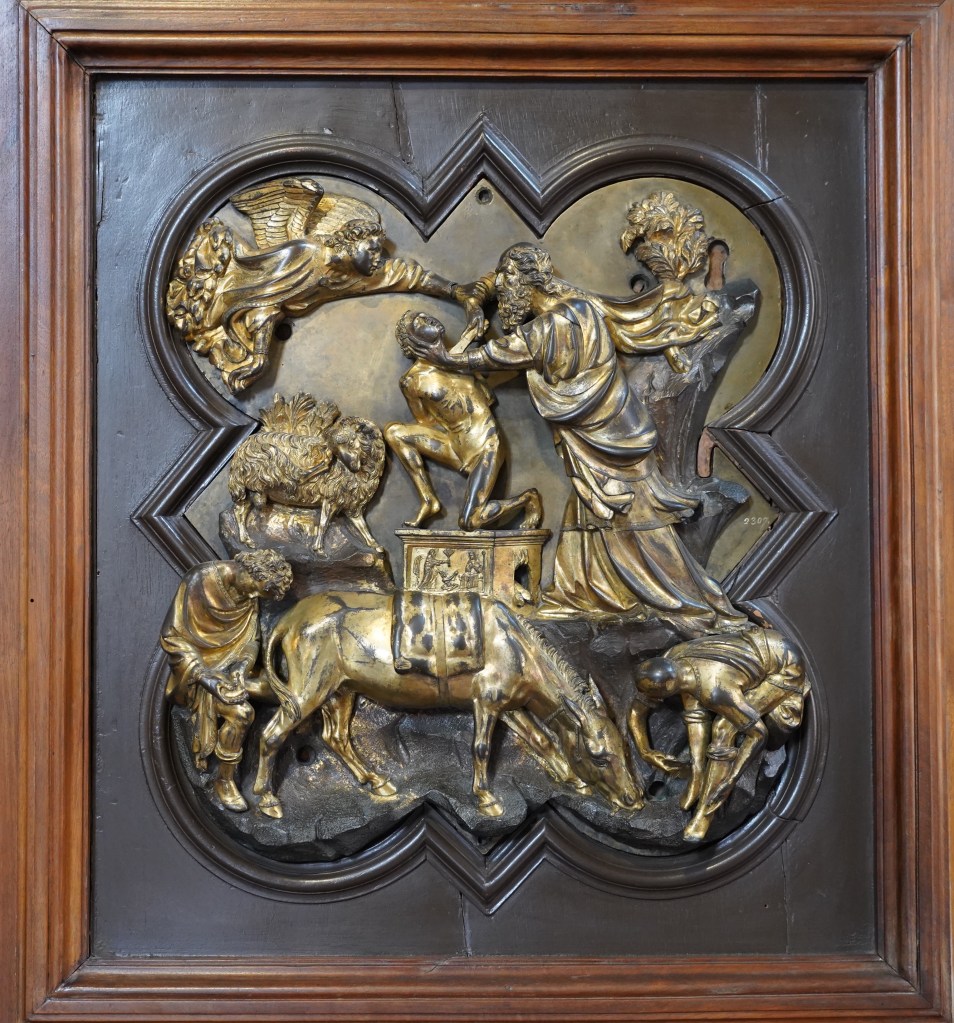
Brunelleschi 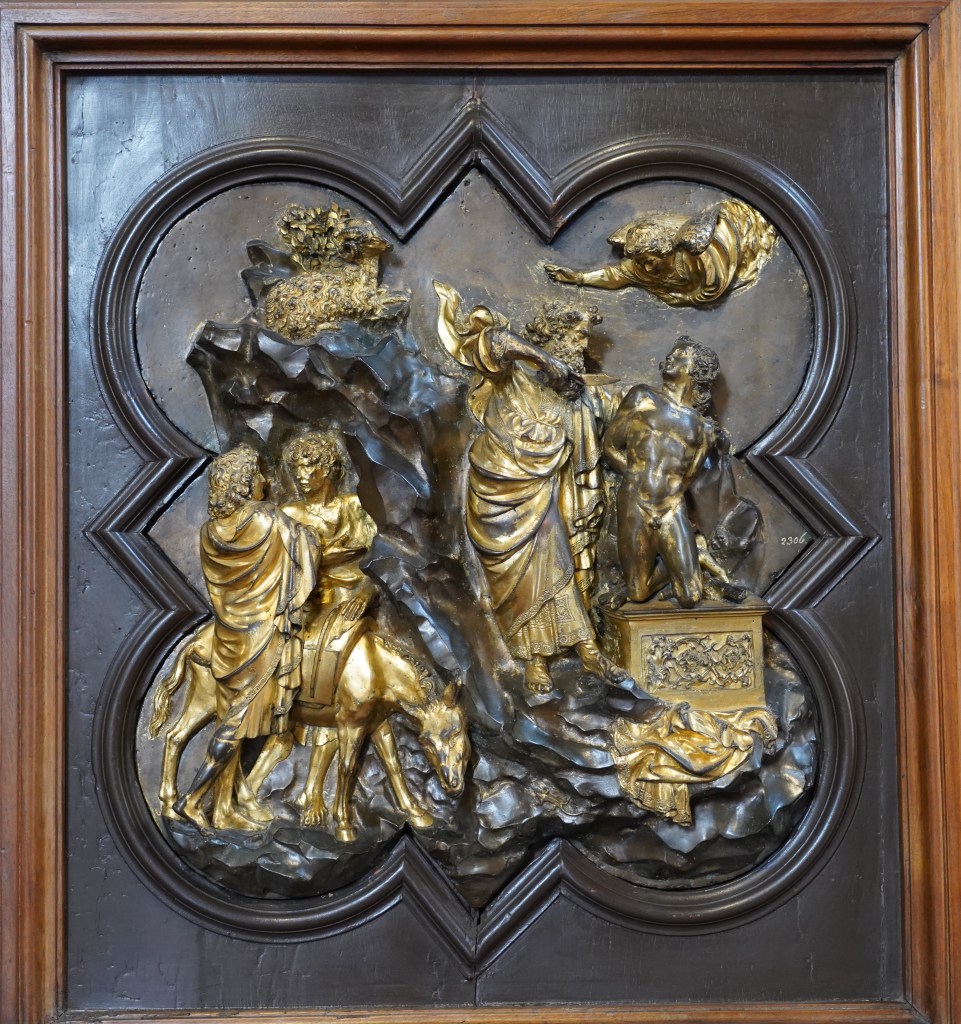
Ghiberti When to visit
Not August, that’s for sure. Unless you happen to be in the area, because you have to go at some point.
I miraculously avoided the 104 degree (40C) weather that they’d been having for a month prior to my arrival, so the weather was more typical—low 90s and sunny. But like most medieval towns when the sun is directly overhead, the sun bounces off the pavement and stone and burns like the sun in Super Mario 3. The sun saps of your energy so that you’re really only motivated to do two or three things in a day, not spend an entire day doing things, and drained of the desire to go out at night. I can’t imagine the horrors that would have awaited a week earlier. I shortened my Italy trip to 6 days from 12 knowing it was going to be like this and I couldn’t be happier.
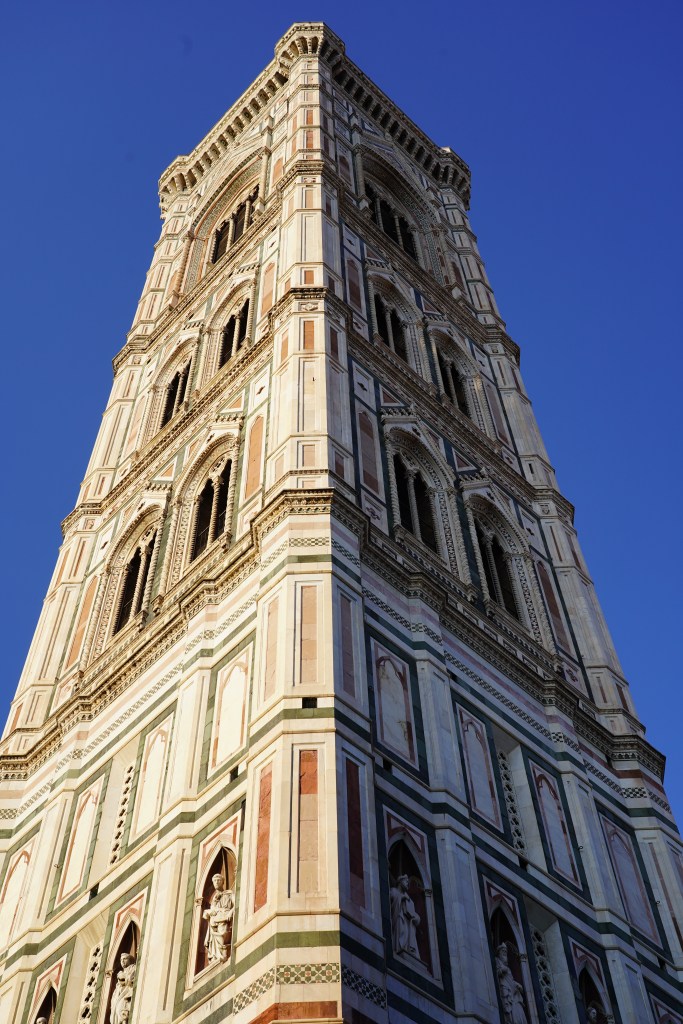
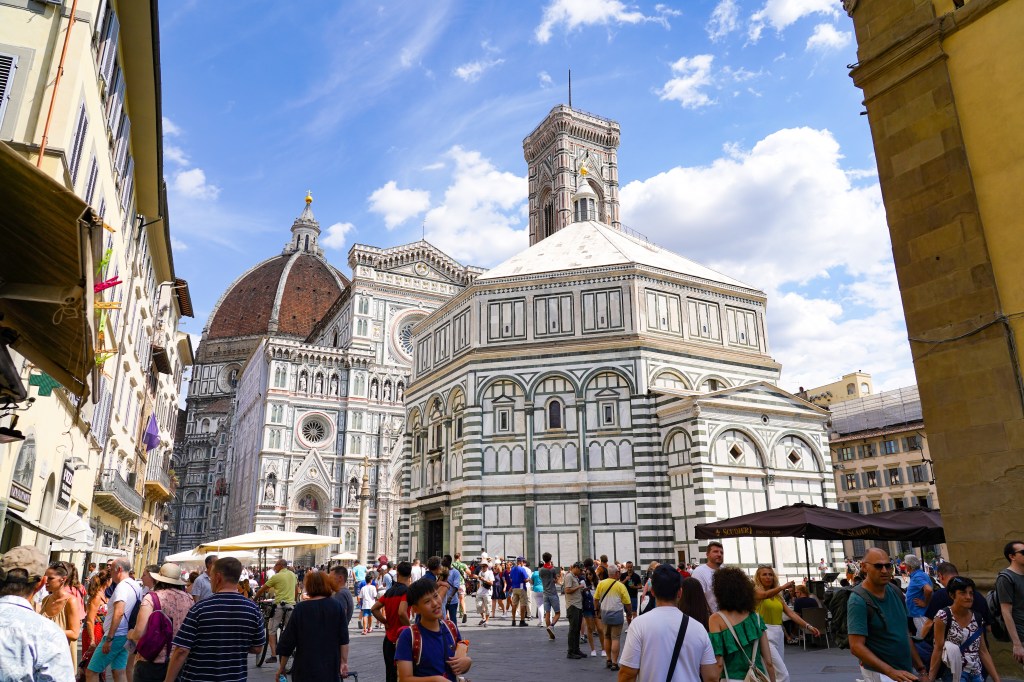
Giotto’s tower at the Duomo What to do
See the sights. Eat. Drink wine. That’s about it. Florence is swarming with tourists wandering aimlessly. There are not many Italians here. The shopping is all over the place—you can buy watches more expensive than a Rolex on the Ponte Vecchio or you can buy a $50 leather jacket. I didn’t see much happening from a nightlife perspective other than the typical aimless tourists, street vendors, sidewalk cafes serving Aperol spritzes ad nauseam, you get the idea.
What to eat
Eh? I’m not the best person to tell you. Like with Milan, a lot of the best restaurants were closed or booked. My experience was that the food was consistently quite satisfying but not necessarily great. One local specialty that kept coming up was the Florentine steak, which is usually served in quantities > 2 pounds (1 kg) so as a solo traveler that was gastrically out of reach for me.
What to see
Let’s play a game of contrasts.
Tired: the outside of the Palazzo Vecchio. Wired: the outside of the Duomo
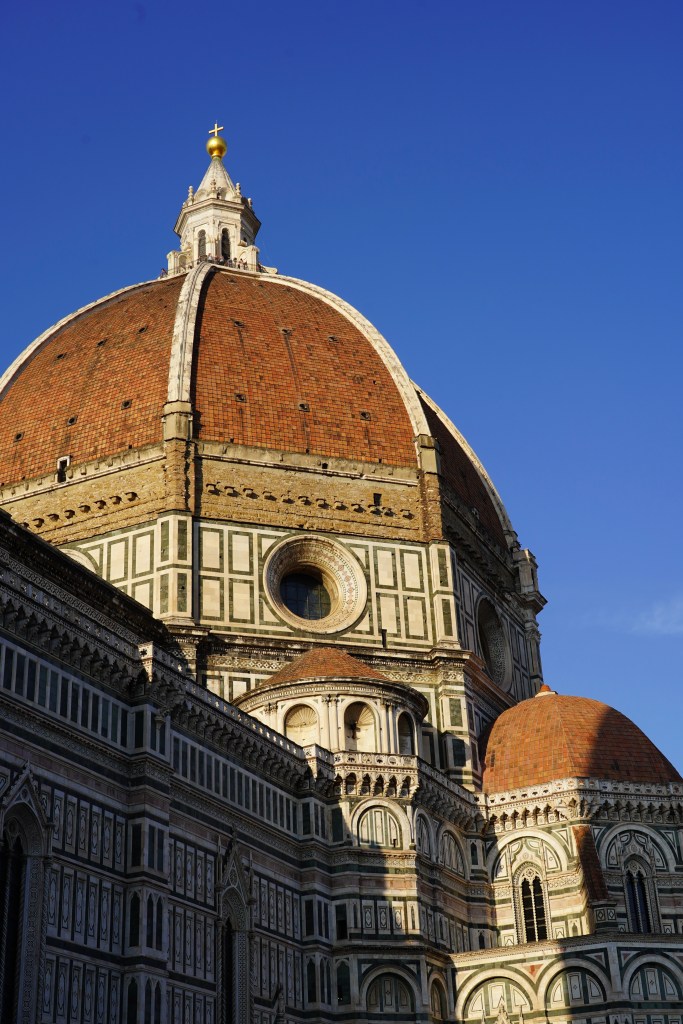
It is your obligation to see the outside of the Duomo from up close and afar. It is one of the most spectacular church exteriors on the planet.
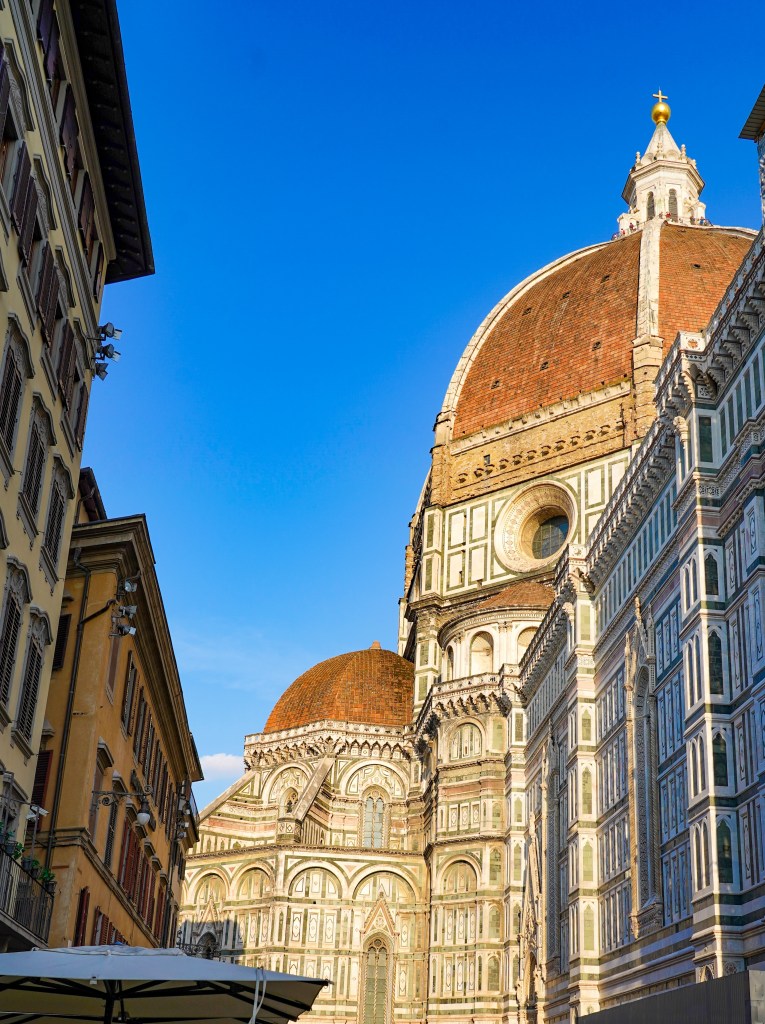
By comparison, the outside of the Palazzo Vecchio just looks like a plain brown brick tower. The tower would have been as charming as the one in Siena except that it is overwhelmed by one of the most architecturally perfect buildings ever created.
The dome is the largest brick dome in the world and was the first dome built without central supports since antiquity. To this day it remains a masterpiece of structural engineering, but its aesthetics are what you will care about, how it sits perfectly in the Tuscan landscape.
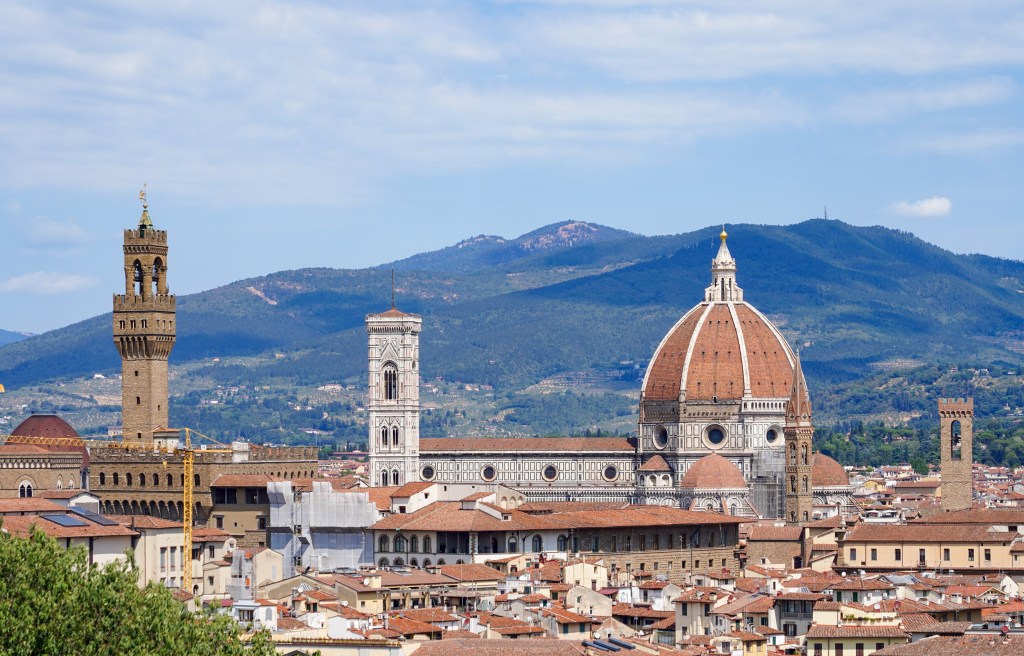
Duomo plus Palazzo Vecchio Tired: the inside of the Duomo. Wired: the inside of the Baptistry (across the plaza)
The INSIDE of the Duomo is one of the plainest, least ornate places you’ll ever see, all the more disappointing not just because of the gorgeous exterior but because you’ll have to wait at least 30 minutes to get in, because it’s free and ticketless. And the line will be blazing hot.
The Baptistry, however, has stunning golden mosaics covering the ceiling, some of which are downright weird and wacky.
You can get a single ticket to the Baptistry and the Duomo Museum for 15 euros and it’s so worth it. And speaking of the Duomo Museum…
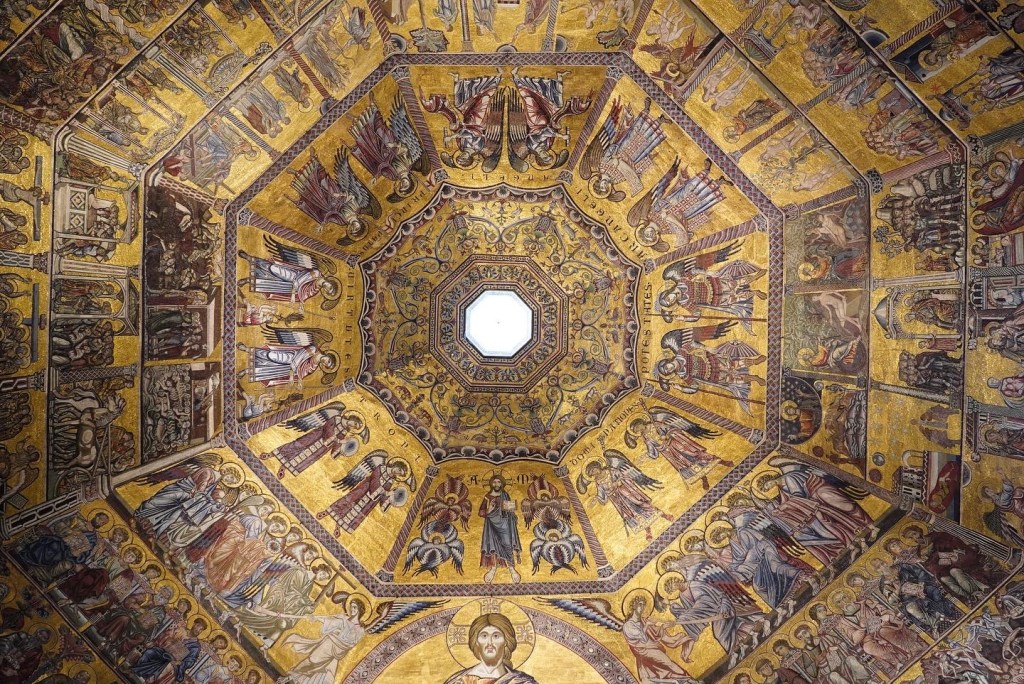
The Baptistry ceiling 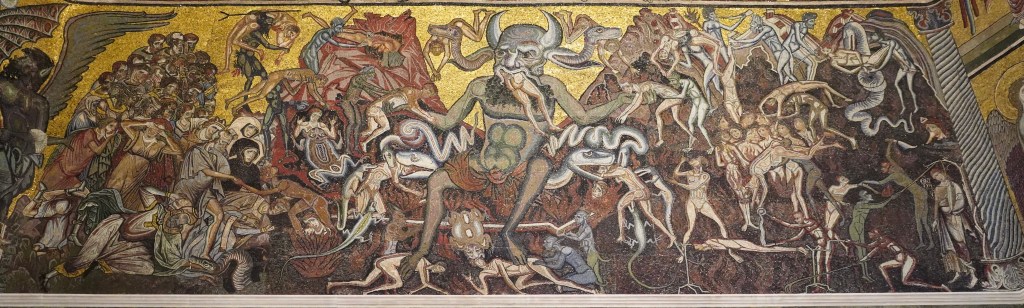
WTF. Zoom in if you can stomach it. Tired: the Uffizi Museum. Wired: the Duomo Museum
The Duomo Museum has the original Ghiberti bronze doors, a Michelangelo pieta, the Baptistry’s silver altar, gorgeous vestments and religious objects, an exhibit on how the dome was constructed, all in a modern setting with clear explanations of the importance of each work.
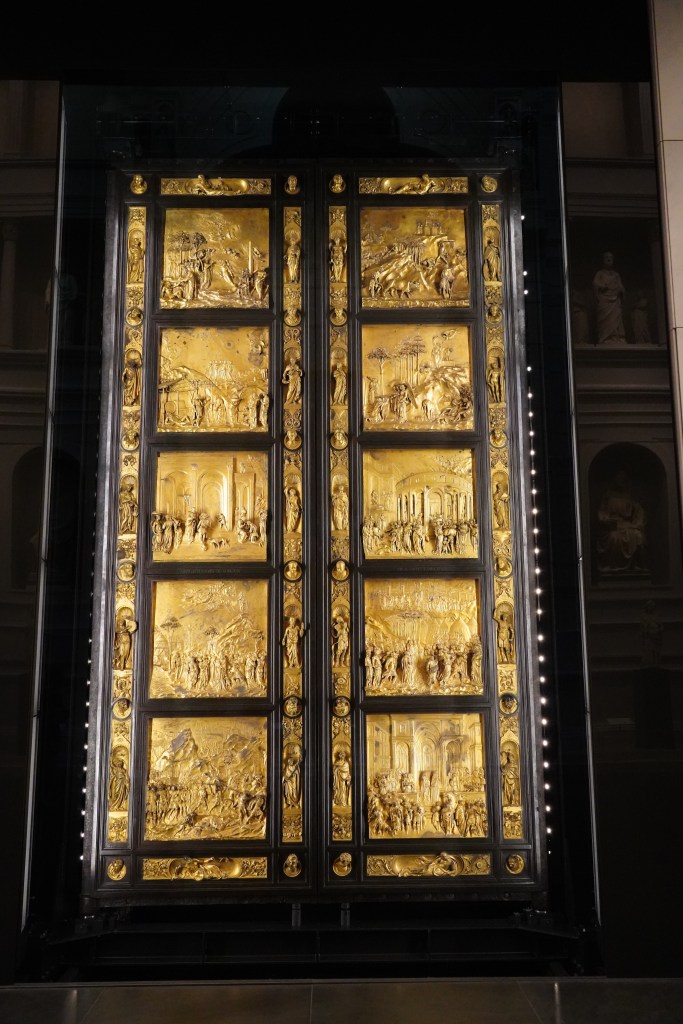
Ghiberti’s doors 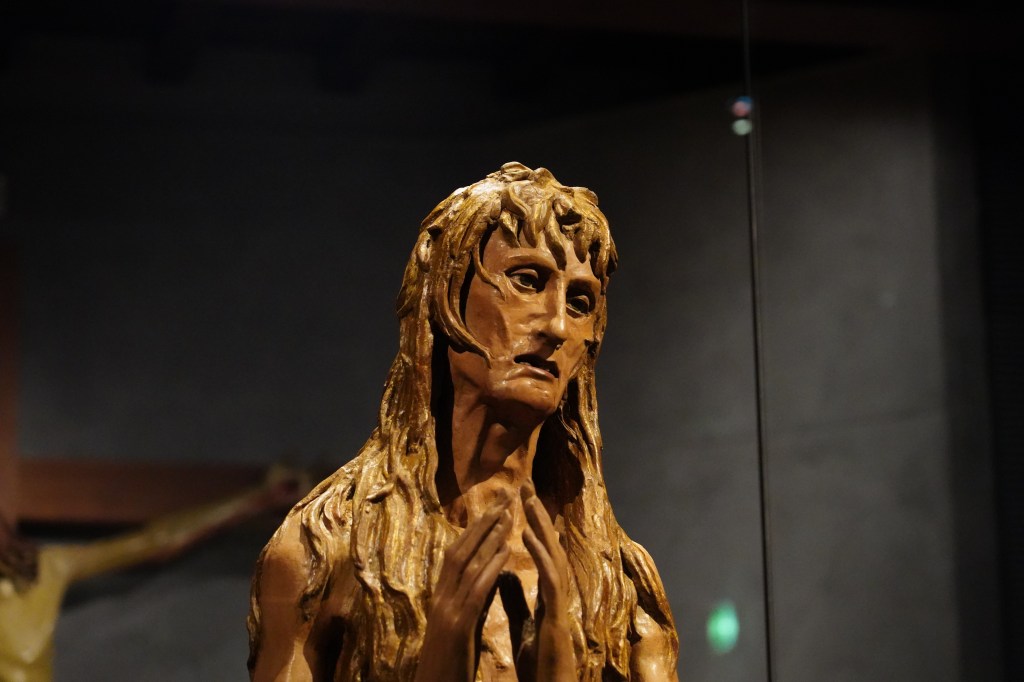
Donatello 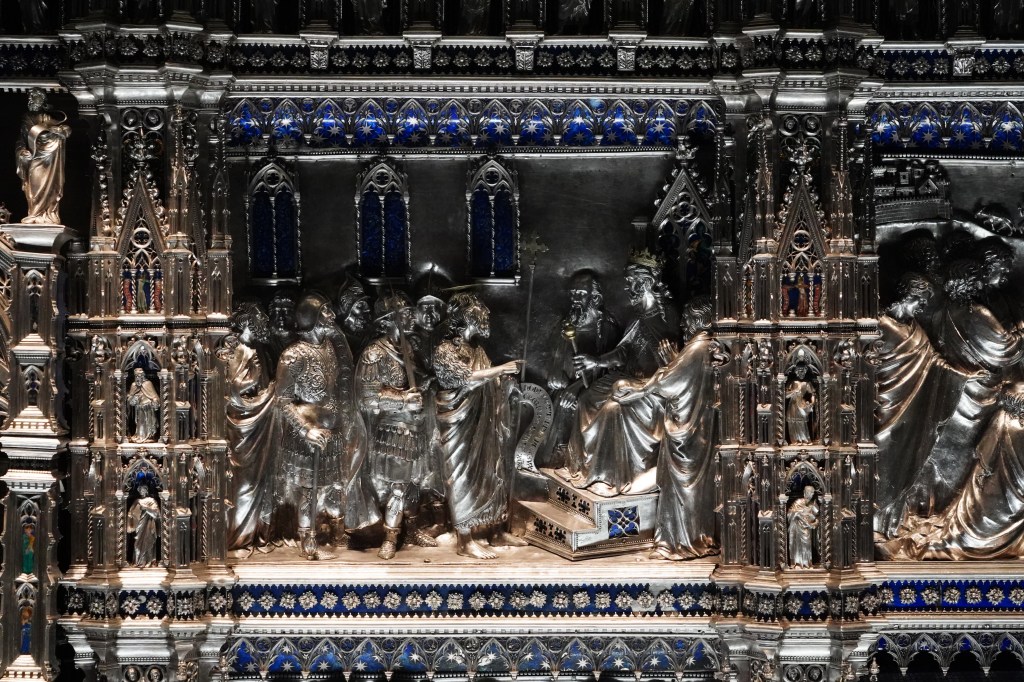
Part of silver altar The Uffizi museum is chock full of spectacular art displayed in the most unimaginably dispiriting way.
If you’re not absolutely determined to see the Botticelli masterpieces (“The Spring” or “The Birth of Venus”), or if there’s not another specific artist or work you want to see, you can (gasp!) skip it. If you’re not into early Renaissance art, here’s my suggested slimmed down version:
- The works by Giotto
- The works by Botticelli
- Gallery 35 and adjacent for the works by Leonardo da Vinci, Michelangelo, and especially Raphael
- The sculpture Laocoon and His Sons, in the hallway outside the cafeteria
- The two Caravaggios (Medusa and Bacchus)
- The Rubens/Rembrandt room
- And that’s enough. You can do that in an hour and see what needs to be seen. Definitely don’t stand in line to see the Tribune, treasures of the Medici family that you can’t get up close to. Most of the best works are on the top floor.
Tired: Boboli Gardens. Wired: Bardini Gardens
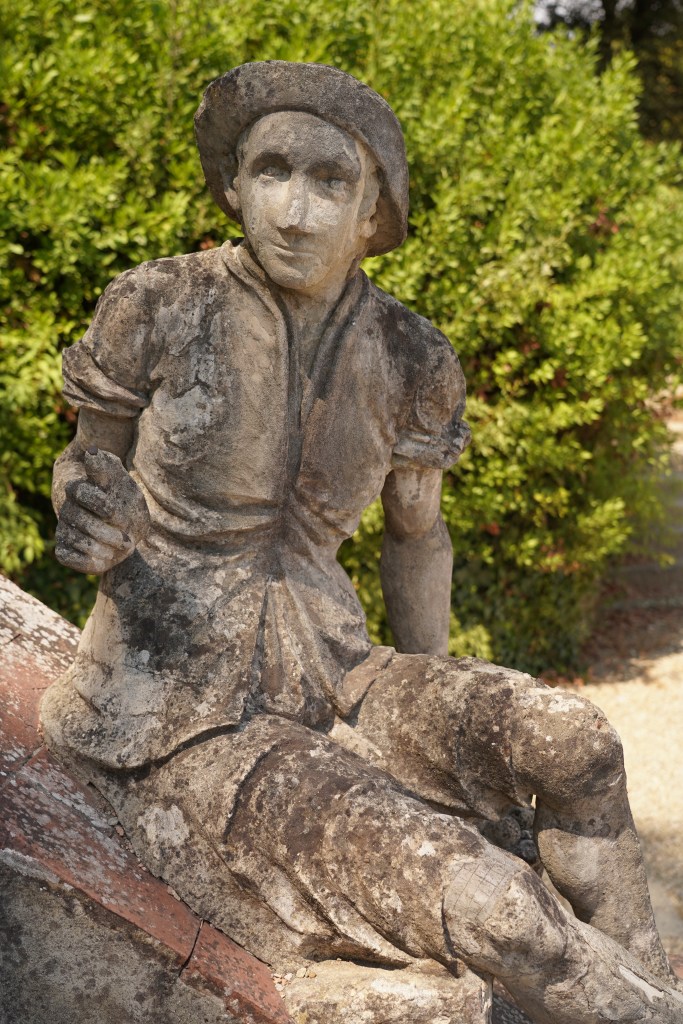
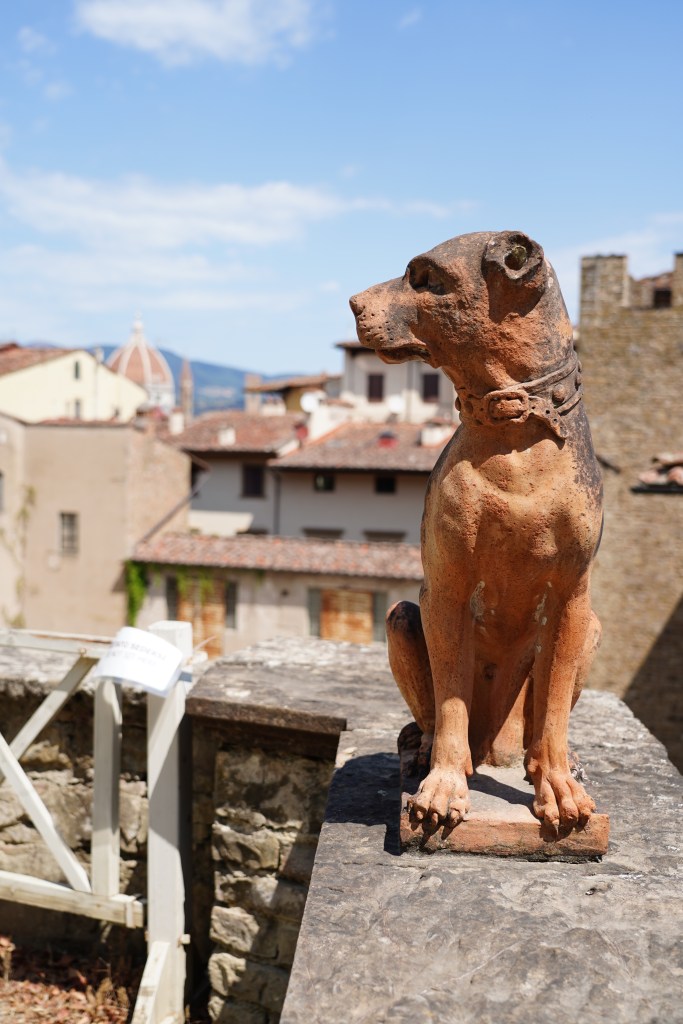
Bardini This may be a summer issue, but the Boboli Gardens are a hilly, sun-scorched, shadeless Tuscan helscape. They’re famous because they’re big. But on a 90 degree day even in the morning, it’s just not approachable. The Bardini Gardens next door are shadier, cooler, more charming, more walkable, and give you the relaxed sensation the Boboli was intended to give. Sometimes smaller is better.
Bardini Tired: just about every statue in this city. Wired: Michelangelo’s David at the Galleria Accademia. And Donatello’s David at the Bargello Museum.
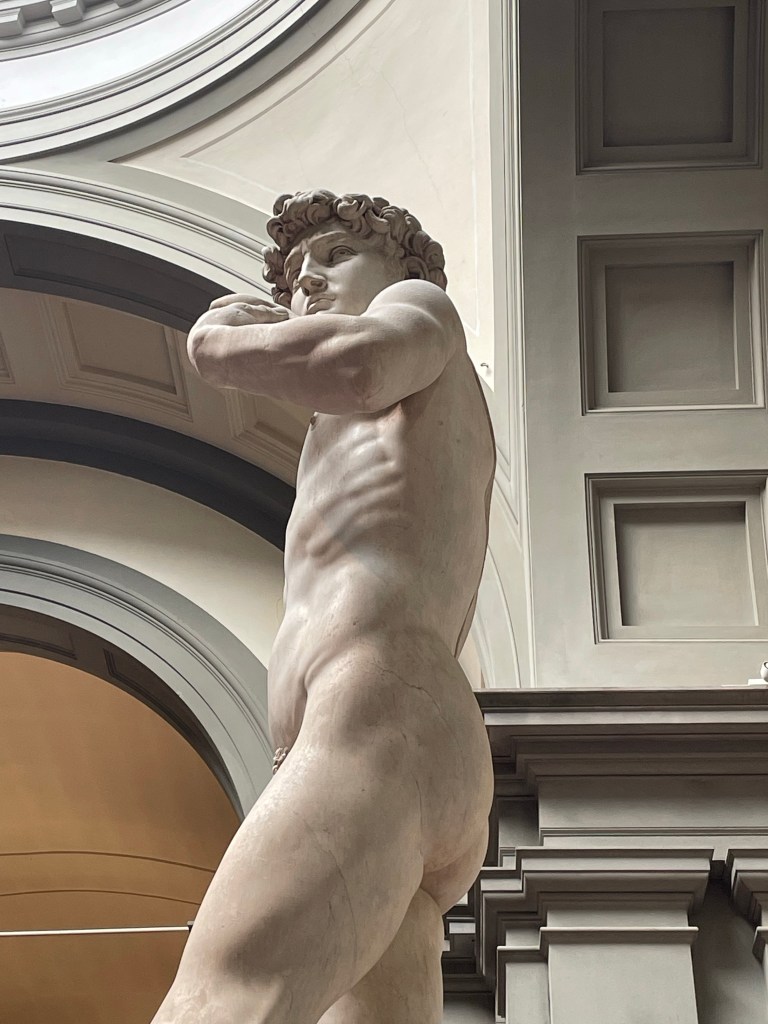
Not so confident from this angle If you have never seen it, the statue of David should be your absolute #1 priority coming here. Unlike other statues of David that show David with the slain Goliath’s head, this one is ambiguous as to whether it is before or after he slays Goliath, but the demeanor suggests it is before. The expressions and pose of David convey a different attitude every few degrees you walk around the statue, ranging from a cocky dude strutting to a vulnerable young man wondering whether he’s done the right thing. He is both man (towering over everyone with a godlike build, disproportionately large hands and feet) and boy (youthful face), almost capturing the moment when a person is both. The ambiguity is the beauty. I’m glad I didn’t bring my camera, because I would have spent all day there trying and failing to capture the experience.
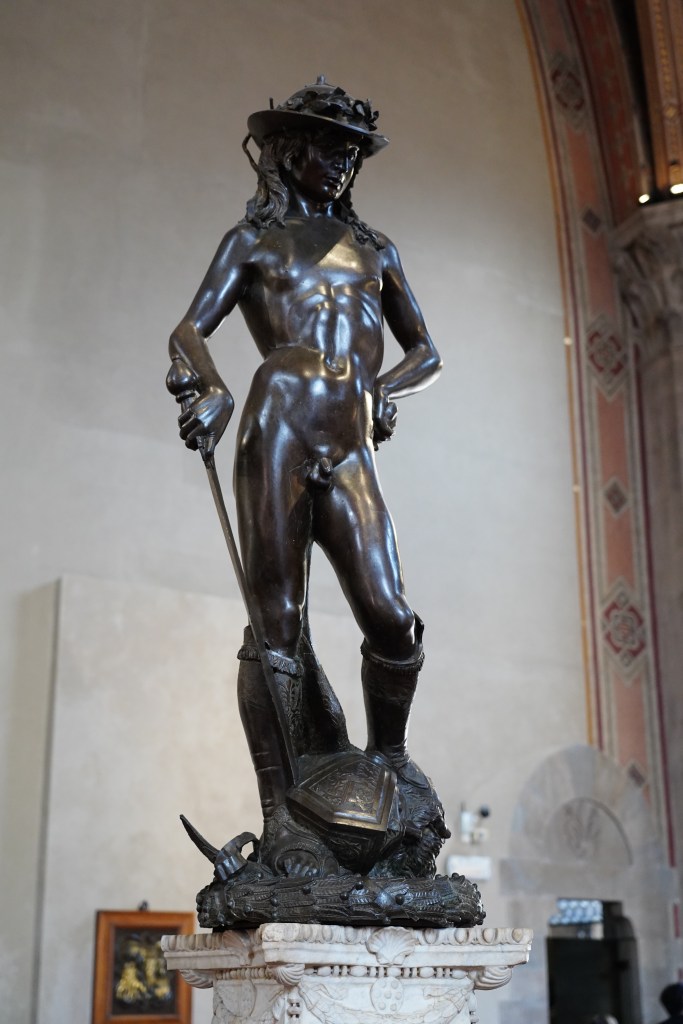
Donatello’s David is worth a look too.
Tired: Central Market. Also tired: Ponte Vecchio
The Central Market is a massive fast food joint. The Ponte Vecchio, a bridge whose stores cantilevered over the water, is a jewelry store. They are crowded and ugly. Take my advice and stay away. Actually the bridge in Bath, England that resembles the Ponte Vecchio is cuter and more quirky looking.
Things I ran out of time and energy for, but feel like I can do these another day or be satisfied if I never do them:
- Climbing the Duomo or Giotto’s Tower. Why would you do this in such intense heat, when you can’t even see the view of the dome and tower at the top? The benefit is that you do get an up close of either the Tower or the Dome, or you may want to see in between the two domes of the Dome, which could be worthwhile to you. The rest of Florence isn’t THAT pretty however.
- The church of Santa Croce
- The basilica of Santa Maria Novella
- Day trips. You can take day trips to
- Bologna (easiest—only 40 minutes away by train),
- Pisa (an hour by train plus a half hour walk to the Leaning Tower),
- or into wine country such as San Gimignano or the Chianti region. Because of the timings of my museum entries, this wasn’t going to be feasible, but as hot as it was and as much as I’d traveled in Milan, I scaled back my ambitions here. I would have gone to San Gimignano but the only way to get there without a car was a 2 hour one-way bus trip, which I was not up for. And I wasn’t going to go wine tasting and drive either.
-
Milan: the best crappy city in the world. Plus dinner theater from Leonardo da Vinci and possibly God
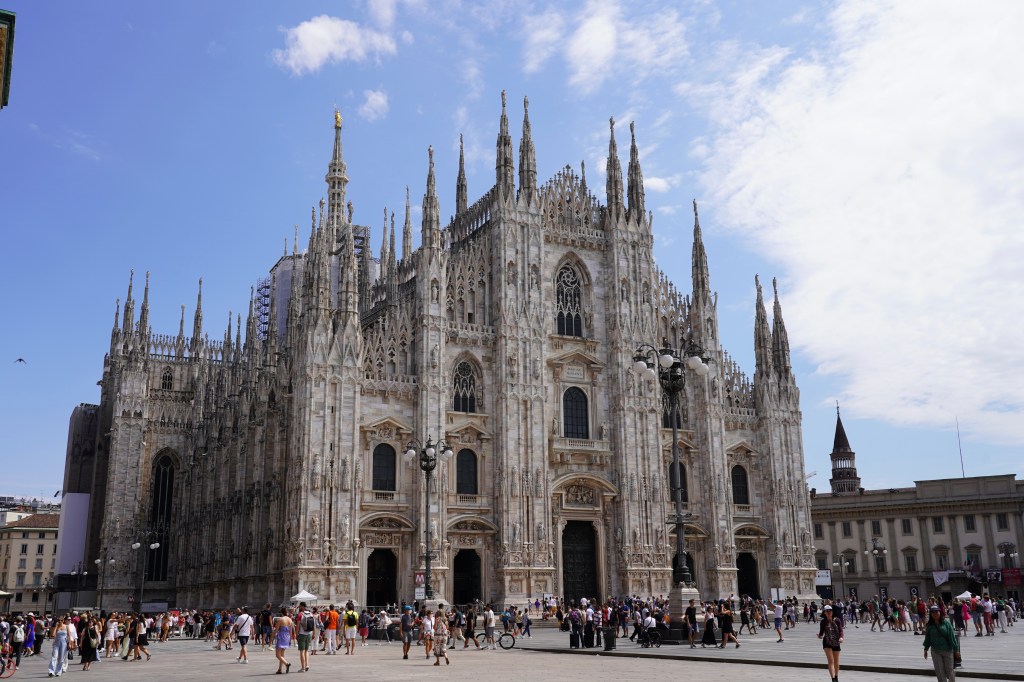
Milan Cathedral (Duomo) San Francisco and Milan, while very different other than that they are in close proximity to spectacular mountain lakes, are vying for similar titles. One is the worst great city in the world, and one is the best crappy city in the world. Since another author I read a long time ago crowned SF the former, I’ll explain how Milan wins the latter.
Milan is a hub of business and fashion. But if you don’t have the money to spend at Dior or Fendi or even Tod’s, it is an ugly city to visit even by American standards. Philadelphia has more charm. Cincinnati has more charm.
Architecturally, it reminds me of Houston or Dallas in the sense that the most striking architecture is grotesque in its brutality. Brutesque, if you will. And before my Texan friends protest my dig on their architecture, some of which is legitimately outstanding, drive on a freeway in downtown Dallas or Houston at rush hour and you’ll understand what I mean.
At least Houston has many redeeming qualities. But I digress. Milan. Let’s start with the Duomo.
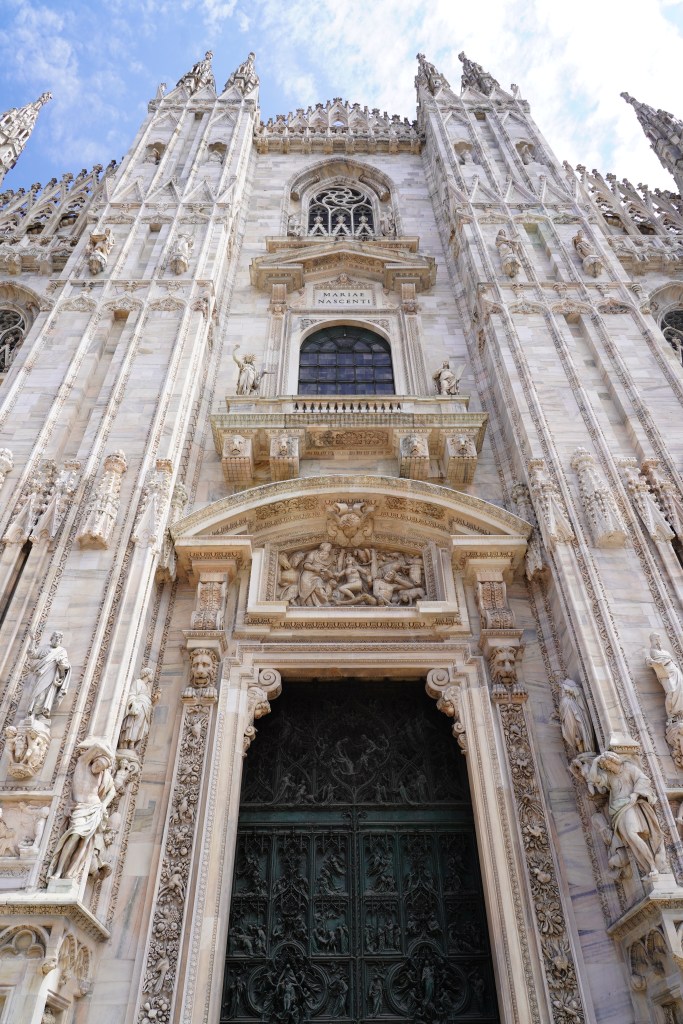
I will say the exterior does have a beauty to it—the marble gleams and the bronze doors capture your attention when you look closely.

In the shadowless plaza beneath, you feel twice burned by the sun and the travertine.

All shall look upon me and despair But there’s a reason you don’t see pictures of the Duomo’s interior. You walk in, and your first impression is immensity and grayness. The cathedral is taller and longer than you expect from the outside, and the pillars holding it up are girthy. The stained glass windows are small relative to the size of the building. You do not come to this building to commune with God. You come here to be cowed by God and to be intimidated by Milan. Can you imagine a bishop or even a priest saying Mass in such a place, how the immense stone would crush any sense of wonder and awe at the divine and any sense of connection with the parishioners? And yet, it does feel kind of awesome to be in such an inhuman space, imagining yourself as an emperor being crowned to lord over all the known realms of the world, as though a primal scream of power is coursing through you. St. Peter’s to me conveys a sense of rigidity and formality that is stifling, but it is so vast and has so many beautiful treasures that one can still reach to the heavens and rejoice. It does not convey immensity in the same oppressive way as the Duomo in Milan.
Milan’s other great sights underwhelm.
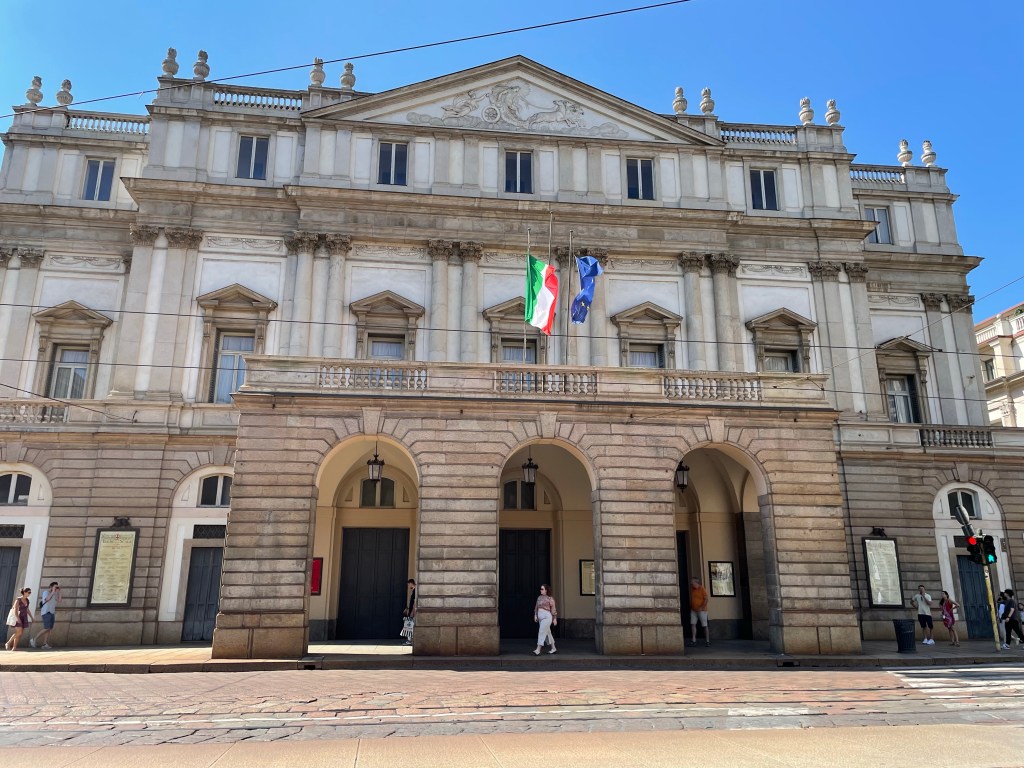
Teatro alla Scala, the world’s greatest opera house, is from the outside the ugliest theater I’ve ever seen. And that includes the cube that was my high school theater.
Milan’s prettiest building is a mall. A MALL.

The mall Its liveliest area, Navigli, conveys the San Antonio river walk without the greenery or charm. And the people there ironically are the least fashionably dressed in all of Europe. It’s shorts and t-shirts just like back home. My travel planner told me I should go there at night and take photos. But there was nothing I wanted to remember visually.
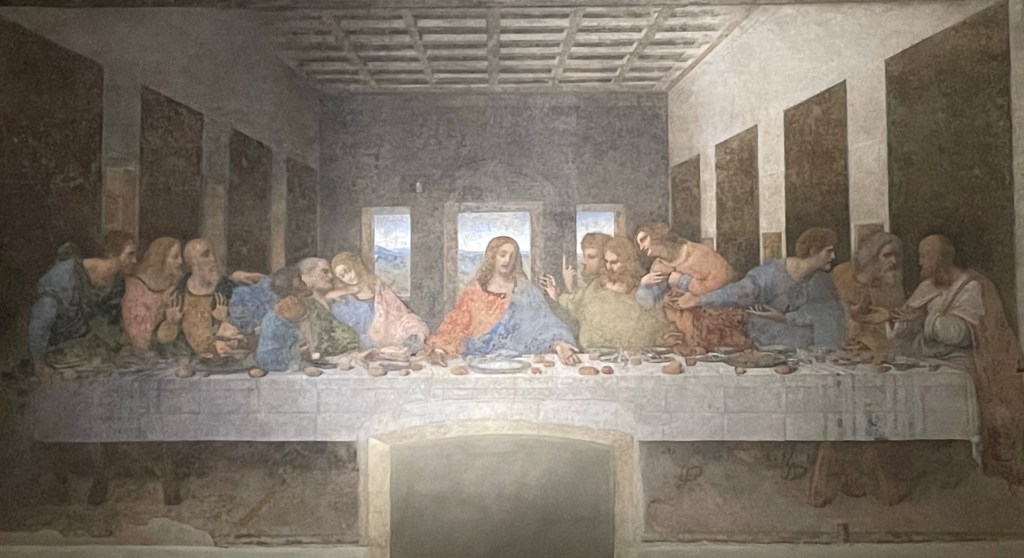
Milan’s beauty is hidden, and even then ugliness can’t help but seep through. Milan’s most famous work of art is the Cenacolo Vinciano. You know it as the Last Supper. Did you know it was in Milan? Until I got here, I didn’t.
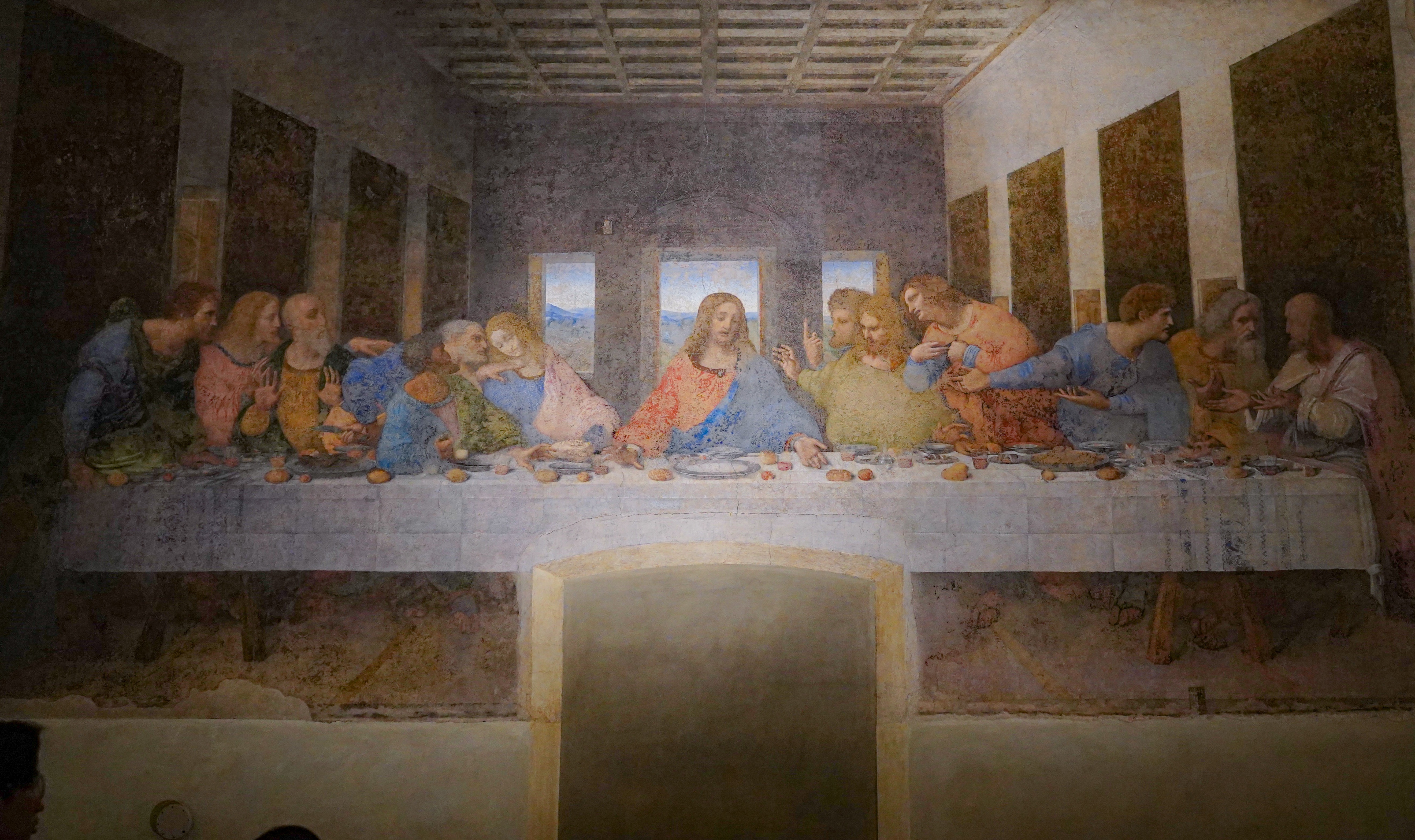
The real thing is more pale and ghostly, but for you to see the whole thing I had to play on Lightroom a bit. Leonardo da Vinci moved to Milan to escape what he felt were stifling artistic norms in Florence in the late 15th century. As the uber-Renaissance man, he took a job to re-engineer the Milan canal system to ensure consistent water flow without flooding, and according to the tour guide, fixed the previously unsolvable problems in a matter of weeks. He was granted lifetime residency in Milan by the ruling duke as a result, and stayed there for 20 years.
- An aside about tourism in Italy. Why was I on a tour of the Last Supper instead of just buying a ticket? Ah. You see, sites such as the Cenacolo Vinciano sell a limited number of tickets to the general public which sell out months in advance. But you can still get tickets through tour groups. And frankly, virtually everyone in there was with a tour group. So instead of paying $16, I paid $77 and got access as part of a 3 hour Milan walking tour, which I left after 90 minutes. It’s an officially sanctioned tourist scam to milk more money out of you. Even worse was the way I got legally scammed on the train from the airport. You buy a ticket but they don’t make it clear that you have to validate it, and when the conductor sees you haven’t validated your ticket, he charges you an extra 8 euro fine. It’s just a tourist tax. You’re damn right I paid him in cash so he’d have to fish for change. But you realize that all these scams are just part of the culture here and you’re kind of OK with it because Italy is so exceptional. And since I got forced paying $77 for the tour, you’re going to hear about what I learned. Now. Back to getting my money’s worth.
While he was there, he painted the Last Supper. The Last Supper is, I kid you not, a cafeteria mural. Actually, it was painted directly on the wall of a dining room of a monastery. It was meant to convey Jesus and his disciples as diners seated at the table next to the monks. Instead of depicting Jesus and his disciples as static figures, he made the novel decision to paint them as living human beings with emotion. This was a radical departure from the norm in the 1400s, part of why I suppose he left Florence so he could break the rules.
Leonardo chose a novel way of painting on the wall. Instead of using fresco technique, where paint is quickly applied to a wet wall, Leonardo wanted to take his time and use a technique that allowed him to work more slowly. He innovated an experimental technique where he mixed oil and tempera paints and painted them on a dry wall. This allowed him to paint the extraordinary figures that he did.
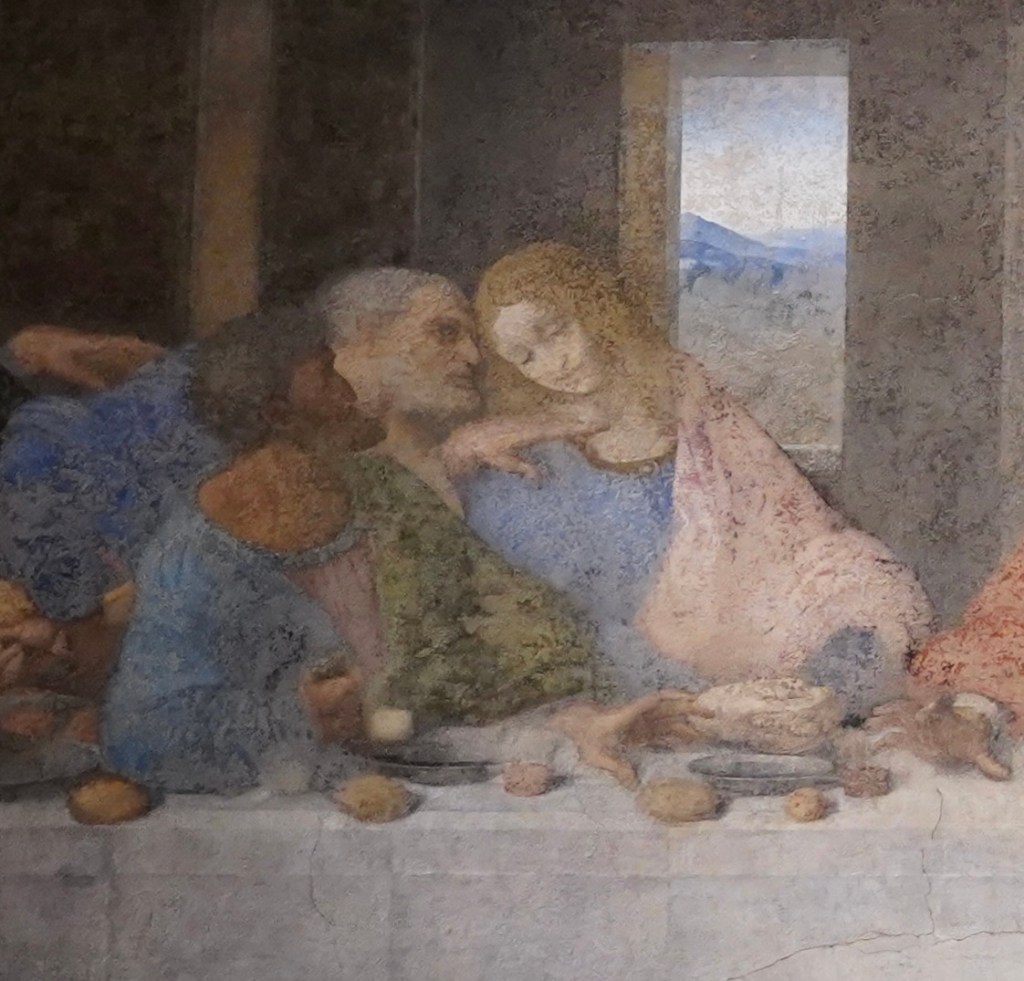
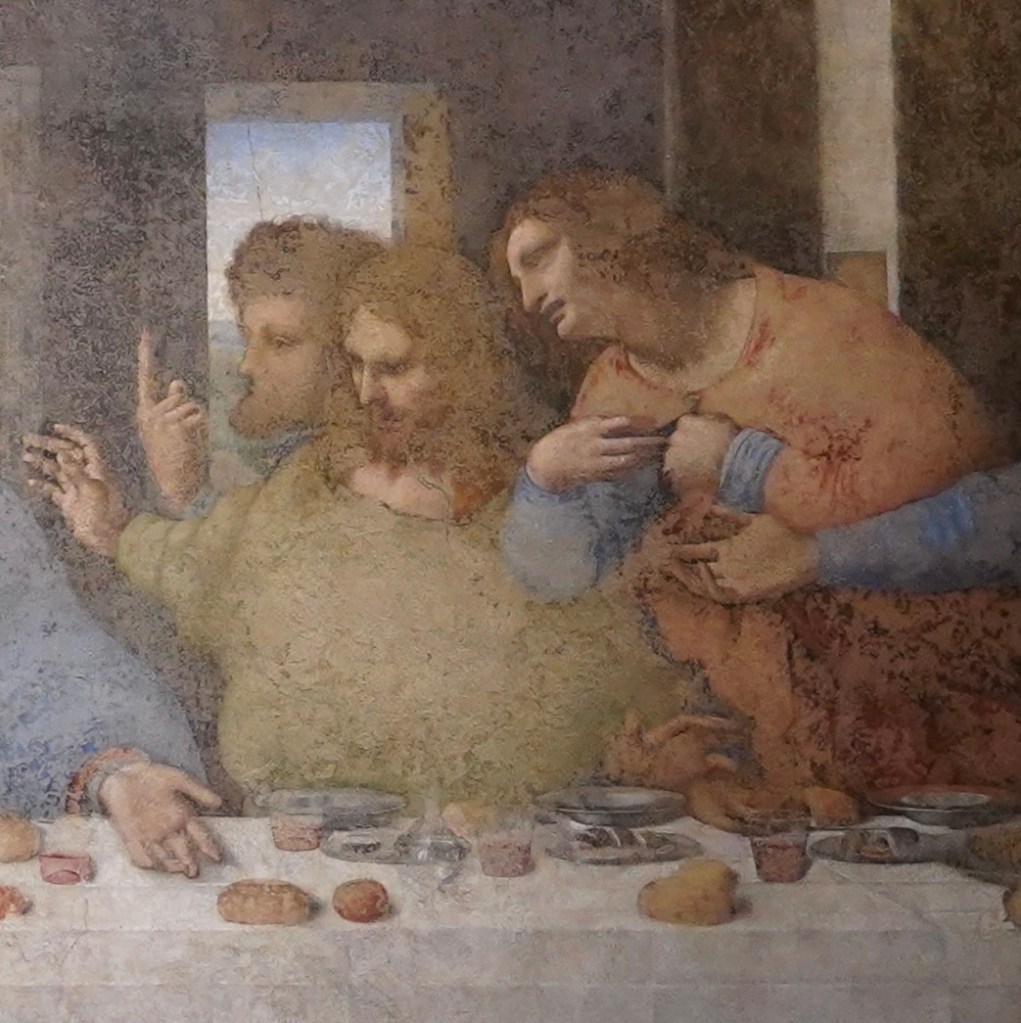
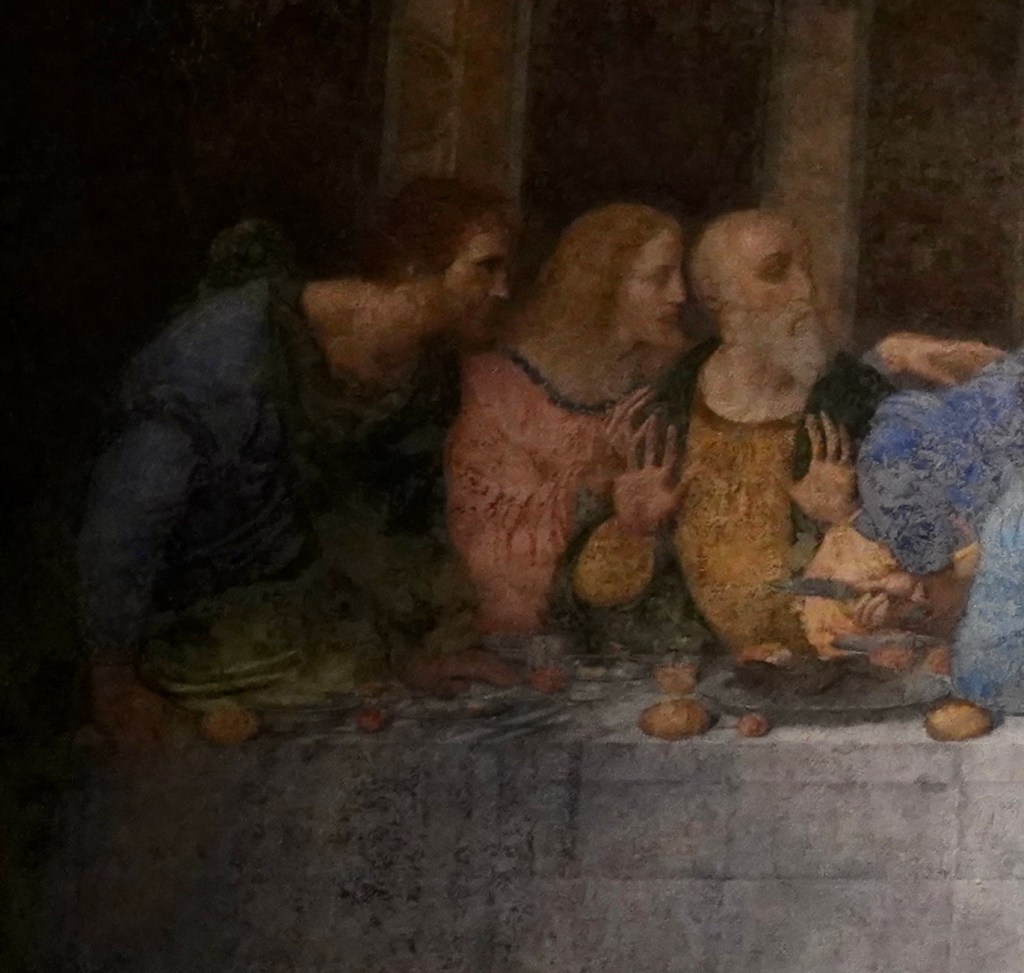
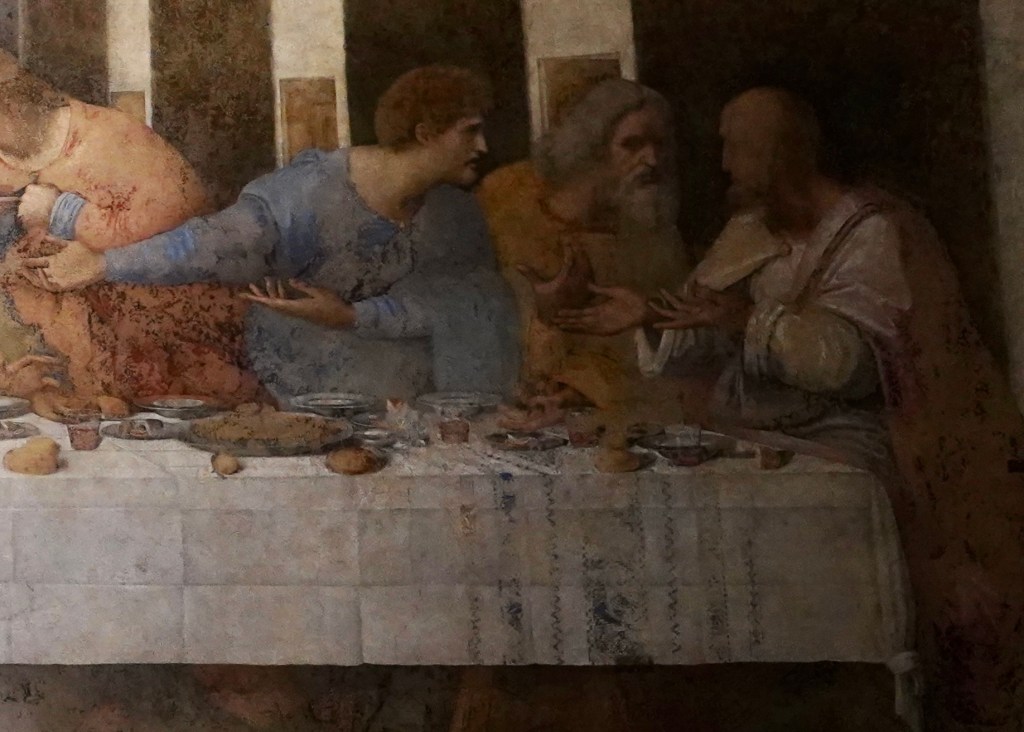
Sadly, this technique did not result in paint sticking to the walls for the long term, and paint began flaking off the walls within a few years. The Last Supper deteriorated over the years, not to mention was nearly destroyed by Allied bombing in World War II—the adjacent building was. Oops 🇺🇸

The painting was closed for restoration for over 20 years until it was reopened in 1999. I had no idea that for so much of my life, this work was completely inaccessible to the public. The photographs you see are generally oversaturated and brightened to make the figures more vivid. In truth, the work is pale, dim, and crumbling, and yet still conveys the beauty of Leonardo’s ability to capture the humanity of the disciples.
- Another aside: this is where a real camera is needed. All the images above were from the same single photo. This is the best my iPhone could do. It gets the light balance right but the expressiveness is totally lost.
And that’s the thing about Milan. It’s human. It’s a real, living, organic city. It’s not a museum like Venice, and it’s not stiff like Copenhagen. It’s the kind of place that someone will jump over your back trying to force their way into closing subway doors. (That happened. The kid was wearing an SF Giants cap.) It’s messy, but it has a pulse. And as a result, you’re able to meet people that just want to hang out and have a good time. So I did, meeting locals and tourists along the way.
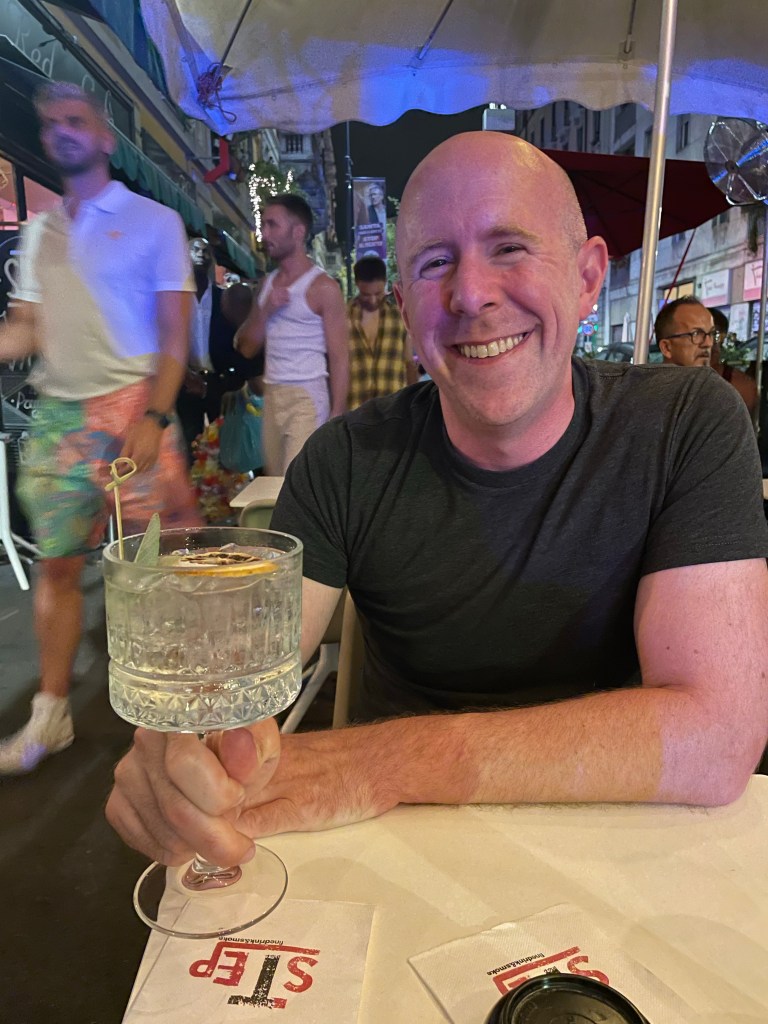
This happened I don’t know what this drink was. The details are hazy. But while I was drinking it there was a fistfight outside the bar. The cops showed up and broke it up, and then they stayed and smoked and hung out, their cars blocking the road for half an hour while the bars were packed.
Thanks Milan for a really good couple of days. Yeah you’re a mess, but you’re as good of a crappy place as I’ve ever been.
Oh yeah, I mentioned dinner theater from God too. Well, one night I went to Lake Maggiore for dinner to meet some American friends, and we got caught in a hailstorm. If it wasn’t for some dude named Fabio, I would have missed my train back to Milan.
-
Denmark, Sweden, and Louisiana
Copenhagen marked a turning point in my trip from the mostly outdoor and small city travels to more urban adventures. It also marks a turning point in my thinking about places—from “is this place fun” to “is this a place I someday might want to live?” The question of whether to become an expat, to go on a more permanent adventure, has been rolling around in my head for a while.
I flew to Copenhagen because it was one of the easiest places to get to from Ljubljana without wasting a day. I took a two hour van ride to Zagreb (after a stellar Michelin starred meal at Atelje) late at night, stayed in the Croatian equivalent of a Motel 6 near the airport, and flew out early the next morning.
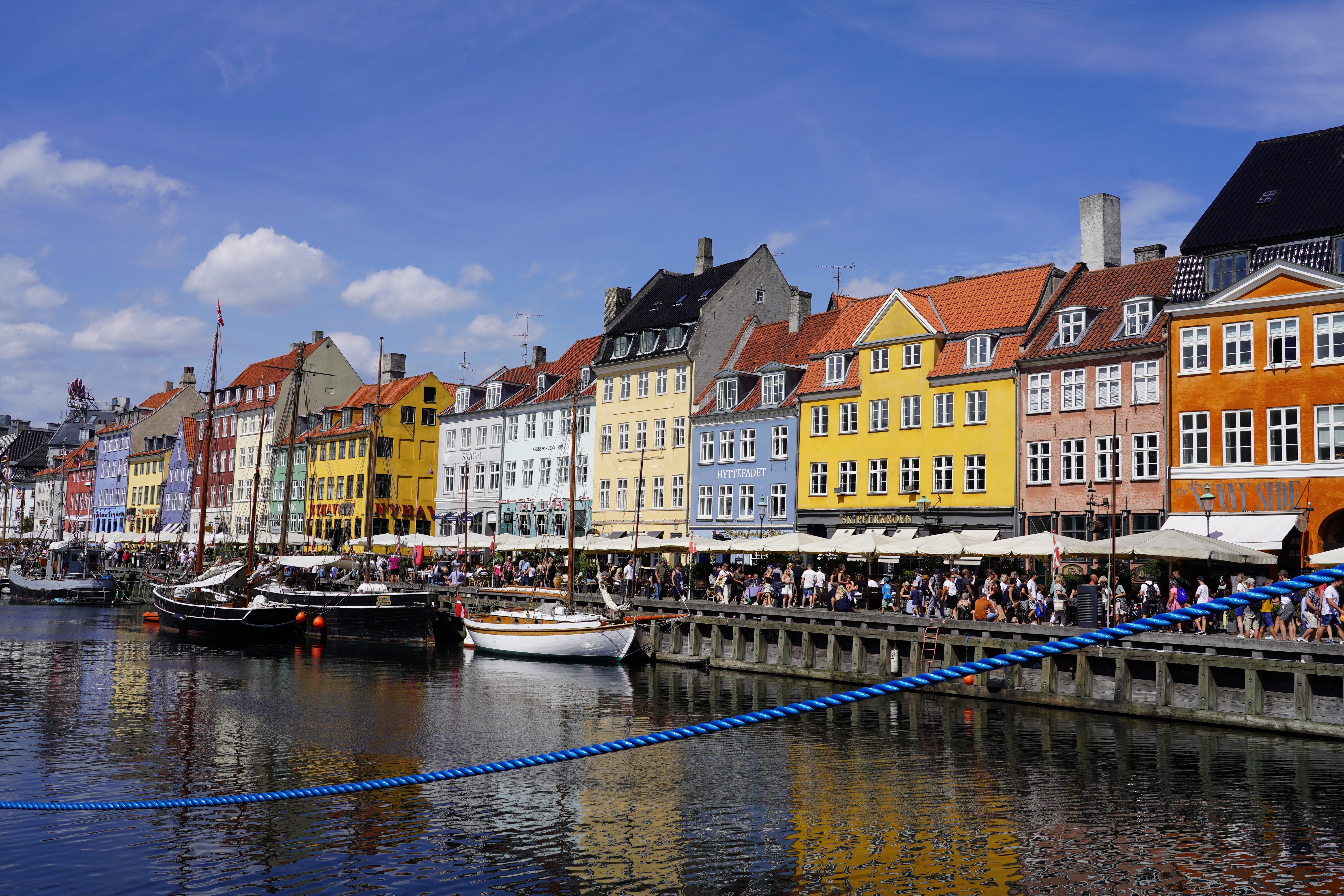
The weather was gorgeous. My pictures in Nyhavn with my new camera did not disappoint.

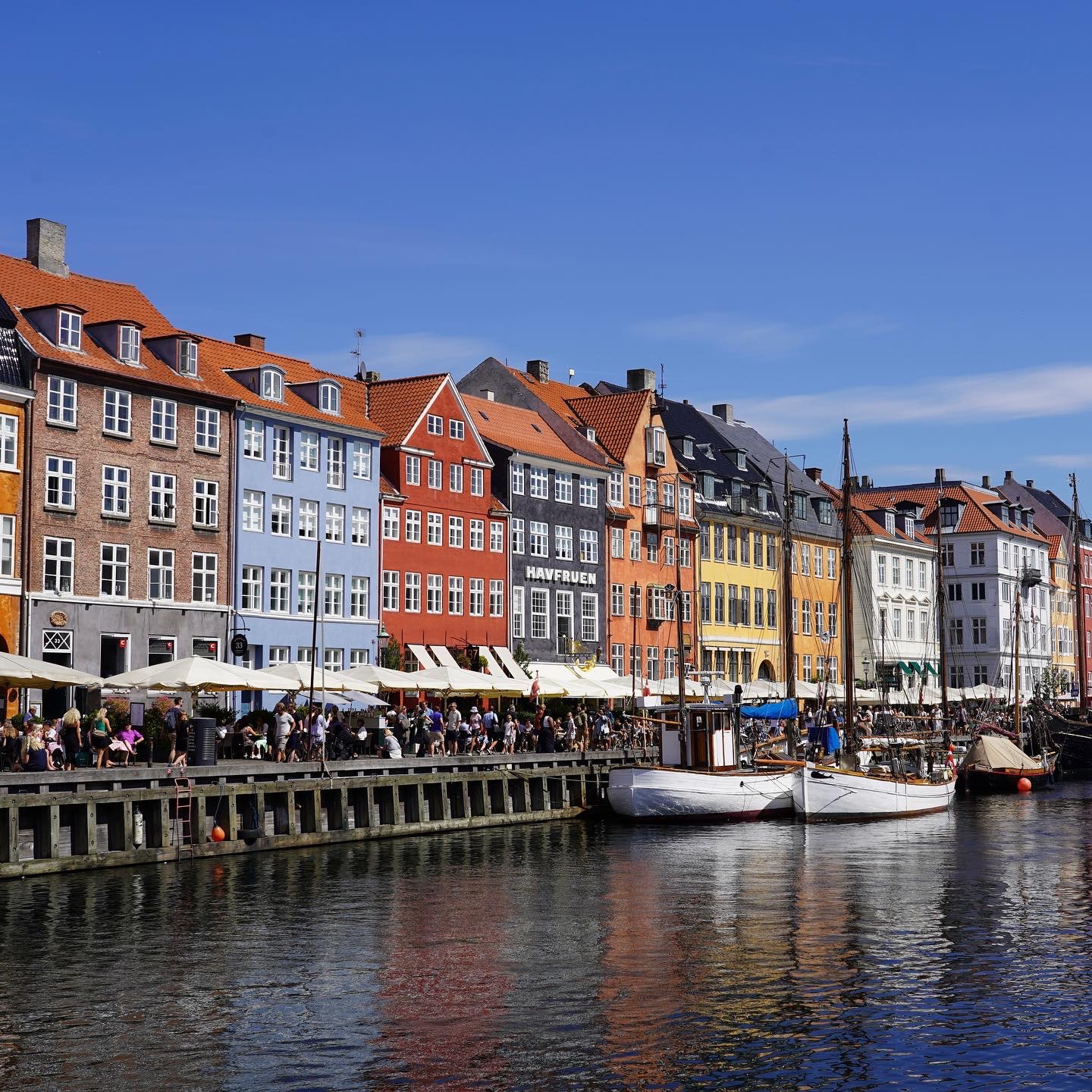
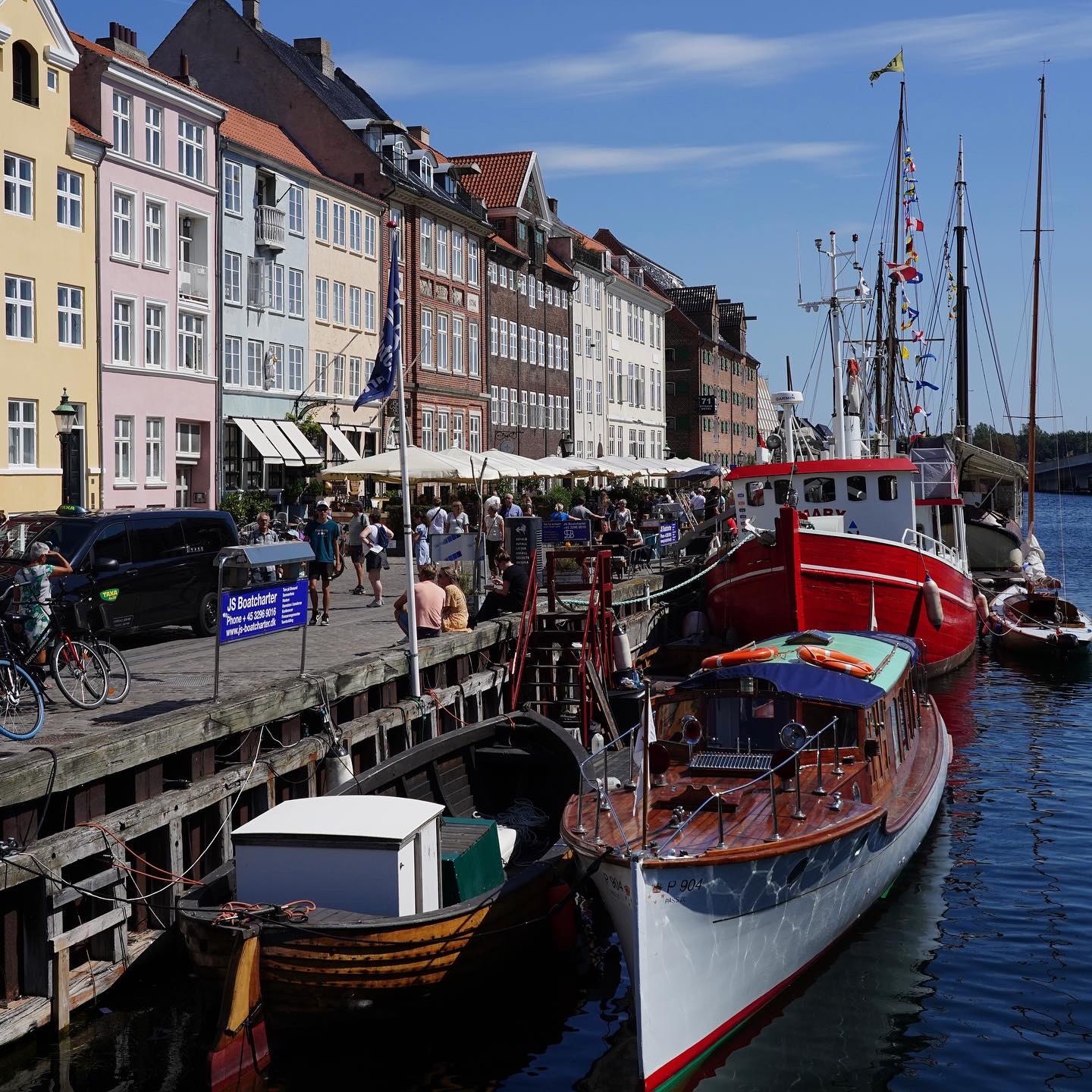
The food ranged in quality from very good to outstanding. I ate three multicourse meals and got the consistent high quality food I’ve been wanting all trip and finally got it. Everything on my plate had some tiny flower or herb that was locally grown or foraged. And by foraged, I mean possibly pilfered from the chef’s neighbor.
I added a second country to my itinerary by delaying my next flight by a few hours and taking the 30 minute train ride to Sweden! I walked through the old towns of Malmö and Lund.
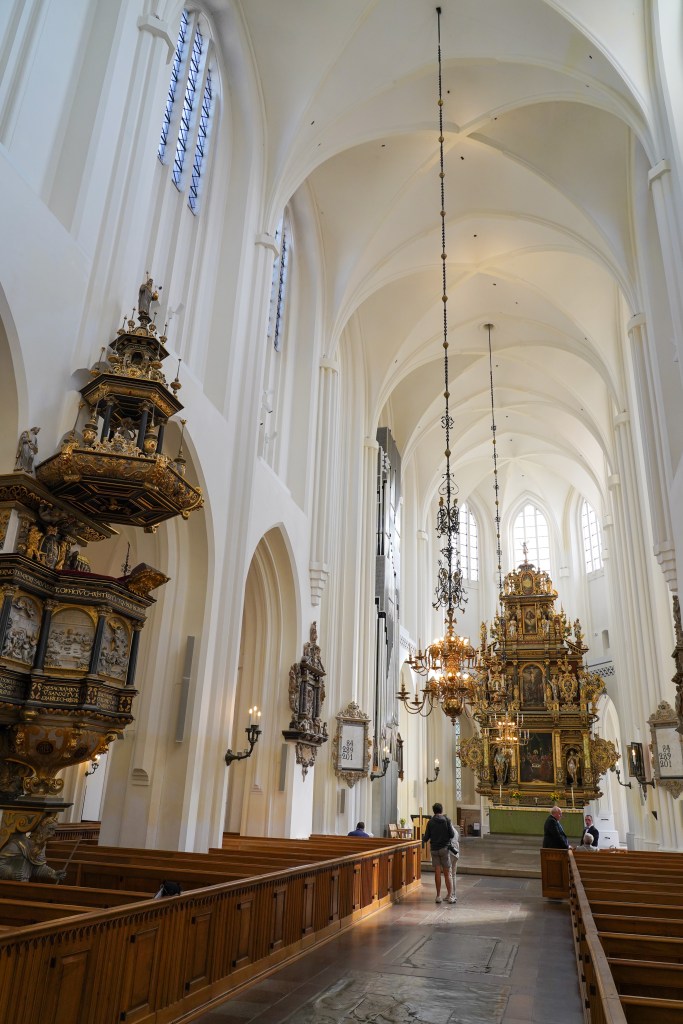
St Aragorn’s Cathedral in Minas Tirith, Gondor. Ok actually St Petri Cathedral, Malmö, Sweden. An organ rehearsal broke out. I did not expect to hear this song. Lund in particular has a museum town where they have transported old churches and houses of different vintages (17th-19th centuries) from the countryside to a museum village in town.
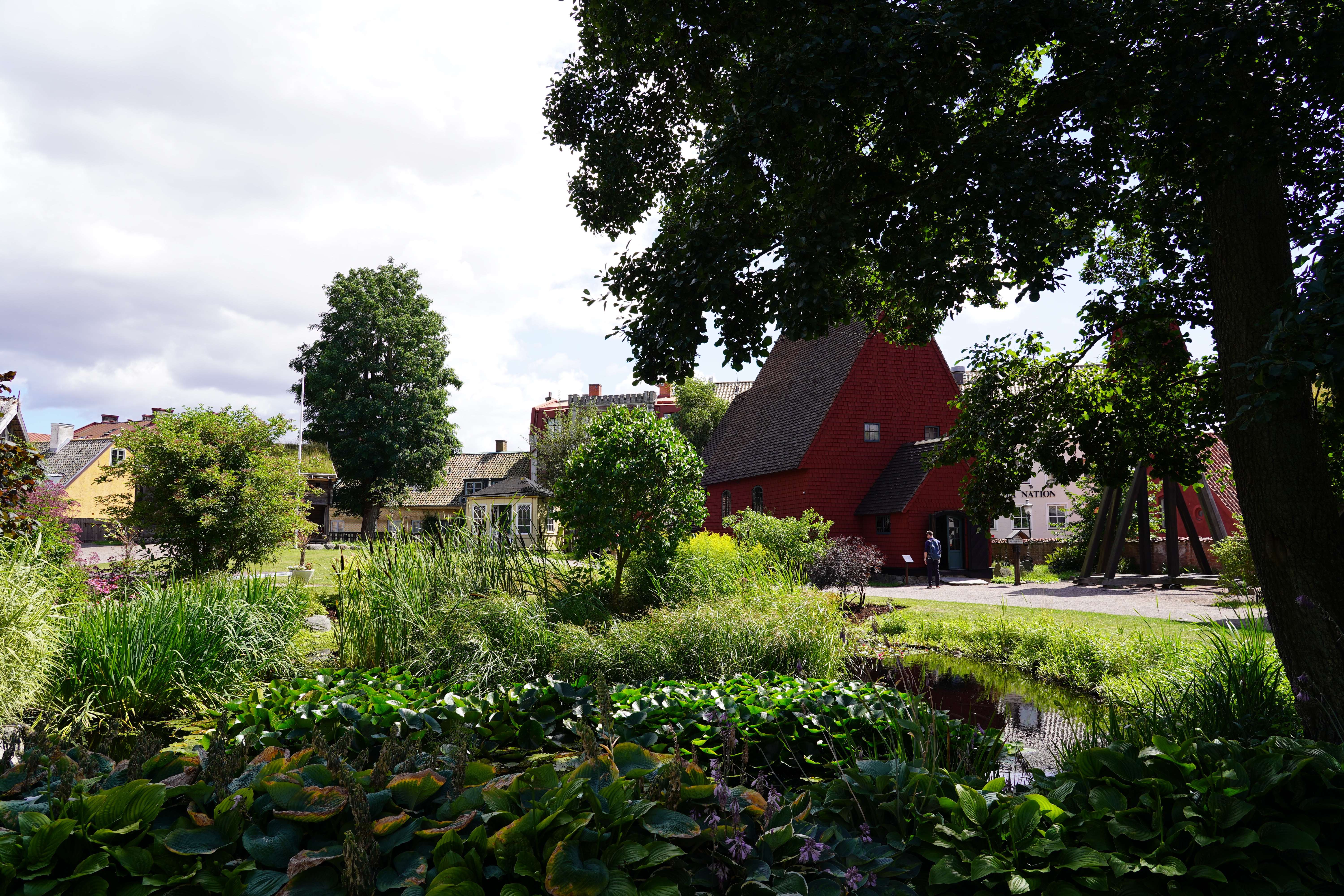
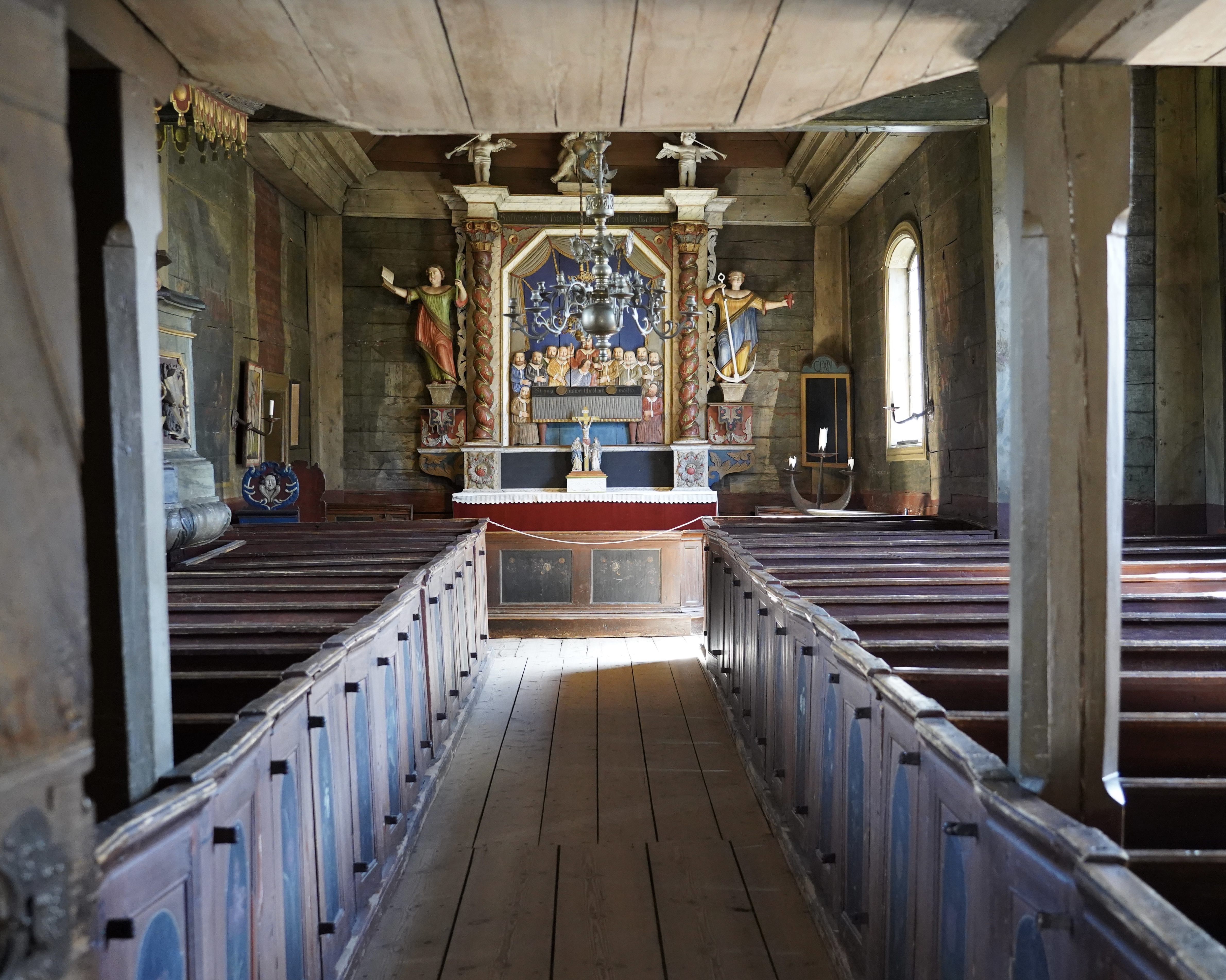
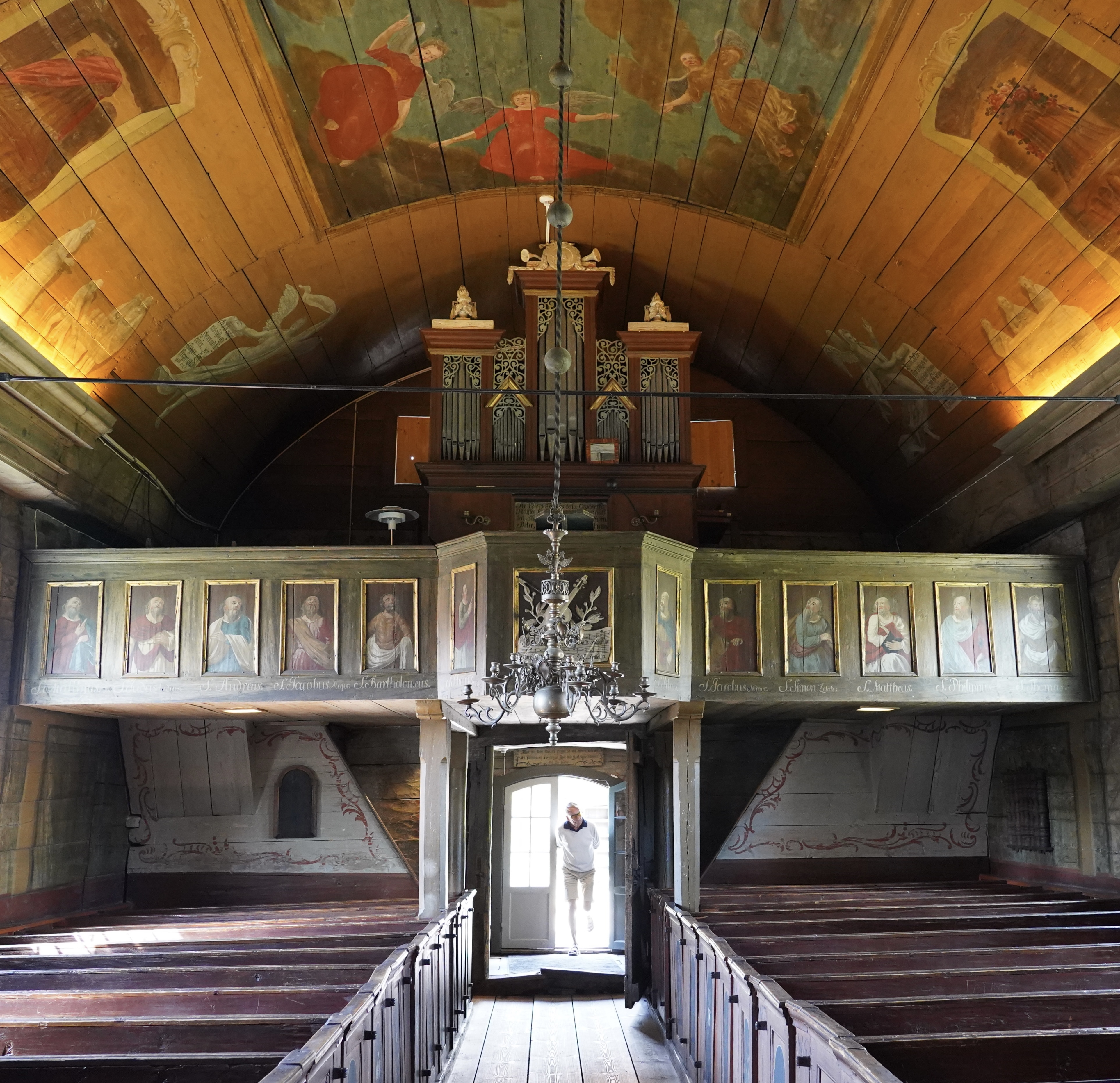
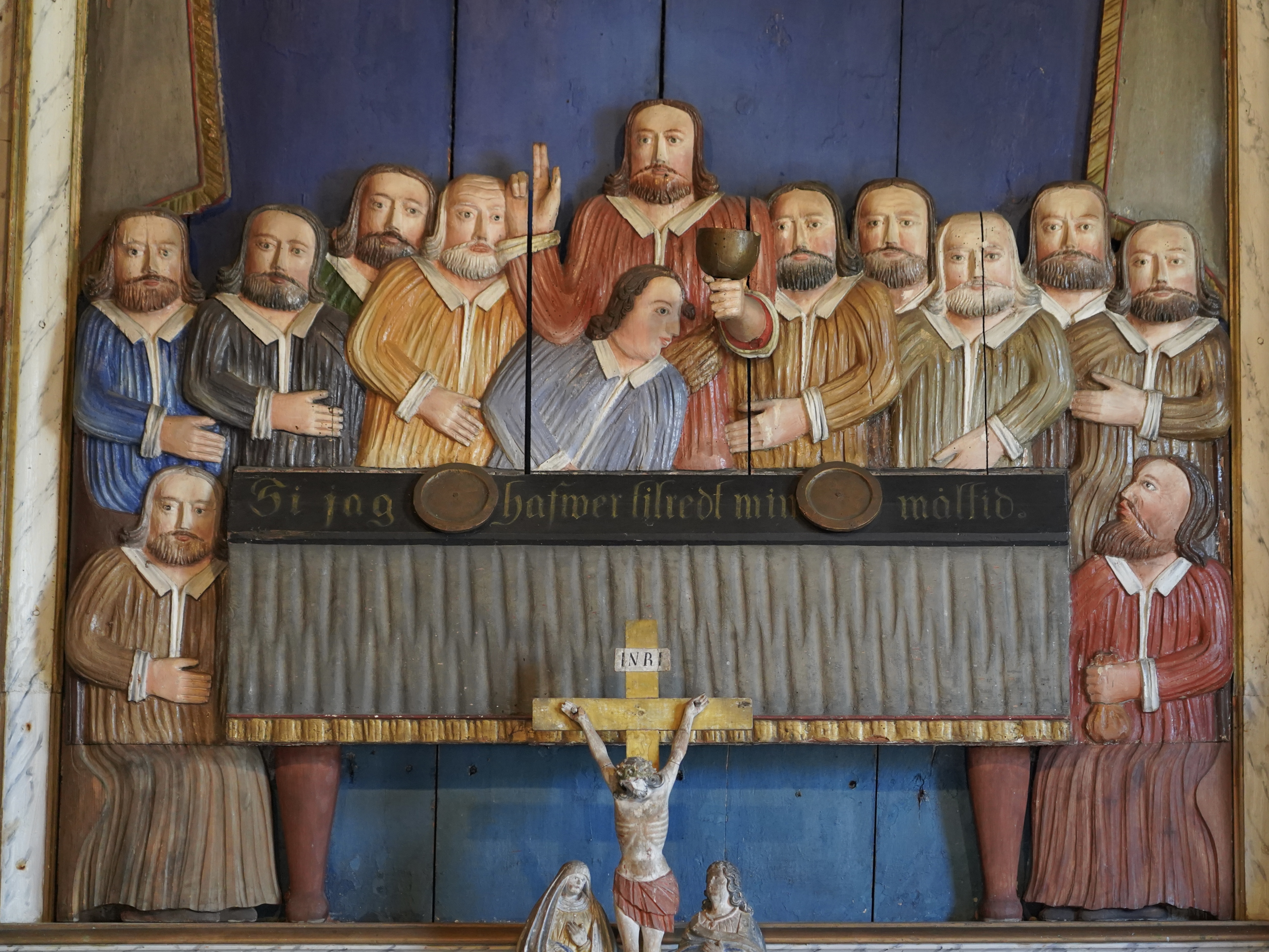
17th century church in Lund. I like small organs too. I don’t have a lot of stories to tell about Copenhagen to be honest. It was mostly sightseeing. I didn’t really meet anyone while I was there—in fact I’ve never felt so ignored on apps for, um, ah, making social connections as I have in Copenhagen. The weather was warm but I felt a certain chill from people there. At one point while riding a train in a quiet section, two people were having a quiet conversation, and a local woman sharply pointed out to them, “Quiet! Too loud!” There’s a certain social conformity you have to have in the Nordic countries, and you will feel the sting of personal coldness if you don’t fit in. But even colder, I suppose, is the lack of sense of welcoming I had there relative to other places on my journeys. Guess my Southern sense of sociability, not to mention a boisterous side that needs to be let out once in a while, doesn’t fit everywhere.

And yet Tivoli Gardens somehow conforms with Danish social norms
OK I do have one story though. More story than pictures, but go to the Louisiana Museum website for a more visual experience.
While there I took a train ride north to see contemporary art at the Louisiana Museum, one a friend with a PhD in art history from Cambridge told me to see and called “the best museum in the world.” The art wasn’t just objectively outstanding, it was as though I found artists who were speaking to ME. I’ve been moved by art before. Seeing Monet for the first time years ago and “getting it”—seeing that the impressionists created a reality that seemed more real than more traditionally authentic representations of reality—was a revelation, but it wasn’t personal. Seeing American Gothic or Sunday at La Grande Jatte at the Art Institute of Chicago transports me into new worlds, but it doesn’t tell me anything about myself or my hopes or my dreams. This was different.
The first artist, Dorothy Iannone, is an American who has lived in Berlin since the 1960s and whose art is largely autobiographical. Her primary focus is expressing the joys of ecstatic union with a partner. The art is, um, VERY expressive, so I will merely save my thoughts on her art for my personal journal.
Walking into Alex Da Corte’s exhibit, however, I knew I was walking into a headspace that was psychologically close to mine in terms of life experience and cultural references. In fact I knew immediately the artist was my age, or very close to it. (He’s two years younger.) It was as though I’d walked into an artist’s reimagining of 1987, lived as a school age child but reinterpreted as an adult with adult themes. The whole exhibit had pink walls and loads of neon and lit signs. For instance, one piece was an upside down sign from a convenience store from the early ‘80s.
Another was a mannequin depicting the artist lying passed out with a red solo cup still his hand, in a bulbous red outfit. I knew it was a reference I knew but couldn’t place it, it wasn’t the Kool-Aid guy…but I finally realized afterward it was the red Fruit of the Loom guy. Was this a self portrait of the artist at a time in his life when he was decadent to the point of unconsciousness, with his life amounting to no individual creation but wry expression of cultural touchstones—as in his life is a meme? Does the fact that he chose to portray himself as a character from an underwear ad imply undertones of sexual decadence? Or is he just being uproariously silly with the nonsense that’s rattling around in his head?
It was like this with almost all of his art, some more overtly queer, some more overtly vulgar, some more overtly childlike and innocent. As Long as the Sun Lasts evoked the formality of Calder mobiles balanced with a hopeful looking Big Bird balanced on the moon and looking hopefully to the stars. You would have seen it on top of the Met last year if you were in New York. And his blue Big Bird, I learned much later, referenced a movie I watched when I was 6 or 7 in which Big Bird was kidnapped and painted blue, as if the artist was saying that society can try to make us something we’re not, but we can still be hopeful and inspired looking to the stars.
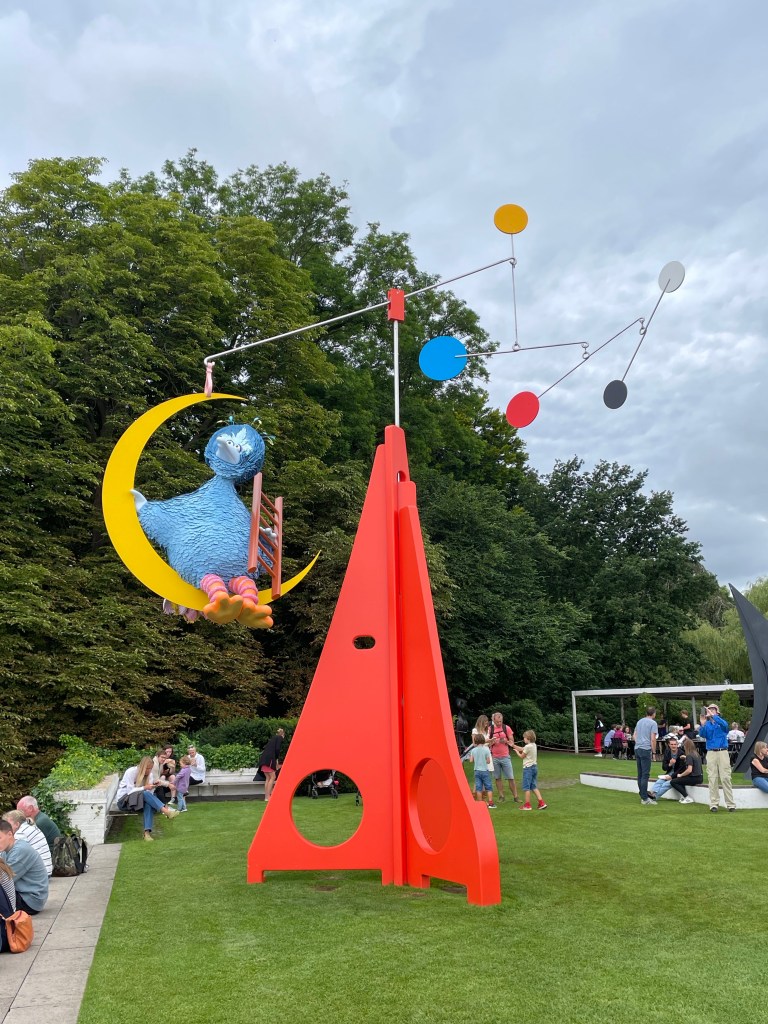
But two of his works were oversized, overly simple expression of cultural references that in a way are expression of love for characters or stories that might be considered evil in their original context, but reimagined are simply queer and lovable (think the Wicked Witch of the West as reimagined in Wicked). In one room there sat a giant plastic well entitled Well for Sensitive Boys. I didn’t recognize the reference, but the museum said it was a skit from SNL. So I watched the skit.
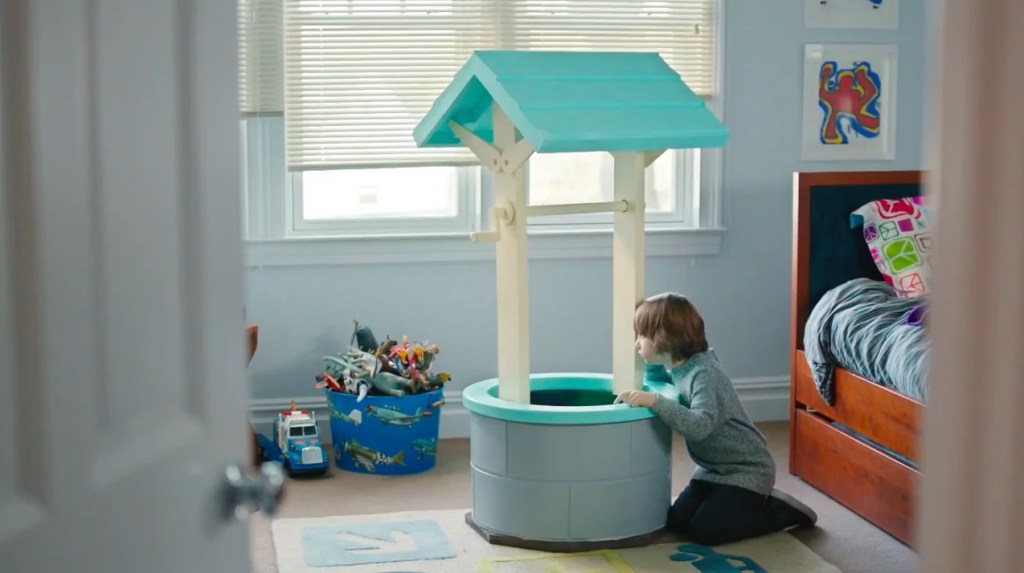
“You don’t want to do the commercial anymore? OK. Do you want to go watch Y Tu Mama Tambien?” And in watching the skit, I recognized a bit of my boyhood self, and a bit more of my adult self. I’ve only rarely had a sense of “fitting in” in my life, and I definitely remember not being interested in what other kids were playing a lot of the time. And sometimes in recent years, especially triggered by the pandemic, life has felt like waiting for something to start. And so in Alex Da Corte’s well, I guess I finally have my adult size wishing spot.
I dream of the vague notion of better years ahead and yet have no idea how to pursue it or exactly what that dream entails. But at least, in experiencing Alex Da Corte’s art, I have a new image of the headspace where I can figure that out.
-
Slovenia: the Slavic Alps
I spent a short time in Slovenia—barely more than 48 hours—so here are my brief thoughts.
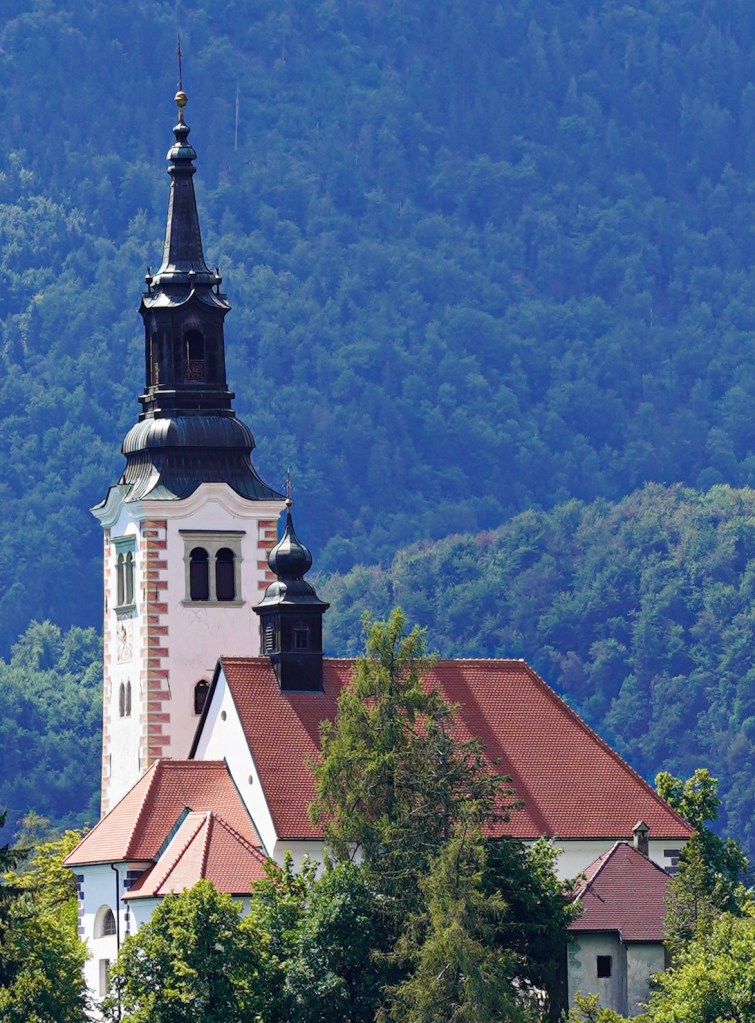
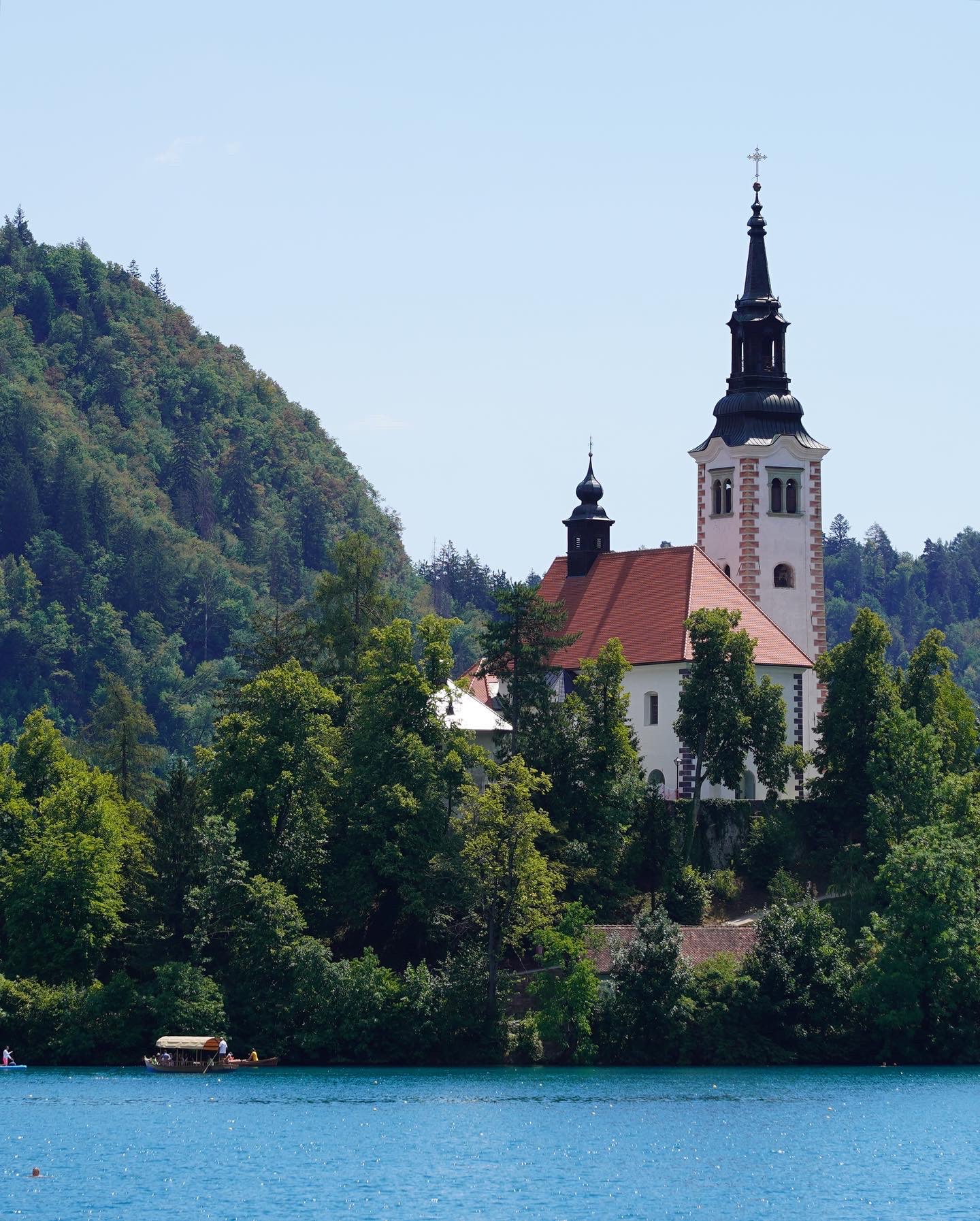
Church of the Mother of God on the Lake, Bled. Slovenia, a Slavic nation sandwiched between Italy, Austria, Hungary, and Croatia, became a country in 1991. But its independence from Yugoslavia had been in the works for years before that. In the summer of 1991, it declared independence from the crumbling Serb-dominated Yugoslav state, whose military unilaterally started a war in Slovenia to keep it in the fold. Within 10 days, however, Slovenia secured enough military and political success for Yugoslavia to back down and sign accords that led to their independence. If you want to read a story of outstanding planning and strategy, read the Wikipedia story. Croatia declared independence at the same time, but Yugoslavia continued to fight a war that lasted another several years, either of its own accord or by Serb separatist proxies.
Slovenia and Croatia took different paths toward their future after independence. Slovenia desired connection and integration with Europe, not the Slavic and Balkan spheres of influence—and set itself up as a democracy that led to full integration within the EU by 2007. Croatia was led by a strongman who viewed himself as the father of the new Balkan world, and failed to pursue democratic reforms or healthy relationships with the EU. Despite once being part of the same country as Croatia, Slovenia still has border checkpoints with Croatia that it doesn’t have with its other neighbors because of its entry into the Schengen zone.
This recent history explains, in large part, why Slovenia’s apparent standard of living appears much higher than in Croatia. It’s just…nicer. It’s clean and charming in ways Croatia isn’t. Driving through the countryside, there’s more life—charming towns instead of extensive void and humble farms that I saw in the Croatian countryside while going to a national park there. There’s more going on in the cities besides tourist traps. And yet, as a tourist, you pay more reasonable prices than in Croatia; as a more mature, wealthy country, its tourism industry doesn’t have the need to rip you off the way it seems like happens in Croatia, where you pay Western European prices even for second-rate meals and hotels. Slovenia’s per capita GDP is 35% higher than that of Croatia.
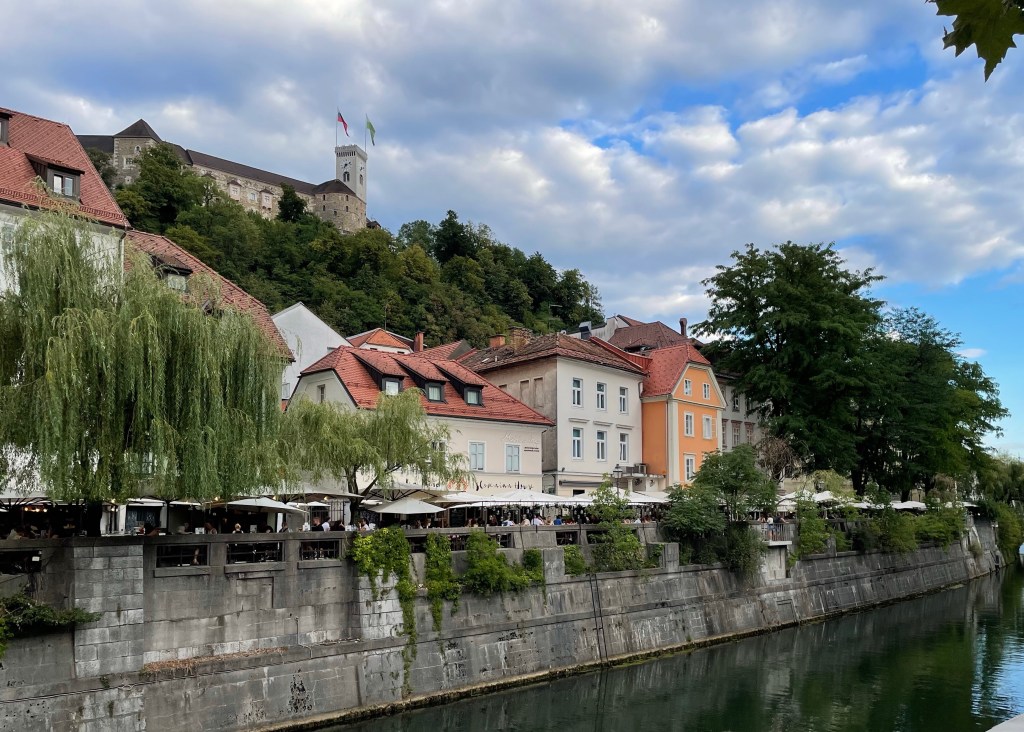
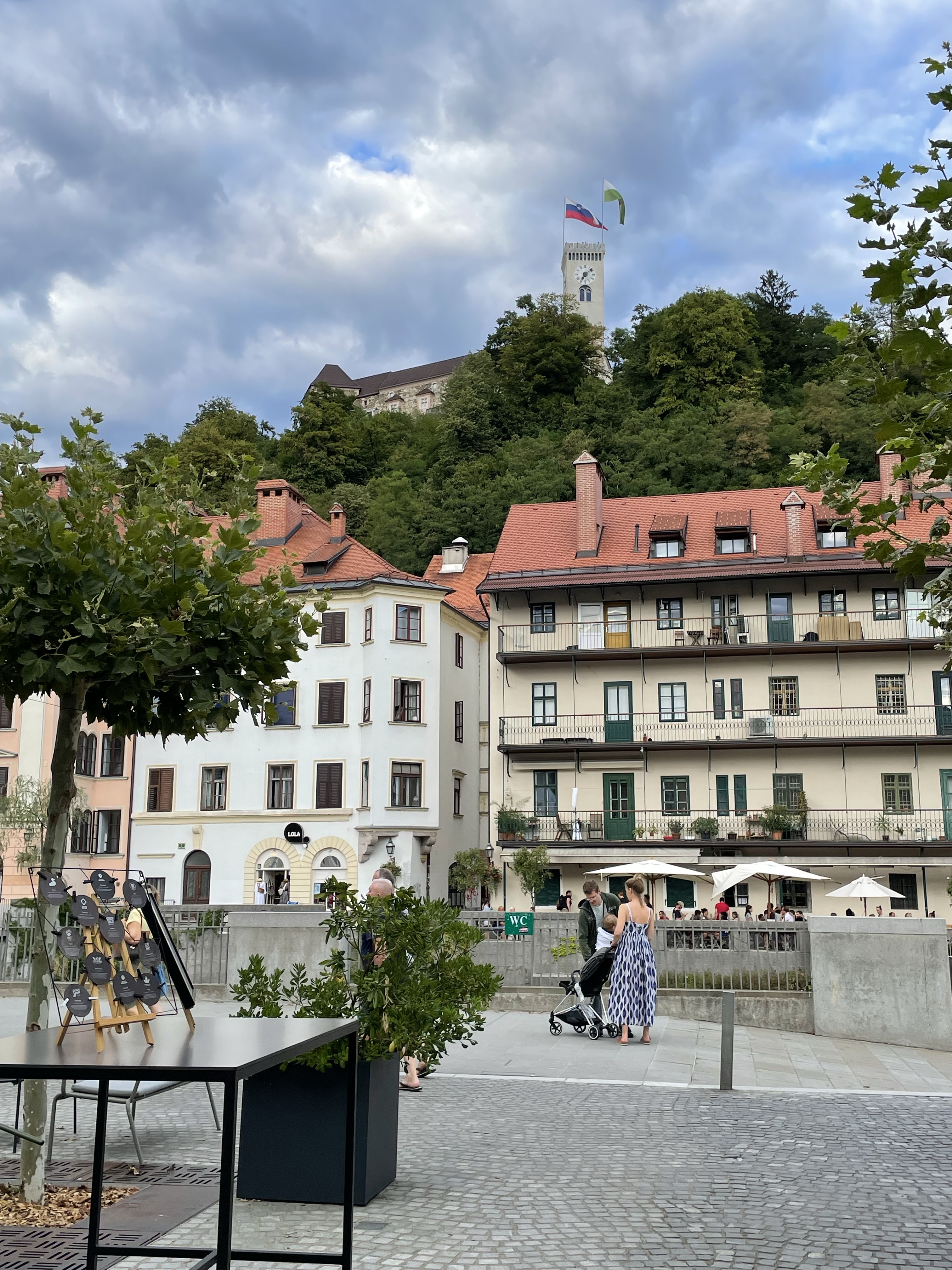
Ljubljana Culturally, Slovenia is part Slavic, part Germanic, and part Italian. The old town of Ljubljana is as charming as Rick Steves and my brother will tell you. My one regret is that I didn’t spend more time taking pictures there.
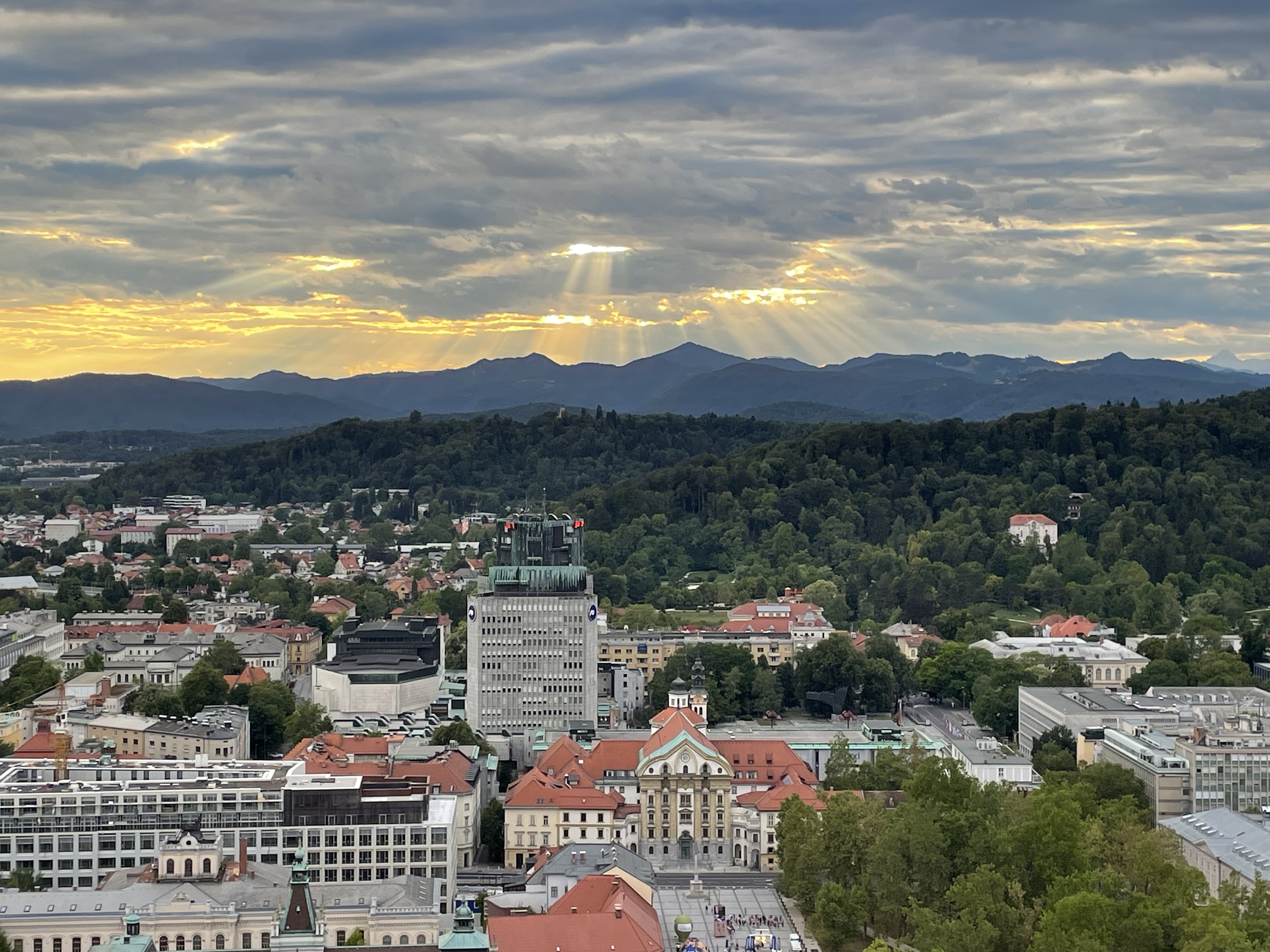

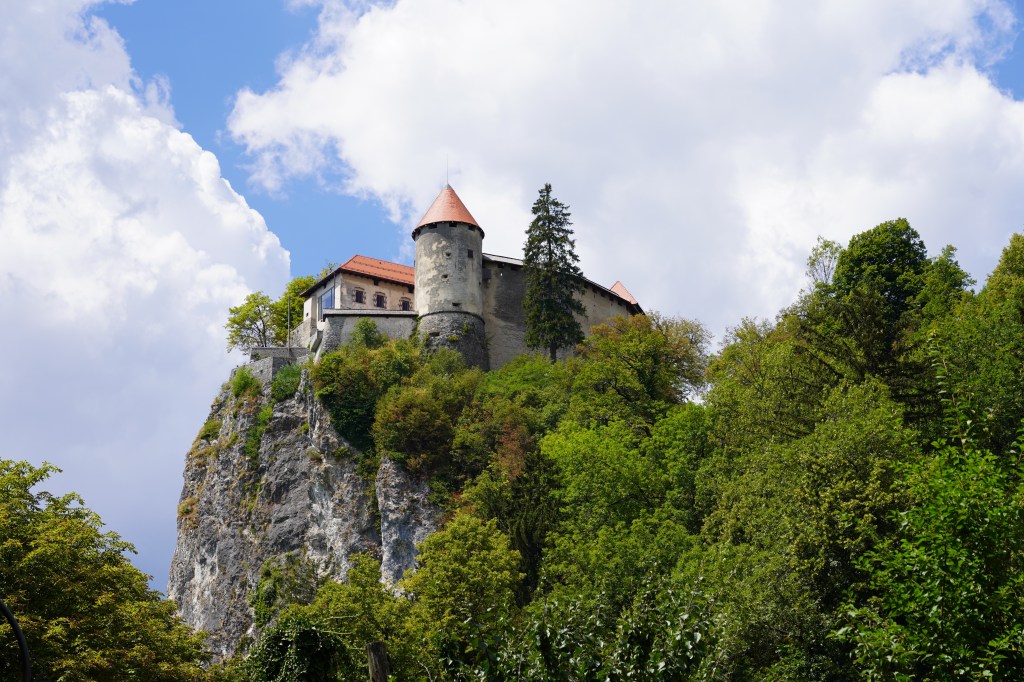
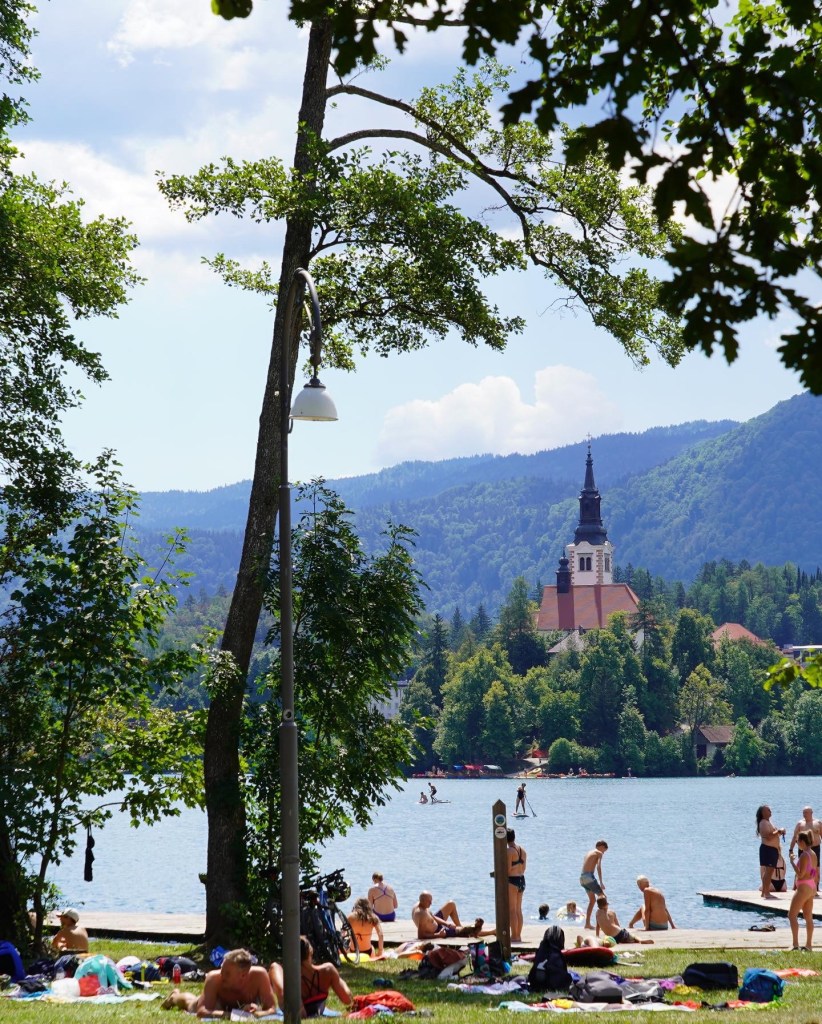
Lake Bled, with its monastery in the middle of the lake and a castle up on a hill, is gorgeous and full of tourists lazing on the shore or riding bikes or living the super relaxed, low key, rural summer you might run into on an American lakeside.

And the Postojna caves are the most stunning rock formations I’ve ever seen. The caves are giant—some chambers are over 40m (130 feet) tall. The rock formations aren’t just classic stalagmites and stalactites. They are twisted myecelial towers and mountains. They appear not like rock but like a living organism, making you hope for a future civilization whose cities grow naturally in such a way. Gaudi had nothing on these shapes. Sometimes the pillars glimmer as though studded with wet diamonds. Sometimes the limestone is free of impurities and you feel like you’re in a cavern made of white crystal.
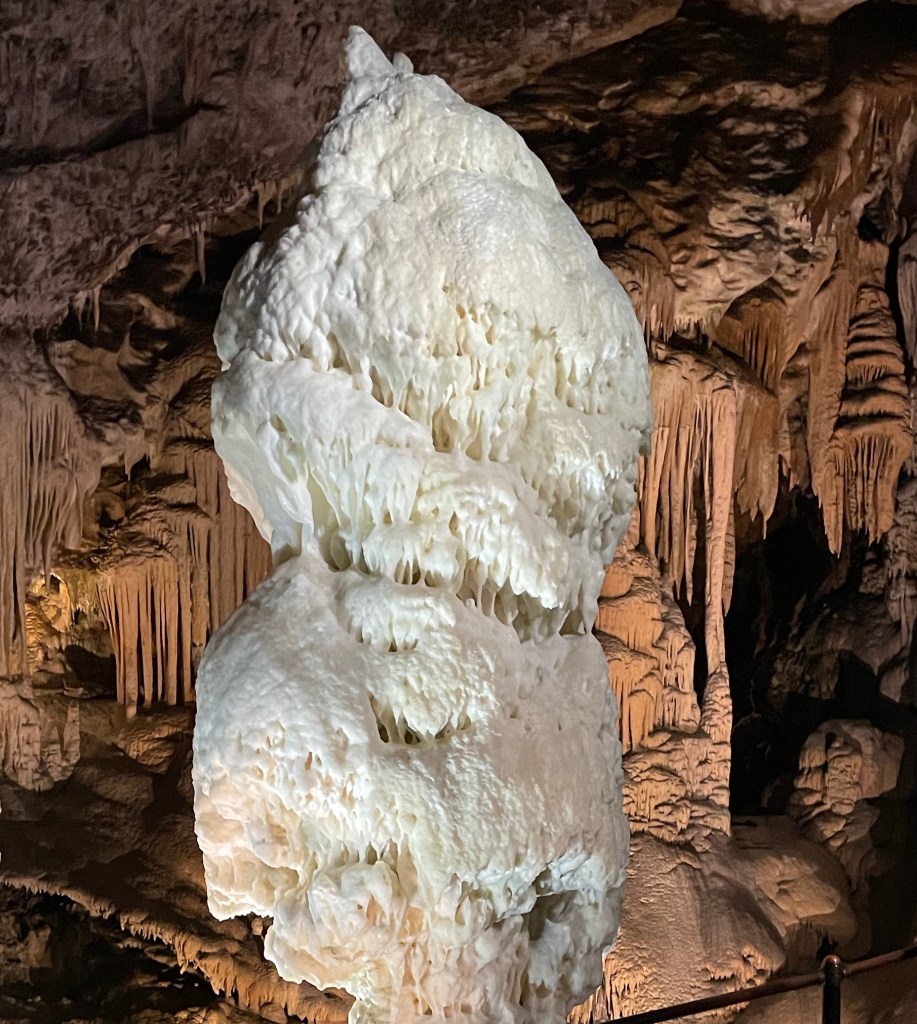
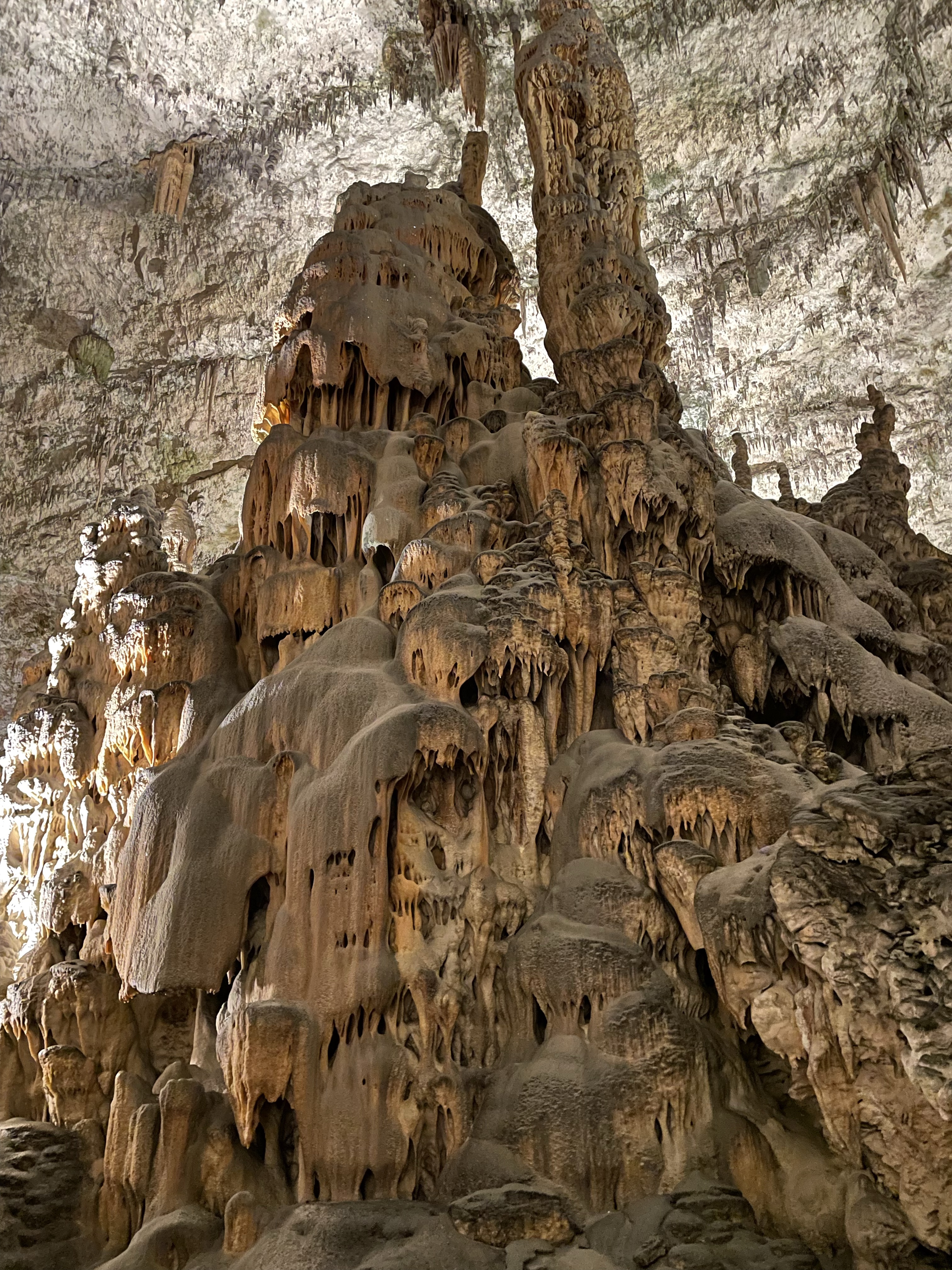
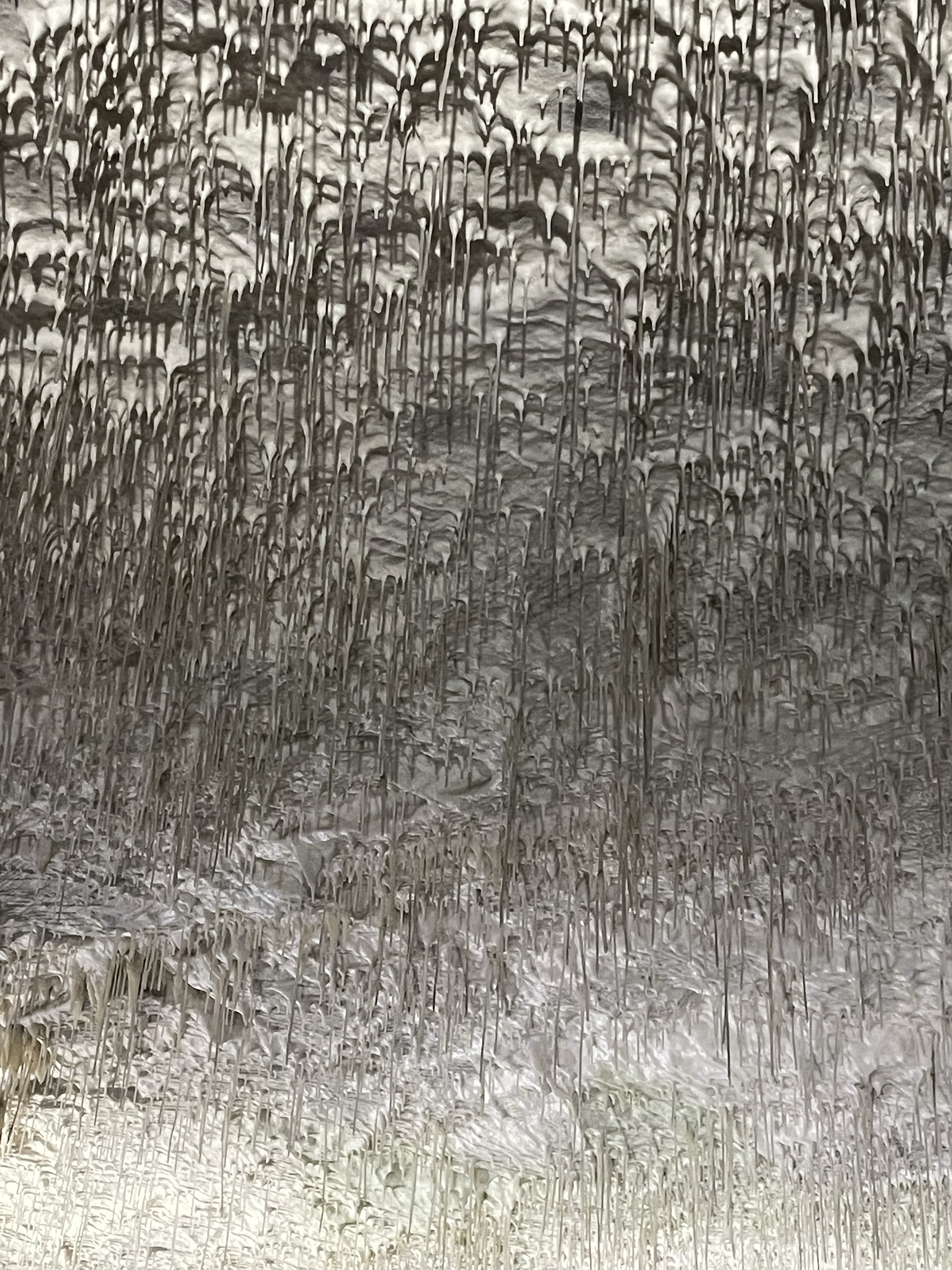
Postojna Caves But while Slovenia is beautiful and integrated with Europe, integration as an expat does not sound easy. I had dinner one night with a Taiwanese expat acquaintance who has been living there for 6 years with his Slovene husband. There are few expats there, he says. He joined a chorus for expats and they’ve only been able to recruit 8 people. He has been sad because of his lack of friends. Since the pandemic, flight connectivity has decreased dramatically, so getting other places is much more difficult. (That’s true from my experience—it’s why I flew in and out of Zagreb, Croatia, a 2 hour drive away.) It is, as he says, an ethnostate—a Slovene state for Slovenes.
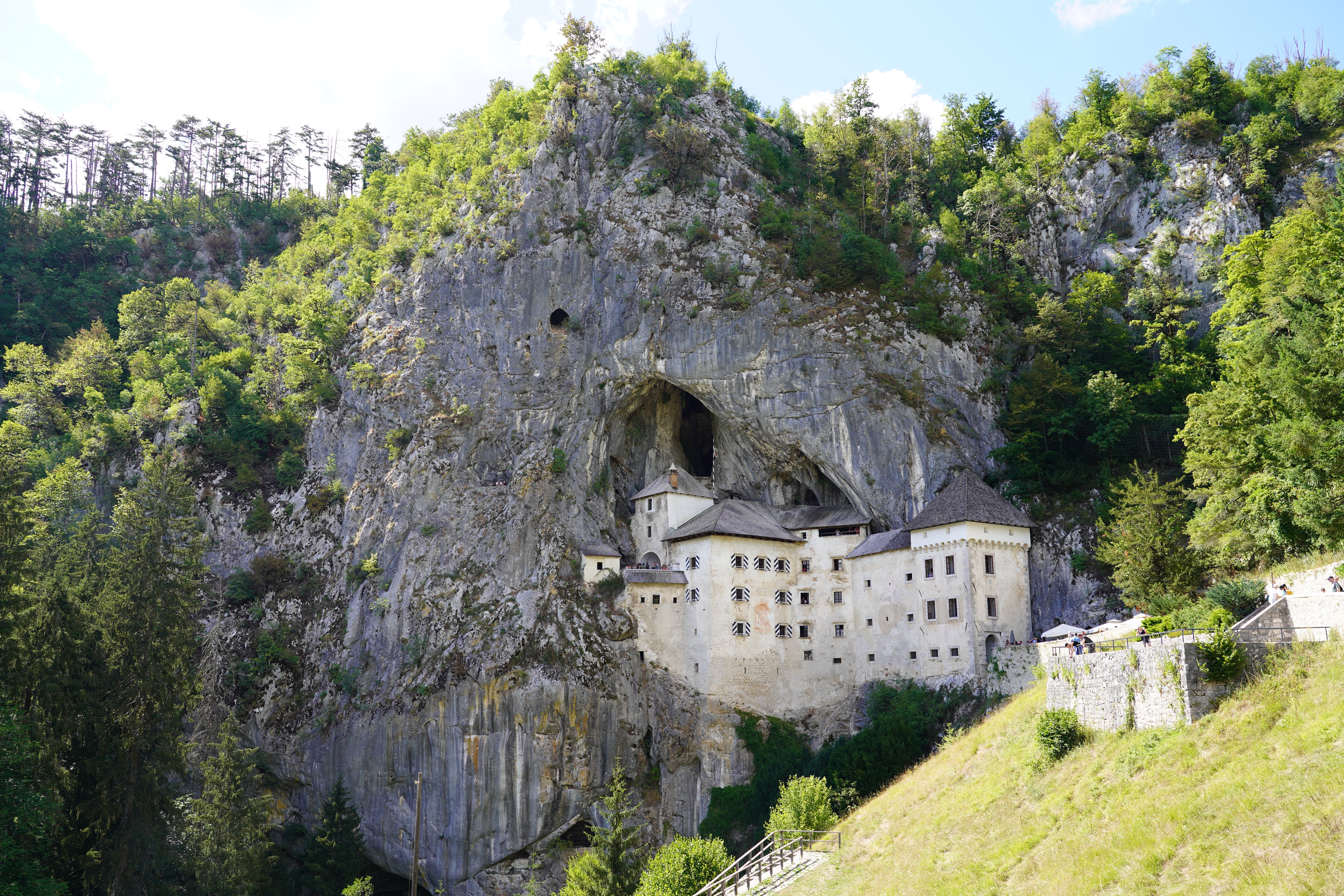

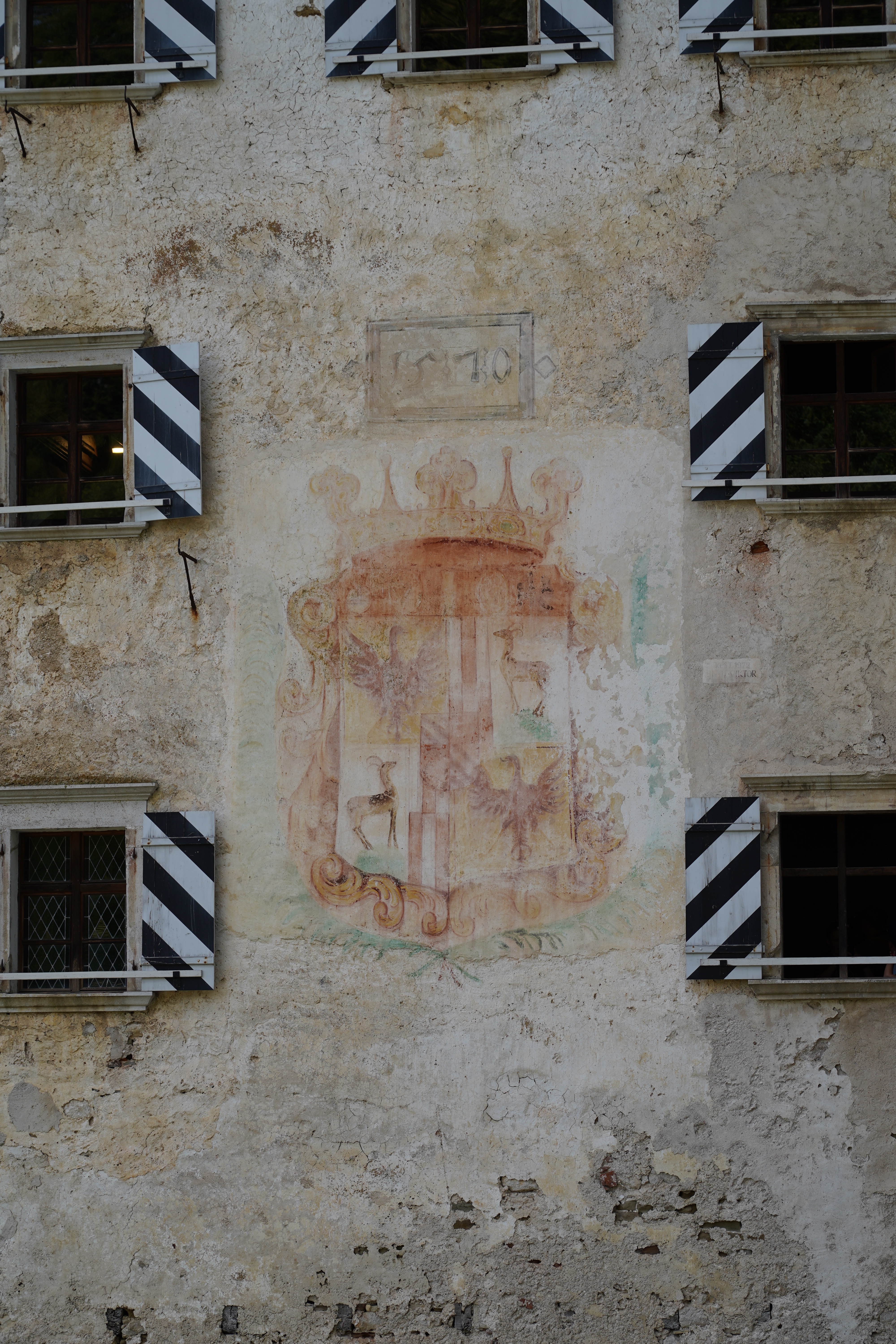
Predjama Castle, one of the best preserved medieval cave castles The reality may be less than ideal for expats, but it’s lovely for tourists. The Jurian Alps and its woods are gorgeous. I can see myself going back for a backpacking or ski trip someday, and I certainly recommend you go—if you can get there without too much trouble.

-
Croatia: a song of treason and pride
This post starts with treason and ends with something quite the opposite of that.
My fellow sailors on the Pride Boat have spent the last week talking about setting up a confession booth on the boat. Friday morning, I woke up early and had coffee with the other two early risers and decided to just go ahead and confess things to them. Now, I’d already proven I was a traitor to the boat by making friends with our partner and rival sailboat that followed us from port to port, the Yoga Boat. I even joined them for an impromptu jam session late in the trip, doing duets with an amazing singer accompanied by a guitar. But that morning, I took my treason to the next level by confessing my sins:
- I don’t like rosé.
- I’ve only ever watched Rupaul’s Drag Race once and have no desire to watch it again.
Gay sailing camp has been an exercise in exactly that: camp. Camp is what we gays do best. Even when things go terribly wrong, as in our wig strut, it’s camp in its highest form.
The only people with laughs as big as mine are The Gays. For instance, this is not me laughing. While we at the Steve Simko blog are grateful for this tragic ending, we genuinely feel bad that it happened to Vance, who couldn’t have been nicer or more helpful to all of us, whether it was making sure I didn’t die on an electric bike, or always helping our skipper. Or maybe that makes it even funnier. As Vance reminded me, “it just goes to show, kindness gets you nowhere.” Of note, Vance was Canadian, which explains both his giving nature and his unique nom de plume choice of “Vance” for purposes of this blog.
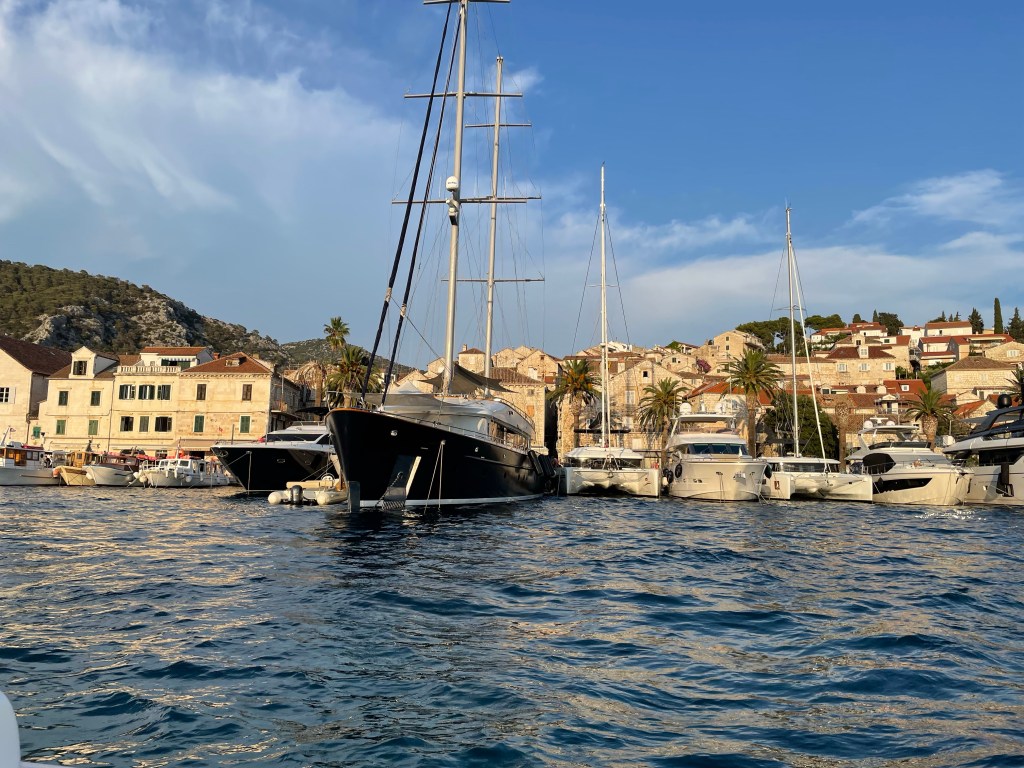
Not our boats The other thing we do well is bond over common enemies, real or imagined. We declared the Yoga Boat our rivals the first day and immediately bonded with each other. But later in the week, we found our true enemies, a bunch of pallid, snide gays on a yacht. We stopped in a swimming cove and they were there watching from their sunless balconies smugly bragging about how they had a bigger boat. (We would have said “at least we know how to use ours,” but judging from how generally unhelpful we were to our skipper all week, she would have called us out for saying something so patently untrue.) Then we started diving off the boat to go swimming, and unprompted they started judging our dives. Our best swimmer and diver was rated a 6. I got a 2. As they were leaving, our boat got hit by a rogue wave that caused our lunch to go flying all over the deck. We haven’t seen them since. I hoped that they ran aground, that their rosé spilled into the ocean, and that their toilets clogged. Instead they booked a nice restaurant and prevented anyone else from attending. 😡
I almost booked that trip, in which case I would have paid more than twice as much money and had less than half the fun.
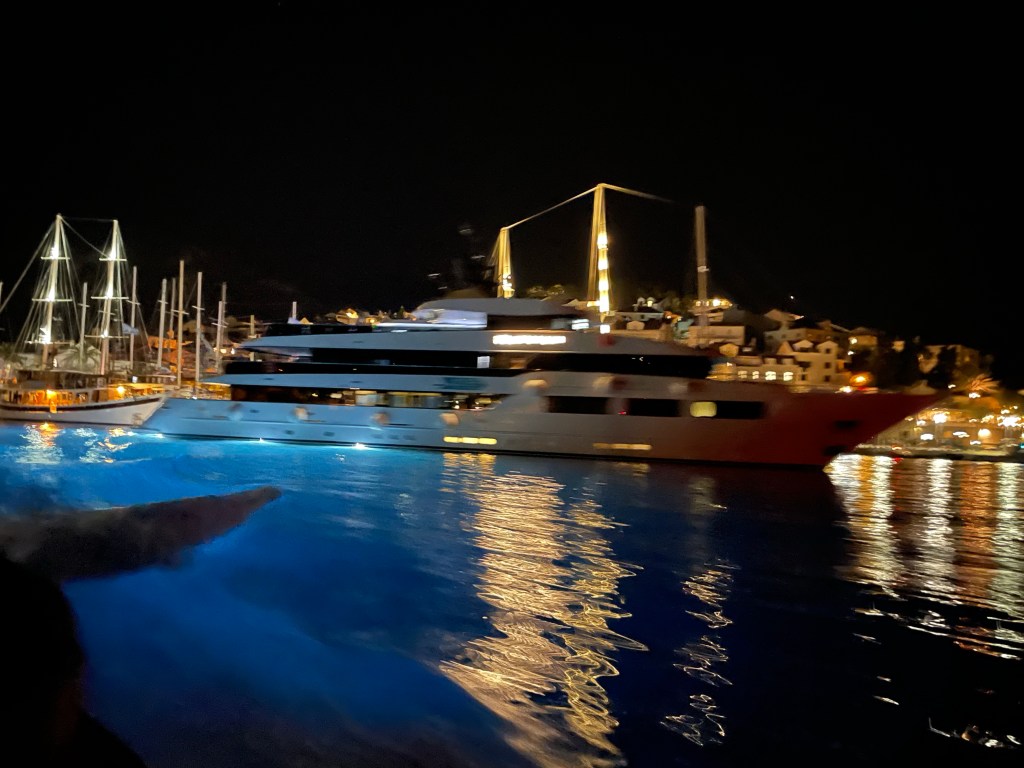
The tackiest yacht we saw on the trip. Rest assured that you would not have been able to read the overstylized name on the side of the boat even if this pic had been in focus. I’ll reserve the rest of my reminiscences about my new friends and our onboard experiences for my journal and our group chat—I think you’ve heard the essence of what you need to know, except for one thing related to my confession. I was surprised and amazed to learn that the two early risers didn’t like rosé either. Proving the age old truth, to my relief, that the dominant group dynamic isn’t always how everyone feels.
Our sailing itinerary was this:
Day 1: arrive at 4 pm, sail to Milna for dinner. We docked overnight in the marina, as we would do most places. Milna is a small village and there wasn’t much there, but we swam and ate heavy local fare.
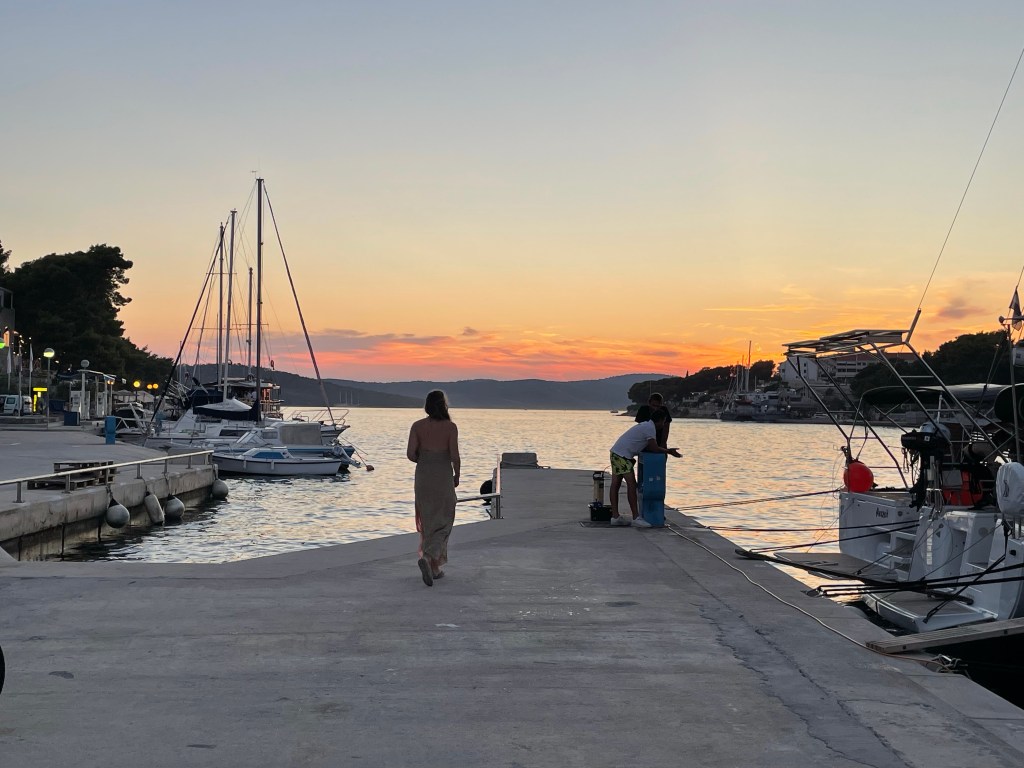


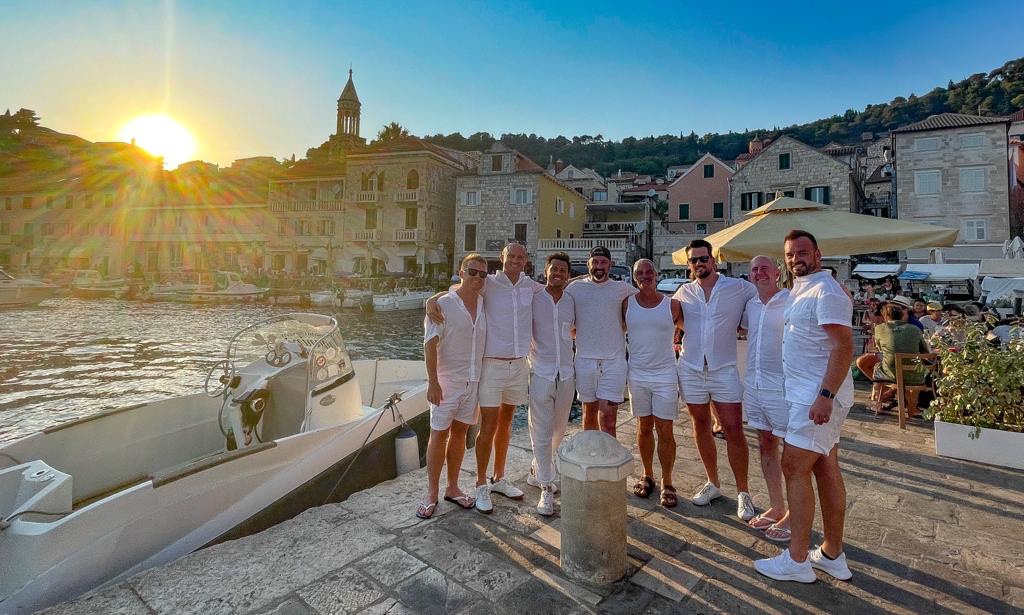
Milna Day 2: sail to Hvar. Hvar is a party town frequented by 20 somethings who are either jacked on steroids, wish they were, or are dating either of the above. But we made it our own and wore all white just like none of us will be able to do at any of our own future weddings. At one bar, one of our party was served a tequila and tonic instead of a gin and tonic, and didn’t realize it until one of our party smelled it and said, “That’s not gin.”
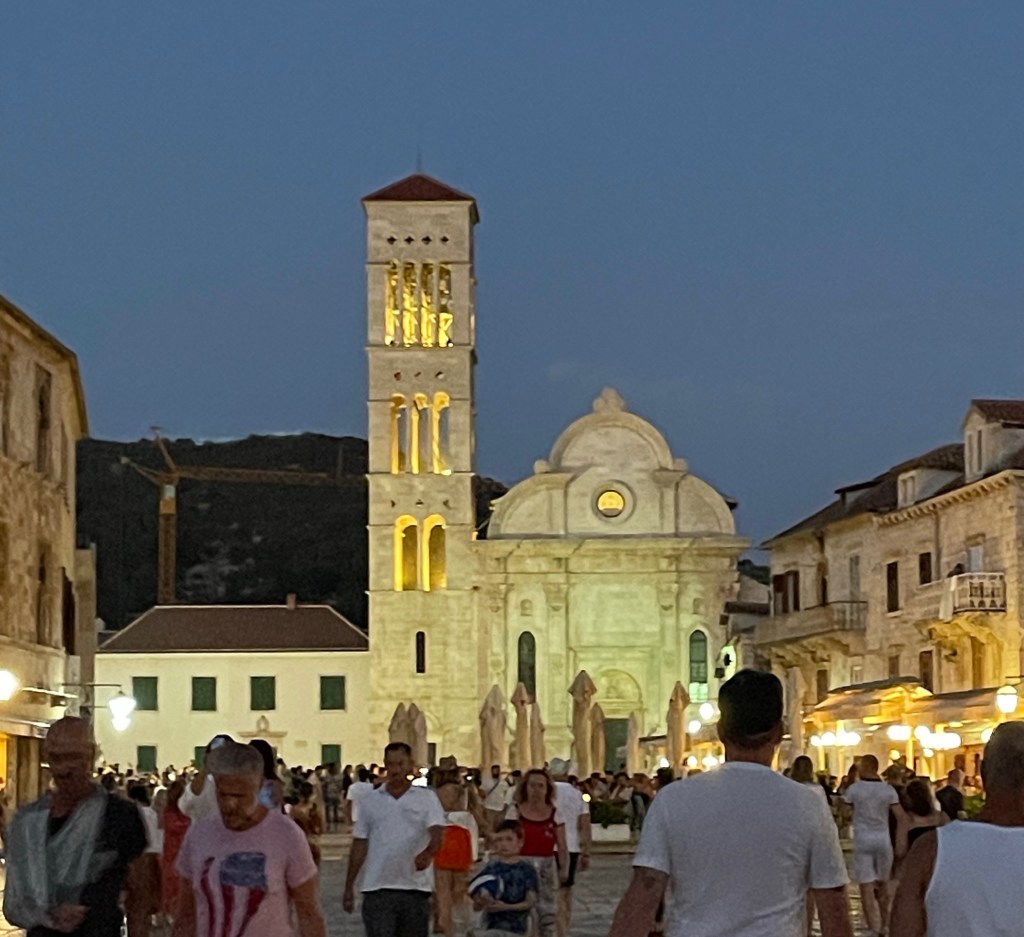
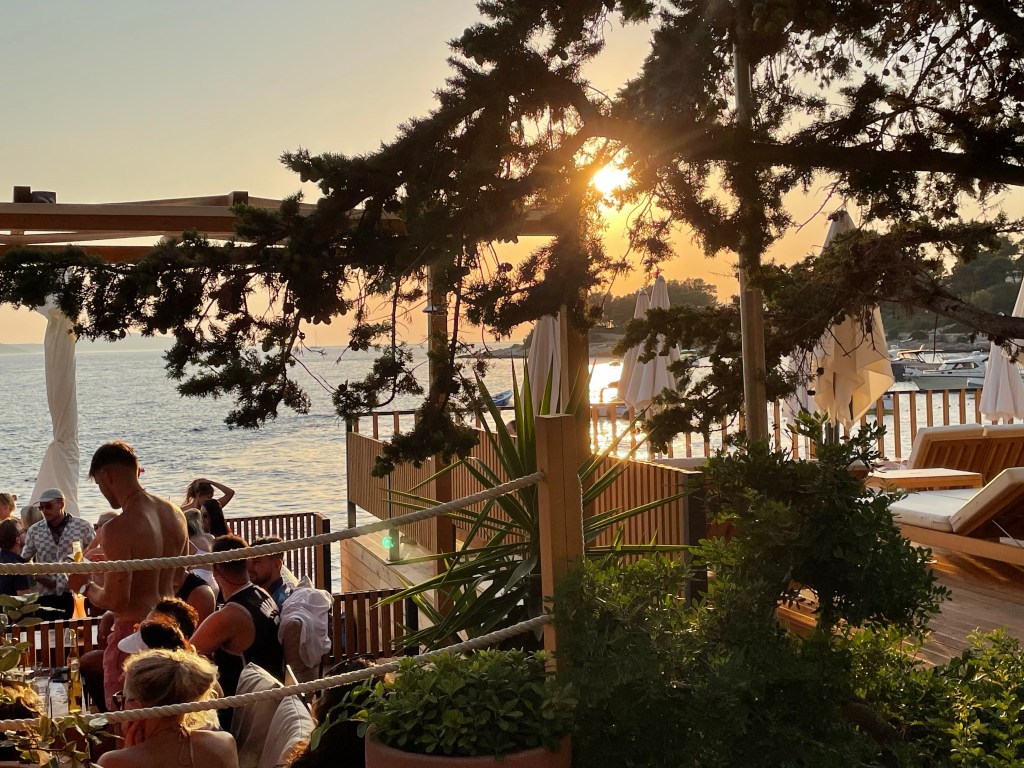
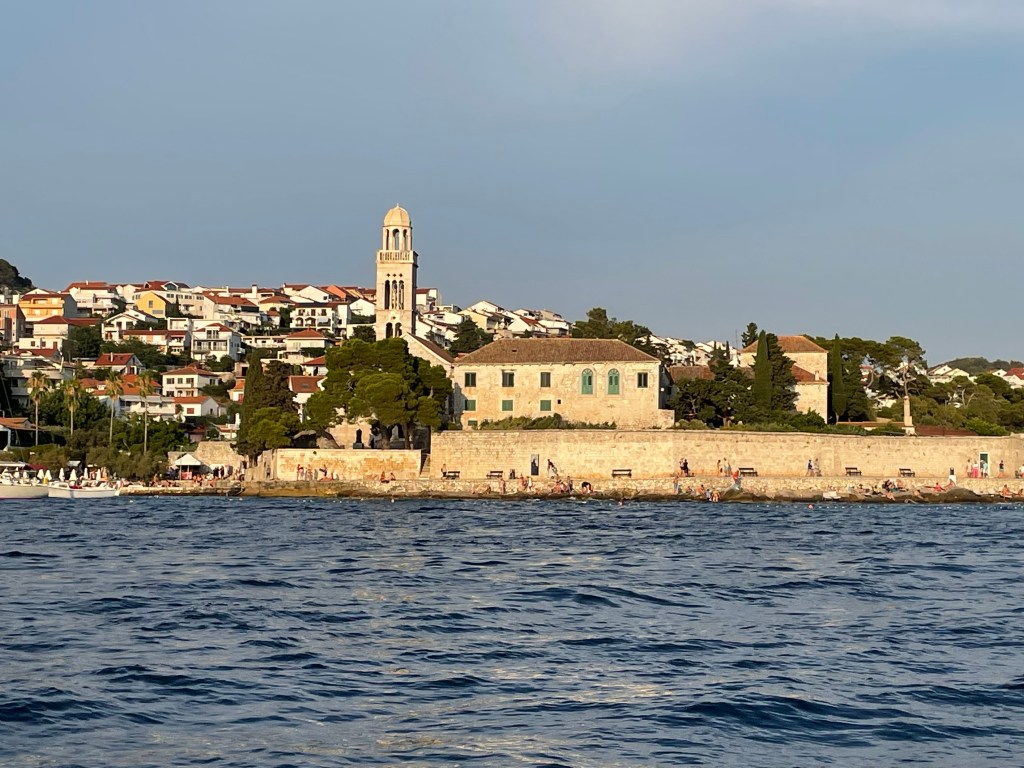
Hvar Day 3: sail to Vis. Vis was the highlight day for me but not necessarily for everyone else. We first went on a wine tour in a decrepit Jeep with a great bumper sticker, neither of which you would see on a wine tour in Napa.
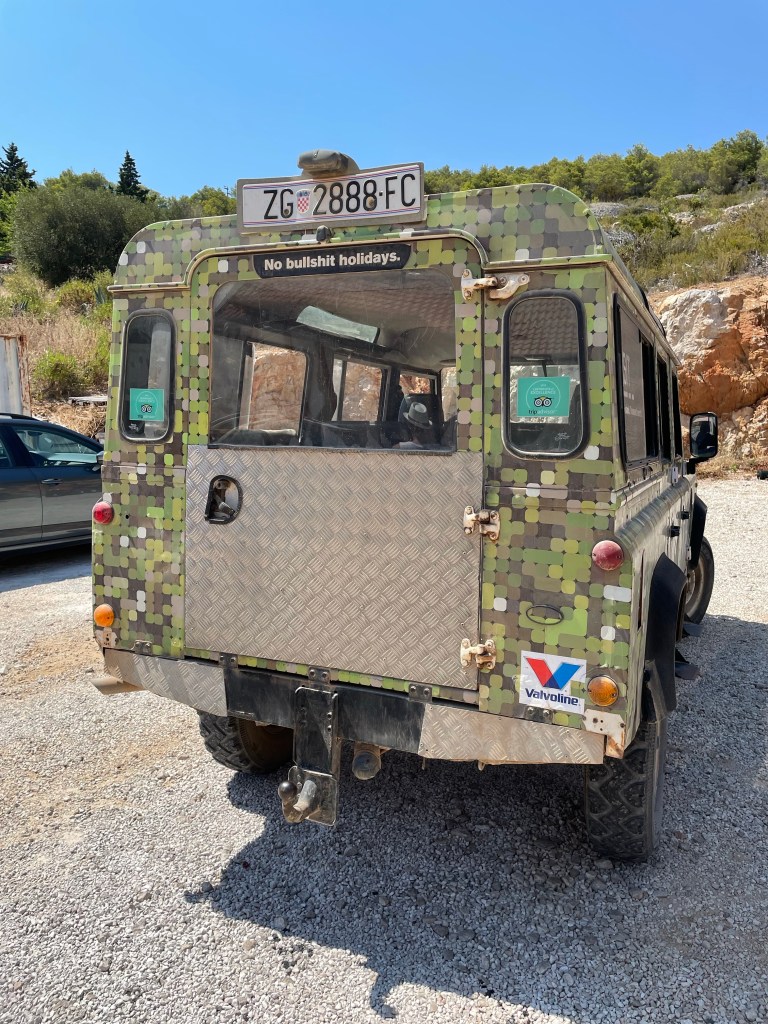
Unfortunately two of our party discovered that they were Willy Wonka characters being rolled out of the chocolate factory when things went horribly wrong. One of our group got heat exhaustion and had to be driven home from the first winery. Within a few minutes another in our group got terrible allergic conjunctivitis, and we thought the Oompa Loompas were going to roll out with a song about what happens when you don’t take your Claritin. Luckily they did recover well, although I did have to hand lavender cookies to the one with eye issues. For those of us children who survived, we had a great day with our guide Relja (there was no shortage of joy that his name was pronounced “rail ya”) who clearly knew more about RuPaul than me. The tastings were generally wonderful except for the one that required us to drive over a WWII airstrip/dirt field to access.
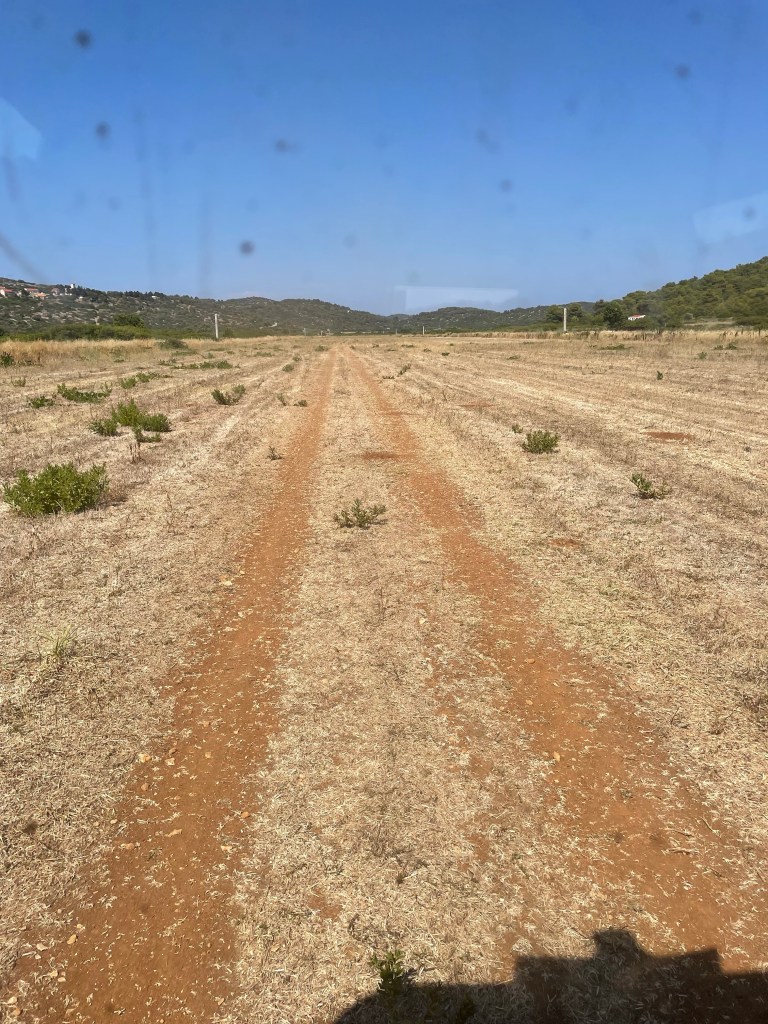
Wrong kind of runway for a gay trip 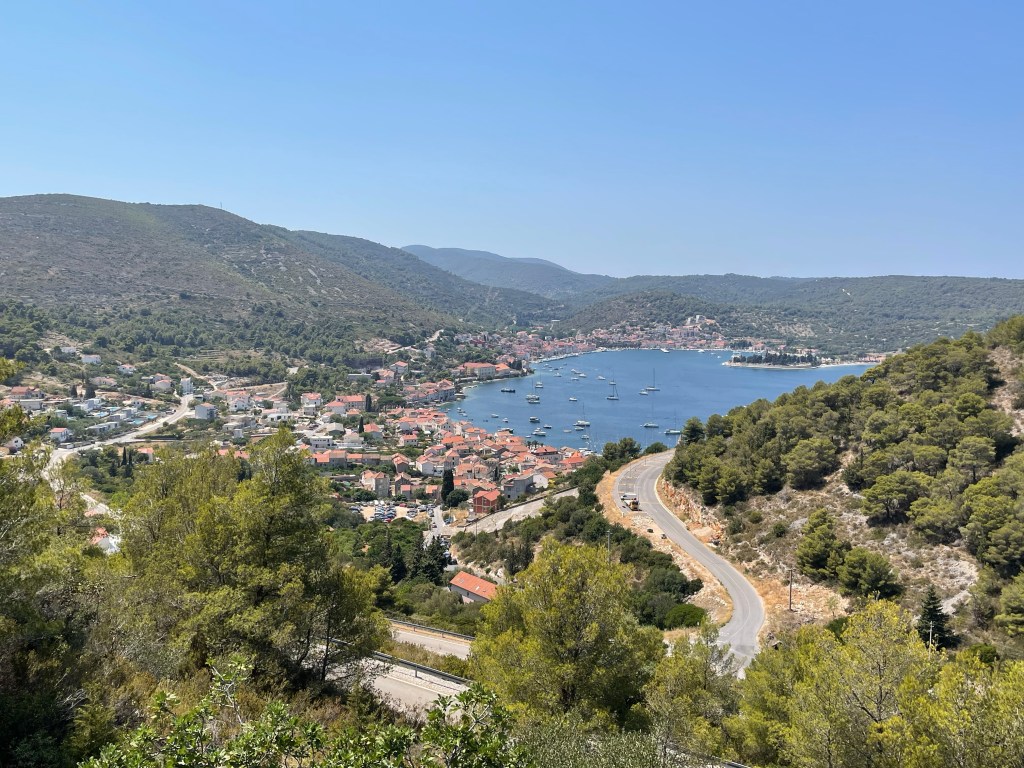

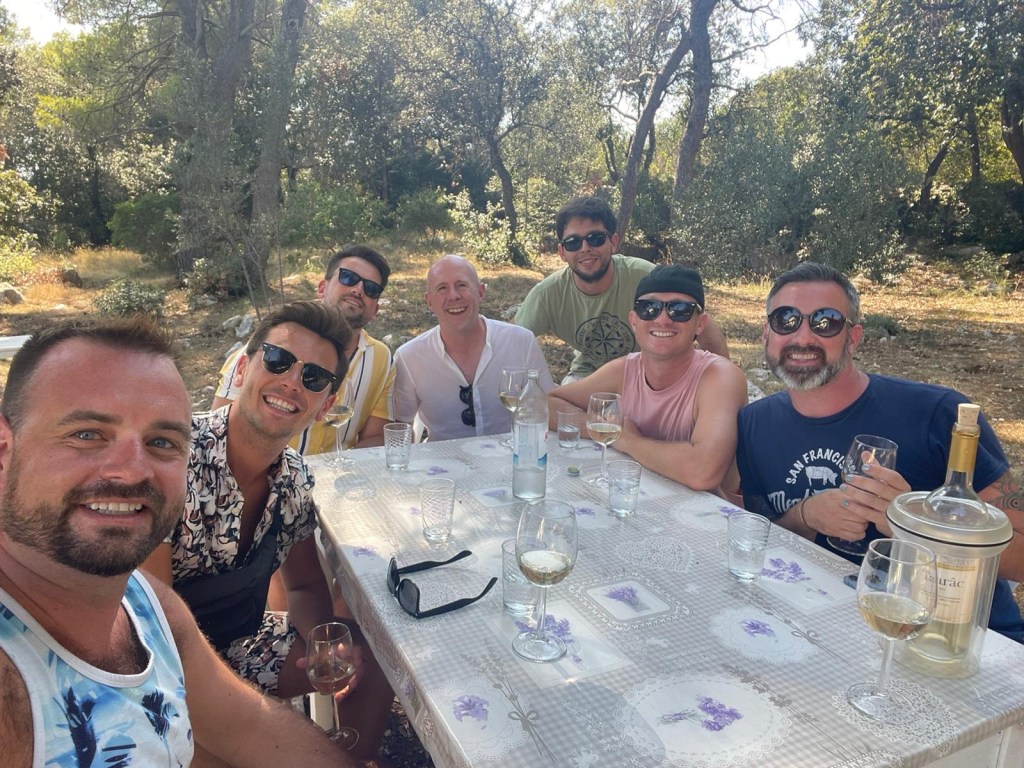
Vis That night, we ate at Boccadoro, a restaurant at the only hotel on the island. For the first and possibly only time on the trip, the dinner was delicious and creative, the service was charming, witty, and engaged, and the setting was beautiful.
Day 4: Korčula. The haček, or carat over the c, is essential as it tells you to pronounce it “KORTCH-u-la” instead of “KORTS-u-la.” We found dramatic ways of pronouncing it and for no good reason found this unceasingly funny. This was the day our skipper dreaded as it was the longest day of sailing, and frankly by the time we got to Korčula I was overheated and ready to throw in the towel. But the Yoga Boat came to my rescue by regaling me with love stories and erotic poetry. OK actually it was probably the cold shower beforehand that revived me, but the stories and poetry were just too good. It was our first dinner not together as a group, which actually facilitated more revealing conversation among the three of us who traveled there solo.
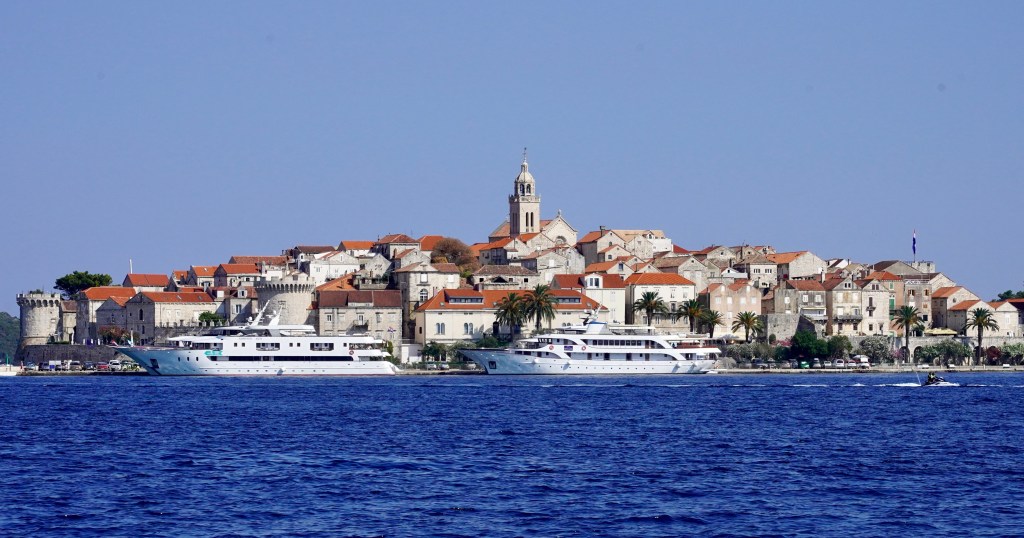
Korčula! Day 5 and 6: National Park and fishing village. This was the chill part of the trip, and besides me almost dying on a gravel bike path and Vance coming to my rescue, not a lot actually happened, but we saw some pretty things. Not gonna lie, I was ready to get to land and sleep in a bed by this point.
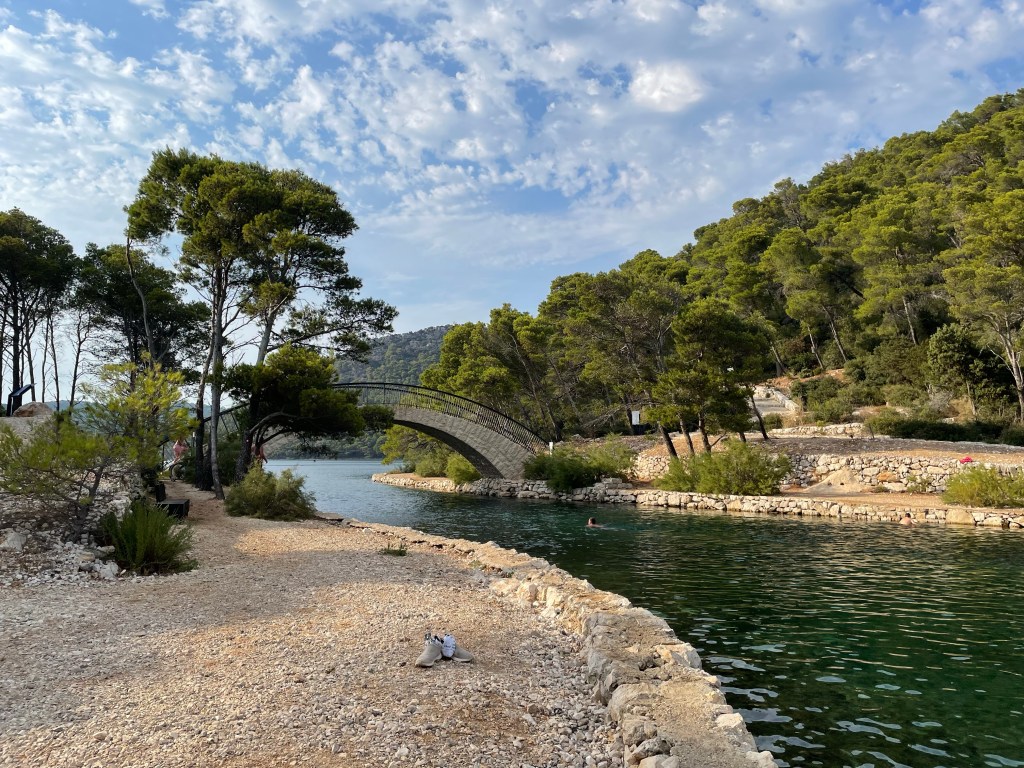
Mljet The hills were alive with the sound of gays and cicadas. That ain’t music honey 
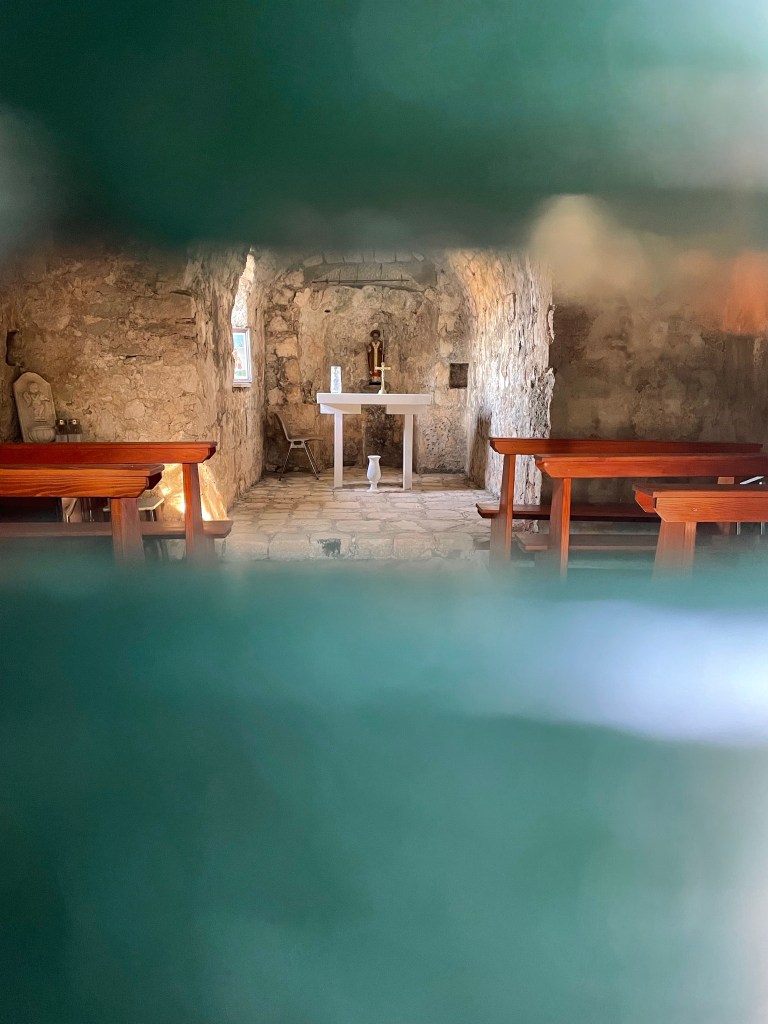

The fishing village of Okuklje Day 7: Finally! Dubrovnik. More on that later.
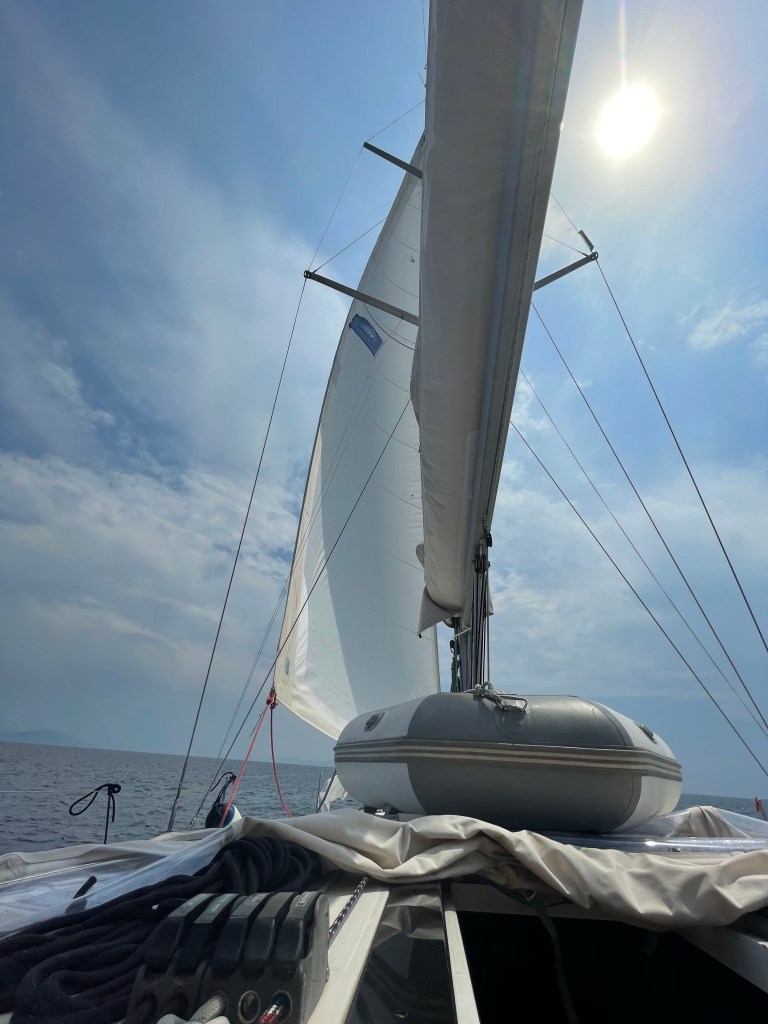
The one time we actually sailed I’ve felt that being on a sailboat is analogous to backpacking in a lot of ways. You have to conserve water, for instance. Showers on the boat are limited to two minutes. Also managing toilet paper is unpleasant—you can’t flush it. Most of us steadfastly avoided pooping on the boat because, you know, gay pride or shame or some combination of the two. I did it three times and am not worse for the experience, but I won’t speak for how my boatmates felt about that.
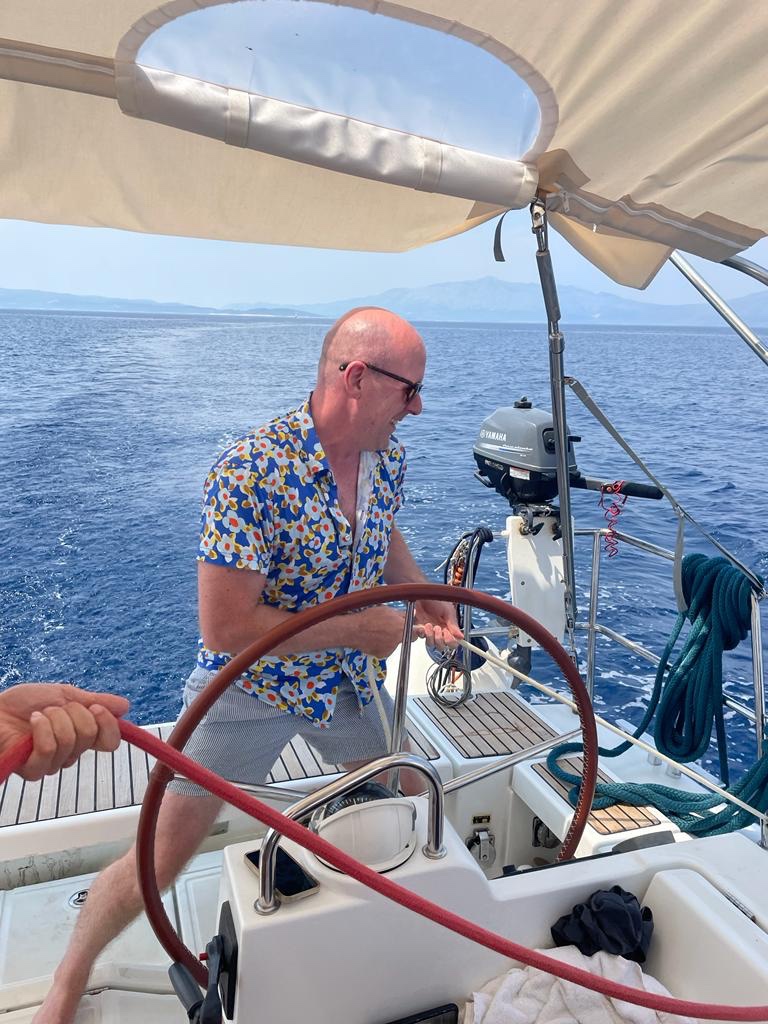
Still a traitor For sleep, you share a tight cabin with someone—in my case, it’s essentially like sharing a full bed, not even a queen, with a stranger. At least my roommate smelled OK and was tidy (and more than that, made me laugh harder than anyone on the boat). But it was hard to maintain good sleep quality.
One beautiful thing sailing that reminds me of backpacking is the stars. Last year, I spent a glorious week backpacking with friends in Washington. A couple of nights, we stayed in a cabin to which you could only backpack. You had shelter, stoves, cots, a few provisions, but not much more. They helicopter in a pallet of firewood every year. And at night, you could see so many stars, and the faint waves of the Milky Way subtly wafting like clouds behind them. You can see it on the water here too. When we were in Hvar, we needed to take a water taxi back to our boat in a separate marina. And out over the black waters you could see it all, just like in the mountains of Washington or any time I’ve ever been backpacking far from light pollution. Last night, lying on the bow of the boat, I watched the stars for about 45 minutes through the stack of masts in the marina, and shooting stars started creeping in to our vision. Like backpacking, you get to see things sailing you can’t normally see.
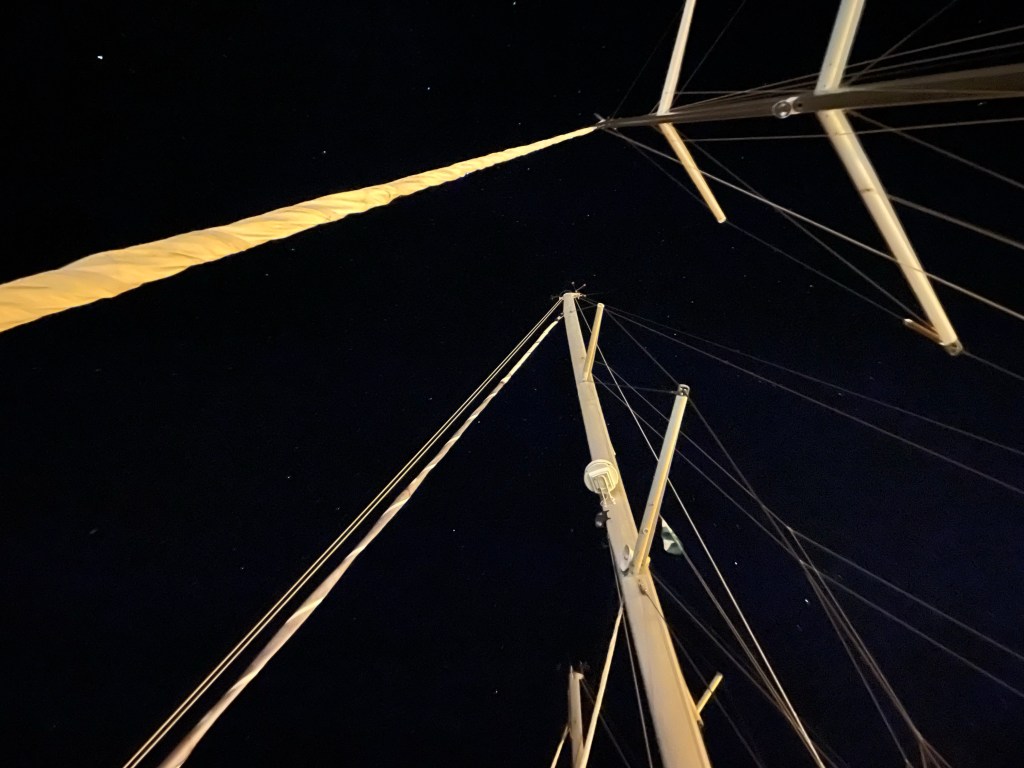
A week on a sailboat in hot weather with no wind (and thus no actual sailing) was more tiring than I expected. To cool off, you have to expend energy by swimming. OK maybe some in the group who are better swimmers don’t feel like they’re expending energy, but I do. Heat saps you of your energy too.
Until the last day or two, I didn’t feel trapped or stuck at all because we were so busy going from place to place. But as I felt so trapped during the pandemic literally and metaphorically, I got tired of depending on a single vessel all the time and was getting desperate for my freedom to travel and sleep and shit where I want.
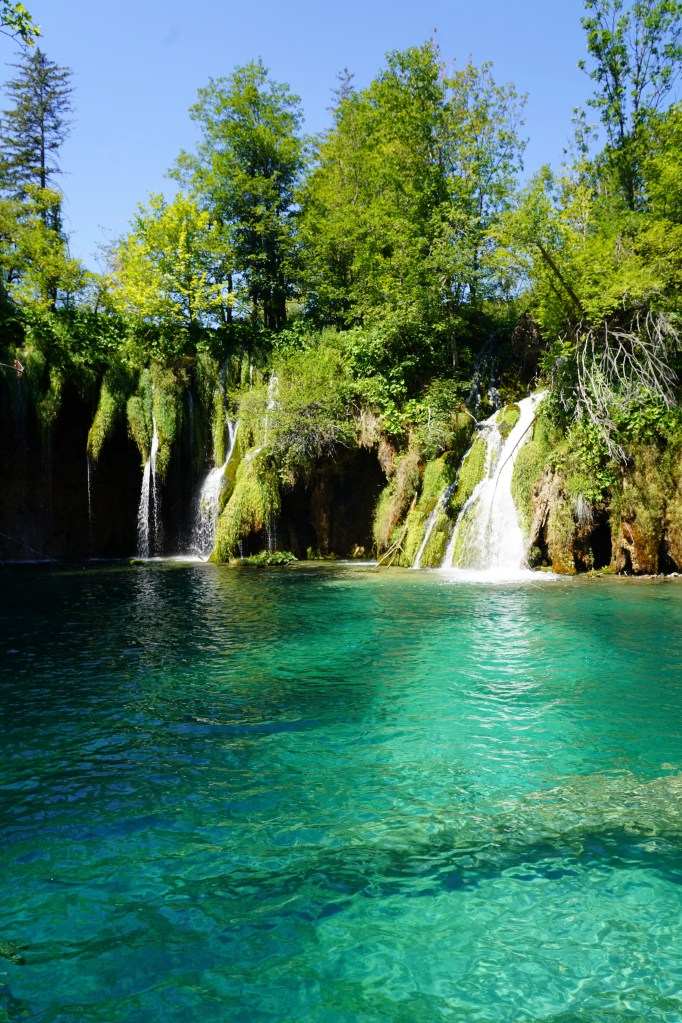
Plitvice Lakes The general consensus on our boat is that Croatians exaggerate their accomplishments in the world. They’re quick to claim Marco Polo and Nikola Tesla as their own even though they were merely born here. One person on our boat noted that they heard a tour guide say the stone in the White House came from Croatia, when in fact it came from Virginia and Maryland. When you’re a new country struggling with the existential threat of massive brain drain—the Croatian population has dropped by 10% since joining the EU, as hundreds of thousands have left seeking work elsewhere—you have to take wins where you can get them.
I don’t have a lot of superlatives to say about Croatia as a country beyond the beautiful landscape. The wine has been of variable quality, the food has mostly uninteresting (only one memorable meal, most of the rest ordinary and repetitive—you can only eat so much cevapi and lightly seasoned fish). People haven’t been outgoing or friendly except for our server at the one memorable meal. As a traveler, it’s like a more expensive Greece but with largely inaccessible culture. I came here to sail and to meet new people and to experience the islands, and I got that, but I can’t say much for Croatia as a country other than it’s proud and struggling and that I wish it a brighter future.
That doesn’t mean Croatia isn’t lovable. My only tie to Croatia before now was being there in person for their first national sporting truimph as an independent country, winning the Olympic gold medal in team handball at the 1996 Olympics in Atlanta. 30,000 people were there on that last day of the Olympics in the Georgia Dome, and I still get goosebumps and even tear up a little thinking about how rapturously happy the players and Croatian fans were after having just won independence a few years earlier after a war against a brutal aggressor. That’s the Croatia I’ll always remember, perhaps even more strongly than these beautiful islands that I recommend you sail someday. And the lesson here is that trying to love a place that isn’t your home, warts and all, can bring you a lot of joy. It might even be a virtue.

-
Gay Sailing Camp Croatia
A friend of mine recently posted the following Facebook status:
“My husband just said gaycare instead of daycare and now I WANT NOTHING MORE THAN TO GO TO GAYCARE. It sounds like a truly magical place.”
I don’t know a thing about gaycare but I can confirm that gay camp is its own special breed of magic. I’m off to gay camp in Croatia for the next week. Specifically, gay camp on a sailboat!!!
I’ll be sailing with 7 strangers and 3 crew from Split to Dubrovnik, stopping at a different island every day. I have no idea how this will go but I’m determined to have a great time!
Of course, getting ready for gay camp requires a change of mindset and alternative planning:
- No more time for introspection or deep commentary. Time for CAMP mindset. Not just summer camp mindset, but CAMP mindset.
- The colors get more vibrant.
- The shorts get shorter.
- The swimwear…I won’t be wearing board shorts this week, I can tell you that.
- I have to go buy a wig before I get on the boat.
Apparently the boat has wifi, but I’ll believe that when I see it. So if you don’t see posts from me in the next week, you’ll know why!
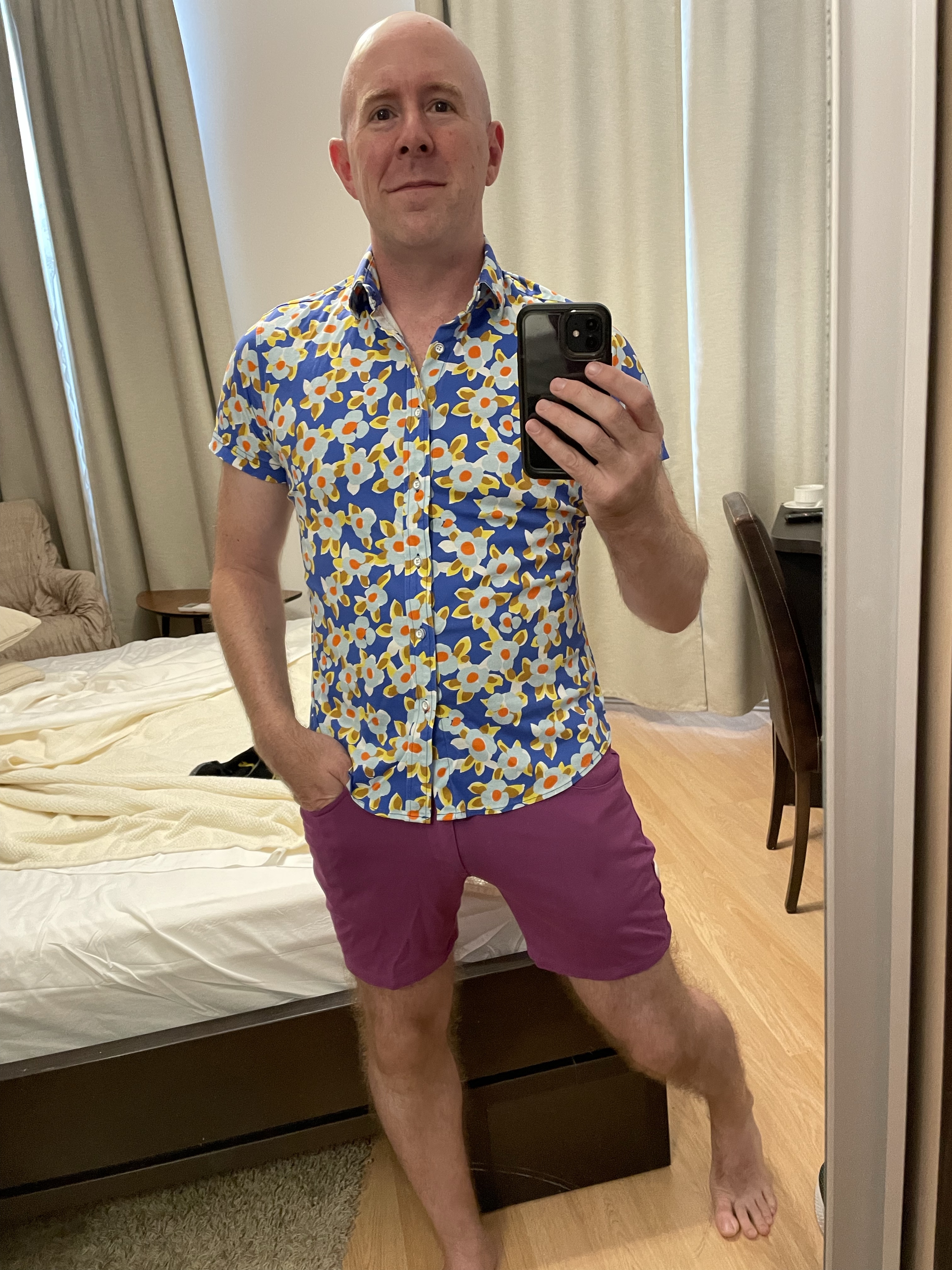
The shorts got shorter OK off to have a gay old time.

Not that kind of gay old time And there are some pics from gay camp that you’re just not going to ever see. Love you but no.
-
Subscribe
Subscribed
Already have a WordPress.com account? Log in now.
 Steve Simko